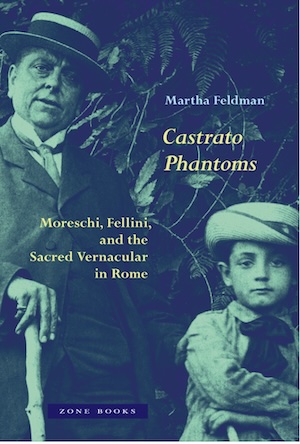
Little is known of the history of the castrato phenomenon in its end stage. Banned from papal chapels in 1903, castrati could thereafter continue singing in the Sistine Chapel and other basilican chapels, seeing out their contracts until their retirements, though Moreschi went on singing at the papal Cappella Giulia for nearly the whole of his life. Even less is known or understood about the aftermath of the castrati. Castrato Phantoms shows that while Rome carried the burden of having preserved castrati long after their sell-by date, memory of them was repressed for decades after their physical disappearance. What is more, the break in discourse about them was abrupt, such that mere months after Moreschi’s death, a hyper-masculinized version of Italian fascism was given official form when the infamous October 1922 “March on Rome” put Mussolini in office. Afterwards, and for several decades thereafter, hardly a word was uttered about Italy’s “castrato past,” a silence not broken until 1959-64 with the first book-length publication on them followed by the first filmic references, which were joking ones.
By utilizing the granular materials of scores, recordings, anecdotes, pedagogies, films, filmic scenarios, photographs, letters, wills, contracts, birth, death, and marriage records, architectural plans, oral histories, and the unpublished memoir of Fellini’s niece Rita Fellini, in part furnished by a rich family archive (shared with me by living Moreschi-Fellini descendants), Castrato Phantoms is able to show how a centuries-long history of castrati, heretofore little understood, survives in the form of latent, submerged, partial, and largely unspoken residues.
In that sense, the book is a consequence of my earlier one on castrati, The Castrato: Reflections on Natures and Kinds (University of California Press, 2015), which represented a first attempt to consider these residues. Indeed, research for The Castrato, culminating in six Ernest Bloch Lectures at the University of California, Berkeley in autumn 2007, was what led me to stumble on the first leads for Castrato Phantoms. But The Castrato also made some foundational arguments about the castrato phenomenon, analyzing it as a set of fundamental paradoxes that make it possible to develop the themes of haunting in the later book. According to the earlier analysis, almost from their inception in Italy in 1555, castrati were embedded in several overarching paradoxes: for one, they functioned as both old-world figures of sacrifice and early modern figures enmeshed in commercial exchange; for another, they functioned as figures deprived of biological reproduction but widely reproduced in male systems of kinship and patronage; and lastly, they functioned as figures abjected by castration yet celebrated on stages, whether royal theaters or aristocratic courts—not just as objects of melophilia but charismatic proxies for every-weakening eighteenth-century monarchs.
Only to a very limited extent did The Castrato attend to the end stage of the castrato phenomenon, as an index of a wide array of historical and social conditions—indeed, it did so only insofar as it concerned Moreschi’s voice, the acoustic holy grail of castrato vocality because the only castrato voice ever recorded solo (in 1902 and 1904). By contrast, Castrato Phantoms focuses on four heretofore neglected matters: 1) The long afterlife of the whole castrato business, which ended up finally in papal hands but by 1922 was quickly if incompletely erased, and whose secret and covert operations have since haunted Roman consciousness and its collective psyche as a kind of abhorrent, repressed residue; 2) the cultural and collective psychic inheritance of the castrati (partly coterminous with them but also succeeding their existence) as it expresses itself in certain films and literary creations of the early to mid-twentieth century; 3) the familial inheritance as it intersects with a complex transgenerational history of tormented consciousness and traumatic experience expressed to me in oral conversations and evinced in the family archive; and 4) the adjacent, and partly subsequent, cultural production of both the family, centrally including Federico Fellini, and various writers and filmmakers who index varieties of romanità.