
The wide angle
May 16, 2026
How Film Became History
The films discussed in How Film Became History are not high-profile titles: they do not appear on Ten Best lists, they have not made the cut for the National Film Registry, and they are not in heavy (or any) rotation on Turner Classic Movies. J. Stuart Blackton’s The Film Parade (1933), Laurence Stallings and Truman Talley’s The First World War (1934), Cornelius Vanderbilt Jr.’s Hitler’s Reign of Terror (1934), and Max Eastman and Herbert Axelbank’s Tsar to Lenin (1937) are not so much below the radar of cinematic memory as entirely off the screen. The March of Time series is better known, but perhaps less for itself than for the parodic “News on the March” sequence that jump starts the search for Rosebud in Orson Welles’s Citizen Kane (1941). Overall, however, the films here may seem to have been chosen out of a willful penchant for the obscure. “I’ve never even heard of Vanderbilt’s film and I’ve taught American film history for decades,” groused a colleague who read the manuscript.
.jpg)
Of course, not every forgotten film is unjustly forgotten, but almost all are worthy of a line entry in an index of American film history and some—like the titles above-- deserve a whole chapter. As blueprints for the archival documentary, they are the best evidence for the overarching argument of the book: that only with the passage of thirty-or-so years of documentation by the motion picture medium had a sufficient backlog of footage accumulated for filmmakers to create a new kind of film stitched together from footage from older films.
Due to the obscurity of the films, I’ve spent a fair amount of space on summaries and explanations. With films that are better known and easily accessible, a critic can dispense with play-by-play descriptions, but for films that are not likely to be vivid in the reader’s mind, a detailed run-through may be helpful. Admittedly, people prefer to read about films they know and admire—a book on MGM musicals or the Marvel Cinematic Universe sells itself-- but I hope they might also like to read about films they might never have heard of.
Curator: Bora Pajo
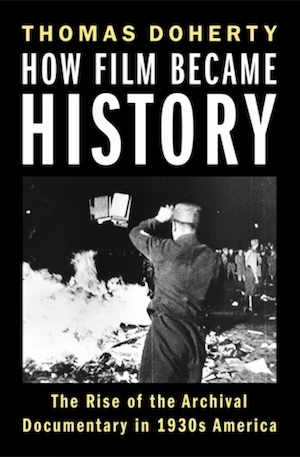
How Film Became History
Doherty, Thomas. How Film Became History: The Rise of the Archival Documentary in 1930s America. Columbia University Press, 280 pages, 6 x 9 inches, ISBN: 9780231222570
Get the book →May 16, 2026
20260516-doherty-thomas-how-film-became-history
The rest of this thread

Thomas Doherty
A cultural historian with a special interest in Hollywood cinema, Thomas Doherty is a professor of American Studies at Brandeis University. He is also the film review editor for the Journal of American History and an associate editor at Cineaste. His books include Pre-Code Hollywood: Sex, Immorality, and Insurrection in American Cinema 1930-1934 [1999]; Hollywood’s Censor: Joseph I. Breen and the Production Code Administration [2007]; and Show Trial: Hollywood, HUAC, and the Birth of the Blacklist, all published by Columbia University Press He lives with his wife Sandra in Salem, MA, and he suggests you do not visit the city in October.
Propose a thread
Know something the rest of us don't?
Most threads on Rorotoko begin with our invitation. Some begin with a proposal. Both use the same prompts and the same editing, with your own pages in the archive. Proposed threads carry a small Sponsored label and a fee.
Propose a thread →