
In a nutshell
May 16, 2026
How Film Became History
The idea behind How Film Became History was to trace the origin of the motion picture genre that is now the central repository for our shared history--the archival documentary.
“Films beget films,” declared the film historian Jay Leyda, but only in the 1930s would they become fruitful and multiply. The proliferation was due to two parallel developments, one archival, one technological. By 1930, a sufficient backlog of motion pictures—roughly four decades worth of filmed life—had accrued to provide the raw material to spawn a second generation stitched together exclusively from the first. That same year, Hollywood completed the task begun in 1927, the re-tooling of the studio assembly lines for the recording of synchronous dialogue. Together, the accumulation of a film inventory and the sound of the human voice gave rise to a new motion picture genre.
“Archival documentary” became the term for the branch of next-generation cinema, though the name would not stick until the end of the twentieth century. In the 1930s, the decade in which it came of age, critics and practitioners struggled for the right label: compilation films, library films, historical films, salvage films, celluloid anthologies, synthetic features, episodic reelage, super newsreel, and collections of stock footage. Whatever the name, it referred to a parasitical genre that drew its life from pre-existing film.
By 1930, plenty of source material had grown up to feed the new format. After the Lumière brothers turned on their projector, the production of motion pictures accelerated as fast as the cellulose nitrate film stock could be processed.
But if the accumulation of some forty years of film footage was a necessary precondition for the creation of the archival documentary, the introduction of synchronous sound into the grammar of cinema was the decisive addition—soundtrack music, ambient noise, and, above all, the human voice. Joined together, the commentary from the human voice and the backlog of film footage parented a supple new medium for the transmission of history.
Curator: Bora Pajo
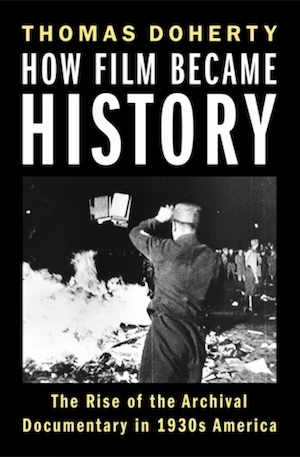
How Film Became History
Doherty, Thomas. How Film Became History: The Rise of the Archival Documentary in 1930s America. Columbia University Press, 280 pages, 6 x 9 inches, ISBN: 9780231222570
Get the book →May 16, 2026
20260516-thomas-doherty-how-film-became-history
The rest of this thread

Thomas Doherty
A cultural historian with a special interest in Hollywood cinema, Thomas Doherty is a professor of American Studies at Brandeis University. He is also the film review editor for the Journal of American History and an associate editor at Cineaste. His books include Pre-Code Hollywood: Sex, Immorality, and Insurrection in American Cinema 1930-1934 [1999]; Hollywood’s Censor: Joseph I. Breen and the Production Code Administration [2007]; and Show Trial: Hollywood, HUAC, and the Birth of the Blacklist, all published by Columbia University Press He lives with his wife Sandra in Salem, MA, and he suggests you do not visit the city in October.
Feature your book, your art, your project
Publishing with a small press, or on your own?
A Sponsored Thread runs like every other thread on Rorotoko: three parts on three dates, the same editorial review, your own pages in the archive. Marked Sponsored.
Get featured →