
A close-up
May 16, 2026
How Film Became History
I was scrolling through a newspaper from 1937 and my eyes happened to fix on an item in a gossip column. At the Filmarte Theatre in New York, a woman saw something so unsettling she screamed and bolted from the theater, leaving in such a hurry that she forgot her purse. The next day she called the management to retrieve the purse and explain her reaction: she had spotted herself on screen.
The woman was Dr. Angelica Balabanoff and the movie was Tsar to Lenin (1937), a landmark archival documentary about the Russian Revolution. A lifelong radical socialist, Balabanoff had been first secretary of the Second Congress of the Comintern, which had met in Petrograd and Moscow from July 19 to August 7, 1920, and during a sequence on the Congress she was shown quite clearly in the footage and identified by name. Lenin was in the same shot. When Balabanoff purchased her ticket, she surely knew she had lived through some of the history she would be witnessing, but in 1937 people were not used to seeing their past selves come back to life on screen. The sudden flashback to her younger self--when both she and the Soviet experiment were full of hope and promise—was jarring.
I had never heard of Balabanoff or the film Tsar to Lenin. Investigating further, I found that Dr. Balabanoff was not alone in being rattled by Tsar to Lenin. It was, in its time and ever since, a one-of-a-kind motion picture journey through the history of the Russian Revolution. Drawing upon a remarkable trove of archival footage, much of it never before compiled and screened, the documentary traced the end of the 300-year-old autocratic rule of the Romanov dynasty and followed the transition to an even more ruthless dictatorship.
Released by Lenauer International Films, produced by Herman Axelbank, and directed, written, and narrated by Max Eastman, Tsar to Lenin premiered on March 10, 1937 at the Filmarte Theatre, a newly opened venue specializing in foreign imports. The film immediately incited a bitter internecine war within the ranks of the Popular Front, the loose coalition of men and women “on the Left,” as the phrase went, who banded together, if sometimes just barely, on the strength of a shared commitment to civil rights at home and resistance to fascism abroad.
.png)
To the hardcore faithful invested in the Russian Revolution, however, every frame of Tsar to Lenin was contested terrain. In good Marxist fashion, two dialectical forces squared off: the Stalinists, who supported the Soviet regime with the fervor of religious zealots, and the Trotskyites, who looked upon Stalin’s dictatorship as a betrayal of the true faith. In the USSR, the suppression of the one by the other had already produced a bloodbath. In America, the fall-out was mainly rhetorical—passionate and hard fought, but not lethal. “Of all the arts, for us the cinema is the most important,” Lenin famously said, and the controversies that swirled around Tsar to Lenin proved his point.
I soon learned that Tsar to Lenin was not the only forgotten archival documentary from the 1930s.
Curator: Bora Pajo
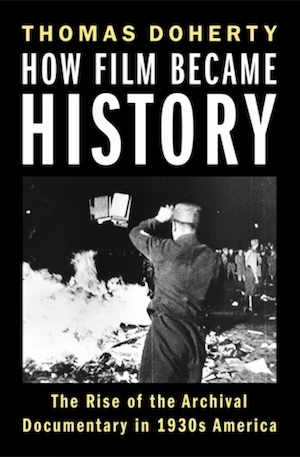
How Film Became History
Doherty, Thomas. How Film Became History: The Rise of the Archival Documentary in 1930s America. Columbia University Press, 280 pages, 6 x 9 inches, ISBN: 9780231222570
Get the book →May 16, 2026
20260516-thomas-doherty
The rest of this thread

Thomas Doherty
A cultural historian with a special interest in Hollywood cinema, Thomas Doherty is a professor of American Studies at Brandeis University. He is also the film review editor for the Journal of American History and an associate editor at Cineaste. His books include Pre-Code Hollywood: Sex, Immorality, and Insurrection in American Cinema 1930-1934 [1999]; Hollywood’s Censor: Joseph I. Breen and the Production Code Administration [2007]; and Show Trial: Hollywood, HUAC, and the Birth of the Blacklist, all published by Columbia University Press He lives with his wife Sandra in Salem, MA, and he suggests you do not visit the city in October.
Propose a thread
Know something the rest of us don't?
Most threads on Rorotoko begin with our invitation. Some begin with a proposal. Both use the same prompts and the same editing, with your own pages in the archive. Proposed threads carry a small Sponsored label and a fee.
Propose a thread →