
Danny Bate
Why Q Needs U
Chapter A, the first chapter of Why Q Needs U, spends a lot of time and page count examining its starring letter, A. As the author, it was a joy to realise that, by sheer accident, the alphabet’s initial character provides an ideal entry point into its millennia-long history. This is due to its letters’ origins in pictographic signs – that is, symbols based on things in the world. A, perhaps better than any other letter, still preserves aspects of its pictographic prototype.
The alphabet as a system has Ancient Egypt for its birthplace. Roughly four thousand years ago, a particular community within Egypt adapted the Egyptians’ already-ancient hieroglyphs for their own purposes. They were a recently arrived minority within Egypt, and they spoke a different language. For reasons of either pride or practicality, they set out to fashion a new version of writing that would suit their speech.
They would take an established hieroglyph, such as an ox’s head, complete with horns and muzzle, and assign it to a particular sound. That element of their speech was determined by the word for the hieroglyphic thing in their language. For example, an ox was to them an ʻalp. Because the word ʻalp began with a glottal stop (as heard in English uh-oh), the ox-head symbol could now represent that throaty sound. The rest of the alphabet, barring a few later creations, was forged through the same principle: pictographic symbol > word for symbol > first sound of word > symbol for sound.

What’s the relevance of this ancient system? It’s behind our letter A. Its point was once that ox’s muzzle, and its legs were its horns. This single letter so nicely demonstrates the development of the alphabet, through both its enduring similarities and later differences with its bovine prototype. The letter A has lost much of the complexity of the original hieroglyph, it does not ‘face’ in the same direction, nor does it stand for a glottal stop. Instead, it represents one of a number of vowels. For this dimension to the letter, we have to thank the ancient Greeks, later adopters of the alphabet.
Nearly all aspects of the letter A have changed since its inception, with one exception. This is its defining logic, the principle that gave birth to the alphabet: that one symbol in writing should represent one sound in speech. Once this principle and its initial set of symbols were up and running, we can say that we (humanity) have an alphabet. It was a simple rule, but in simplicity there is great potential. From out of that seed, a cosmos of writing and communication burst forth.
Curator: Bora Pajo
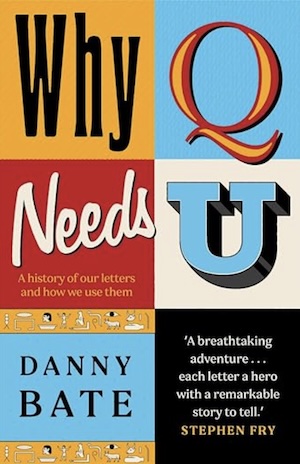
Why Q Needs U
Bate, Danny. Why Q Needs U: A History of Our Letters and How We Use Them. Blink Publishing (Bonnier Books UK), 2025. ISBN 9781785307430
Get the book →May 24, 2026
20260524-danny-bates-on-why-q-needs-u
A close-up
The rest of this thread

Danny Bate
Danny Bate is a linguist and writer. Following a BA and MPhil, he studied for a PhD with the University of Edinburgh, graduating in 2024. His specialisms are historical languages, the Indo-European language family, and word order. Over the course of his time at university, he also pursued a passion for public linguistics – sharing the field with a general audience, through text, audio and video. This vocation has most recently expressed itself through Why Q Needs U, a new book about the alphabet and the English language, named by The Economist as one of its books of 2025.
Know something the rest of us don't?
Most threads on Rorotoko begin with our invitation. Some begin with a proposal. Both use the same prompts and the same editing, with your own pages in the archive. Proposed threads carry a small Sponsored label and a fee.
Propose a thread →