
Nick Epley
A Little More Social
A Little More Social highlights how social connection is a choice that we make—a choice about whether we reach out and engage with another person, or hold back and avoid them. Also, the way we choose to reach out and engage with somebody once we decide to do that. It strikes me that once you start thinking about social connection, not as something that just happens to us and has certain effects, but rather as a choice that we make, you start to ask different questions as a scientist.
One question you ask is, are we making these choices wisely? We might wish we chose to exercise a little more, or chose to eat a little less junk food. And if social connection is a choice, then we can also ask, are we choosing to connect with others as well as we could be?
I was struck by this one morning on a train ride to the University of Chicago. Sitting on the train, I was writing a book called MindWise, about how we have a brain that has a unique capacity for reaching out and connecting with the minds of others. We're made happier and healthier by connecting with the minds of others.
I was riding on this train, full of people, and here we all were, highly social agents, sitting cheek by jowl next to each other, and completely ignoring each other, choosing not to engage with each other. That just seemed paradoxical to me. How could a highly social species, which should be happier connecting with others, choose not to do it?
So that morning, I very distinctly remember trying something different. I decided I'm gonna run an experiment on myself this time, instead of running experiments on other people like I do all the time. I'm gonna try it on myself. So a woman that morning sat down next to me. I remember it just like it was yesterday. The woman had this amazing red hat on—this really bright, beautiful red hat. I turned to her, and I made a very weak joke. I said, ‘I love your hat, I have one just like it’. I'm kind of a big white guy who doesn't wear hats like that. She chuckled at this, turned to me, and we started a conversation. I have a 30-minute commute. It was super easy—the conversation—easier than I thought. And when the conversation ended, what really struck me was this: she reached out and held my wrist as I was getting up, and said, ‘thank you so much for talking with me this morning’. And I remember the feeling I had wasn't just that it was nice, it was surprisingly nice.
Psychologists have thought about social connection as a choice for a long time, but that was the moment that really prompted me to think about whether we're doing this wisely or not. Not just how are we making the choice, but are we making this choice wisely? So we started running a bunch of experiments, and what we found now over tens of thousands of people, is that we are NOT wise enough when we do this. I don't think we are social enough for our own good, just like I did with that woman on the train that morning. I was a little nervous about starting the conversation, didn't know what we'd talk about. Maybe she wasn't interested in talking to me. I was overly pessimistic about how that conversation would go, and that experience seems to be very common, and it pushes us to be unwise in how we connect with other people.
Another big reason is that people underestimate how positively the other person will respond when we reach out to connect with them. People are reluctant to engage a stranger in conversation. If they think the other person doesn't want to talk to them, they often underestimate how interested the other person is in talking to them. We're reluctant to engage in deep conversation if we think other people aren't interested in having those conversations with us. We'll be reluctant to share a compliment if we think the other person won't respond as positively as we hope they might, or express gratitude, or be honest with someone. All of these exaggerated risks come from thinking that other people won't respond as positively as they actually will.
Yet another reason is not being optimistic enough about ourselves, thinking that we're not as good in conversation or in managing social interaction as we actually are. We worry a lot about our competency. We sit down to write a gratitude letter, and the first thing that comes to your mind is, ‘what the heck am I gonna say? What am I gonna write in this gratitude letter?’
Other people tend to evaluate us more in terms of our warmth. How friendly, how trustworthy, how honest are we? And if we're worried about our competency, when other people are mostly asking, 'Is this person nice?' When I reach out to you in a positive way, that builds relationships and makes me feel positive as well. Misunderstanding other people and misunderstanding ourselves create exaggerated perceptions of risk in social interaction.
Ongoing thread. More from Nick Epley to follow.
Curator: Bora Pajo
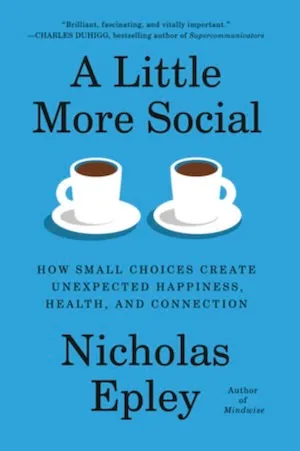
A Little More Social
Epley, Nicholas. A Little More Social: How Small Choices Create Unexpected Happiness, Health, and Connection. Knopf, 320 pp. 6 × 9 in, ISBN: 9780593319543
Get the book →May 28, 2026
20260528-nick-epley-little-more-social
In a nutshell
The rest of this thread
Nick Epley
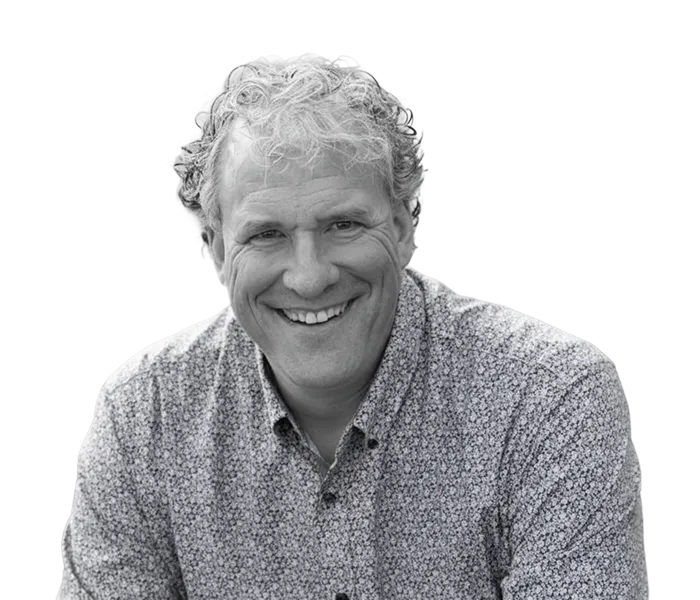
Nicholas Epley is the John Templeton Keller Distinguished Service Professor of Behavioral Science, and Director of the Roman Family Center for Decision Research, at the University of Chicago Booth School of Business. He studies social cognition—how thinking people think about other thinking people—to understand why smart people so routinely misunderstand each other. He teaches an ethics and happiness course to MBA students called Designing a Good Life. His research has appeared in more than two dozen empirical journals, been featured by the New York Times, Wall Street Journal, CNN, Wired, and National Public Radio, among many others, and has been funded by the National Science Foundation and the Templeton Foundation. He has been awarded the 2008 Theoretical Innovation Award from the Society for Personality and Social Psychology, the 2011 Distinguished Scientific Award for Early Career Contribution to Psychology from the American Psychological Association, the 2015 Book Prize for the Promotion of Social and Personality Science, and the 2018 Career Trajectory Award from the Society for Experimental Social Psychology. Epley was named a “professor to watch” by the Financial Times, one of the “World’s Best 40 under 40 Business School Professors” by Poets and Quants, and one of the 100 Most Influential in Business Ethics in 2015 by Ethisphere. He is the author of Mindwise: How We Understand What Others Think, Believe, Feel, and Want.
Know something the rest of us don't?
Most threads on Rorotoko begin with our invitation. Some begin with a proposal. Both use the same prompts and the same editing, with your own pages in the archive. Proposed threads carry a small Sponsored label and a fee.
Propose a thread →