
Nick Epley
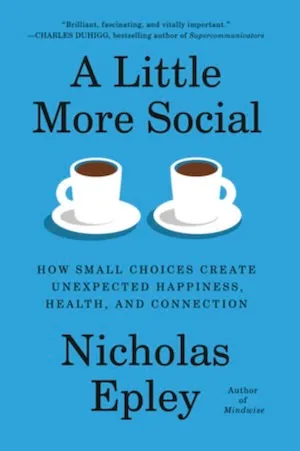
A Little More Social
I hope readers of A Little More Social see what's now a solid decade and a half of research just in our lab, but also tons of research by other people. Documenting the ways in which we're just not optimistic enough about how other people will treat us if we reach out to engage with them.
I talked with tons of people. Xia Zhang is an aspiring entrepreneur out in California, who was worried about being rejected. He tried to dull his fear of being rejected by reaching out to somebody and asking some ludicrous request, and getting rejected 100 days in a row. That's what he was trying to do. He failed because a lot of people accepted. In fact, he was accepted ludicrous things. He wanted to co-pilot a plane at a private airport, they let him. He wanted to give the TSA security announcement on Southwest Airlines. They couldn't let him do that, but they did let him get up and talk to the whole plane. He went to a Krispy Kreme donut shop and asked for the donuts in the shape of the Olympic rings. He thought, this is ridiculous. The woman behind the counter got into action, and she made this beautiful piece of art. He responded in this video that he made of it, that this is why humanity is worth saving. He learned that his fears were misplaced, and that was empowering to him. In fact, now he sees his belief about other people as a calibrated belief—as a kind of superpower.
Other people are nicer than you think. The reason why these matter is because they make us overly avoidant—weaker than we could be. Once you realize that these bars that are in front of you, are keeping you from engaging or connecting with other people—once you realize that they're not made of steel, they're more like made of pasta noodles. That is totally empowering. You don't have the fear of other people that you might otherwise have. You see other people as opportunities to make a dull moment better, to make somebody else's life a little better, and in turn, to make your own better. It's totally empowering.
Once you see that your own beliefs are a little bit misplaced, it’s that sense of empowerment that I hope people get out of the book. I hope the book encourages you to look for those places, and to test your beliefs. You don't have to believe me about the results here. They provide an opportunity or encouragement to go out and test them yourself. And see how it works. See how you feel afterwards. See how the other person feels afterwards. I think people will find the book to be empowering in a way that changes their lives.
Do people connect more in cities?
It's a little hard to answer, because the frequency of sociality, the amount of people you come in contact with differs. If you just look at how many people you do not talk to, it's way higher in cities than in rural places. So that differs a lot. Psychologists going back to Stanley Milgram in the 1970s argued that people in cities are, in fact, less social than folks who live out in the middle of somewhere. I grew up out in the middle of nowhere, out in the woods. It was somewhere to us.
People who live in more rural places, which I love to death and love spending time in, encounter fewer people. However—and this is more anecdotal than anything, because it's hard to do this work—my experience by living both in cities and in rural places, suggests that you do get connected to folks in rural places a little more.
We have land in Wisconsin, out in the country, where we go in the summertime. My wife grew up there. I know my neighbor, Arnie, like the back of my hand. He's down the road from us. Our house is a few miles away, but I know him really well. We live on the south side of Chicago and there are a number of neighbors who I don't know at all. Up there in Wisconsin, I know all of my neighbors, even though they're further away, just because you need each other a little bit more. Interaction is a little rarer, so there are fewer people you do see and say hello to. Whether that means the absolute amount of sociality is more or less is a little hard to say, Andrew Stier, one of our new hires here at the University of Chicago, argues that people do interact more often with people in cities. Now, whether that creates a different sense of social connection, is still something I would say we're trying to figure out.
Curator: Bora Pajo
A Little More Social
Epley, Nicholas. A Little More Social: How Small Choices Create Unexpected Happiness, Health, and Connection. Knopf, 320 pp. 6 × 9 in, ISBN: 9780593319543
Available here →June 14, 2026
20260614-nick-epley-little-more-social
A close-up
The rest of this thread
Nick Epley
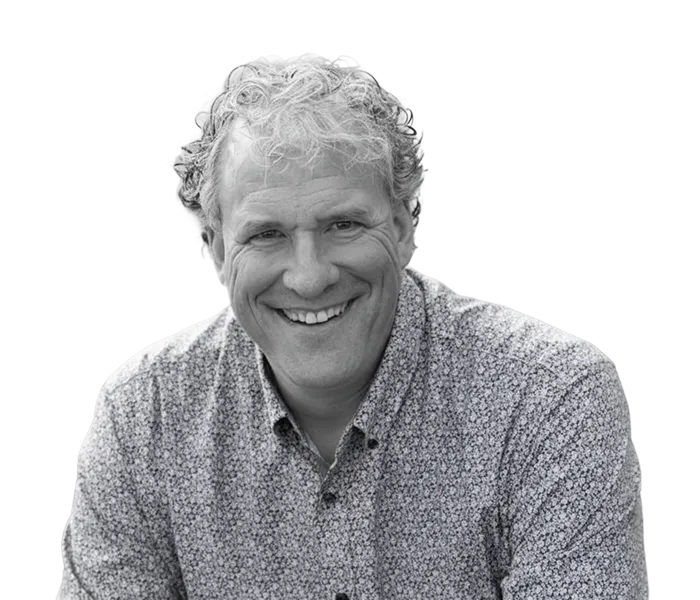
Nicholas Epley is the John Templeton Keller Distinguished Service Professor of Behavioral Science, and Director of the Roman Family Center for Decision Research, at the University of Chicago Booth School of Business. He studies social cognition—how thinking people think about other thinking people—to understand why smart people so routinely misunderstand each other. He teaches an ethics and happiness course to MBA students called Designing a Good Life. His research has appeared in more than two dozen empirical journals, been featured by the New York Times, Wall Street Journal, CNN, Wired, and National Public Radio, among many others, and has been funded by the National Science Foundation and the Templeton Foundation. He has been awarded the 2008 Theoretical Innovation Award from the Society for Personality and Social Psychology, the 2011 Distinguished Scientific Award for Early Career Contribution to Psychology from the American Psychological Association, the 2015 Book Prize for the Promotion of Social and Personality Science, and the 2018 Career Trajectory Award from the Society for Experimental Social Psychology. Epley was named a “professor to watch” by the Financial Times, one of the “World’s Best 40 under 40 Business School Professors” by Poets and Quants, and one of the 100 Most Influential in Business Ethics in 2015 by Ethisphere. He is the author of Mindwise: How We Understand What Others Think, Believe, Feel, and Want.
Pull this thread
People consistently underestimate how positively others will respond to being engaged, and the result is chronic undersociality.
Know something the rest of us don't?
Most threads on Rorotoko begin with our invitation. Any thread can begin with a proposal: you write it with the same prompts every thread answers, and we review it.
Propose a thread →