
Nick Epley
A Little More Social
When I was an undergraduate, I went to my advisor's office one day. We were doing some research together, and he grabbed the book off of the shelf, and handed it to me, and said, ‘I think you'll find this to be really interesting’. The book was How We Know What Isn't So by Tom Gilovich, who's a psychology professor at Cornell University. The book is all about how psychological processes that produce beliefs, perceptions, and attitudes can lead us astray. They can lead to misperceptions and misunderstanding about the reality of the world out there. I just gobbled that book up. It changed my life reading that book. It sent me on a different career path. I couldn't think about why I might want to study anything else other than how we misunderstand the world.
One of the ways that psychology has things to offer people is by creating some wisdom. And wisdom is found in that gap between our beliefs about the world and reality. So, I applied to Cornell's PhD program, which seemed totally out of reach for me at the time. I'm a kid from farm country in Iowa. The thought of going to an Ivy League... it didn't seem in the cards for me, but fortunately, I was put on the waitlist. Somebody ahead of me on the waitlist turned down the offer—unwisely—and it came to me. So I got to work with Tom as a PhD advisor, and he was every bit as fabulous a PhD advisor as he was an author and a scientist.
We initially got interested in social misunderstanding—times when we misunderstand the minds of other people. One of the things that makes us unique on this planet is social cognition. It is the fact that we have a brain that is built for understanding others, understanding other minds, other people in particular. A lot of this neural capacity above our eyes is really built for social cognition. Understanding the minds of other people is a hard problem. It's a really hard problem. It's hard to do perfectly, and in fact, we are reliably imperfect at this.
Tom and I, and Ken Savitsky, and Leif Van Boven, and Justin Kruger, started doing work about how well we can understand what other people are thinking about us. And how well we can understand how other people are responding to us when we're, say, writing an email to them versus calling them on the phone, or when we do something embarrassing that we feel bad about. Can we understand what other people think of us? We were documenting reliable gaps. Other people, it turns out, don't think as poorly of us as we think they will, when we've just done something that we feel bad about. We can cut ourselves some slack.
I found that work to be totally invigorating and exciting, so I view the world through this lens of social cognition. All of us are thinking about each other. But I don't take those thoughts for granted as being right, or correct, or well calibrated. In fact, I think they might often be wrong in ways that are interesting and potentially problematic for us in our lives. When we misunderstand other people, we misunderstand the thing that is most important or among the most important things for our happiness in life. It creates needless friction if we misunderstand, and it makes our lives and those around us worse. I couldn't think of something more interesting to study than that.
There is this old idea in psychology that goes back to the early 1900s, known as the looking glass self. It says that the way we understand ourselves is a little bit by trying to figure out what other people think about us. If somebody thinks that you're a great athlete, you'll start to think, ‘maybe I'm a pretty good athlete’. If somebody tells you you're a good speaker, you'll think ‘I guess I'm a pretty good speaker’. We do have independent thoughts about ourselves, of course, but they are influenced by what we think other people think of us. What we think of ourselves then influences how we behave and affects how other people think of us. These things are so closely intertwined, that it's hard to separate them.
In most experiments, when we ask people, ‘what do you think about yourself’ and ‘what do you think other people think of you’, the answers are very highly correlated like 0.5 to 0.7—which is a super high correlation. They are reciprocal. In fact, the going theory in psychology about self-esteem is that self-esteem operates as a monitor. The work by Mark Leary and Roy Baumeister talks about how self-esteem is a meter—a monitor—of what other people think of us. It's known as the sociometer theory of self-esteem. It supports this idea that our sense of worth comes from our beliefs about others. When self-esteem is low, when we're not feeling good about ourselves, that's our body's and mind's way of signaling to us that things aren't going great in our relationships. It's an alarm.
An example of this comes from social anxiety. We don’t study the clinical version of social anxiety, but momentary, everyday cases of social anxiety. In some ways, we know that social anxiety is misplaced, because in our experiments, we have people predict how others will respond, and they're off about it. Other people respond more positively when you reach out to them. At the clinical level, the way social anxiety disorder is treated, is through exposure therapy. This comes from research by Stefan G. Hofmann and other clinical psychologists. They say that if you're anxious about getting up in front of people and speaking in public, or introducing yourself to someone, or having a conversation, you can treat that by going out and doing the thing you are anxious about. That way you calibrate it more with reality.
Exposure therapy doesn't work with all of our fears. If you are afraid of being shot with a bullet, being shot with a bullet will not make you less afraid, right? Your fear is calibrated there. But when it comes to other people, it is not. Exposing yourself to interactions with other people shows you that it's not quite as bad as you thought. Other people are nicer than you might have imagined or feared. Even if they're not, you can handle that much better than you thought you could.
Ongoing thread. More from Nick Epley to follow.
Curator: Bora Pajo
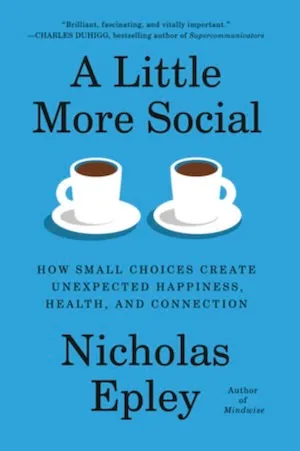
A Little More Social
Epley, Nicholas. A Little More Social: How Small Choices Create Unexpected Happiness, Health, and Connection. Knopf, 320 pp. 6 × 9 in, ISBN: 9780593319543
Available here →June 6, 2026
20260606-nick-epley-little-more-social-kjkv2
The wide angle
The rest of this thread

Nick Epley
Nicholas Epley is the John Templeton Keller Distinguished Service Professor of Behavioral Science, and Director of the Roman Family Center for Decision Research, at the University of Chicago Booth School of Business. He studies social cognition—how thinking people think about other thinking people—to understand why smart people so routinely misunderstand each other. He teaches an ethics and happiness course to MBA students called Designing a Good Life. His research has appeared in more than two dozen empirical journals, been featured by the New York Times, Wall Street Journal, CNN, Wired, and National Public Radio, among many others, and has been funded by the National Science Foundation and the Templeton Foundation. He has been awarded the 2008 Theoretical Innovation Award from the Society for Personality and Social Psychology, the 2011 Distinguished Scientific Award for Early Career Contribution to Psychology from the American Psychological Association, the 2015 Book Prize for the Promotion of Social and Personality Science, and the 2018 Career Trajectory Award from the Society for Experimental Social Psychology. Epley was named a “professor to watch” by the Financial Times, one of the “World’s Best 40 under 40 Business School Professors” by Poets and Quants, and one of the 100 Most Influential in Business Ethics in 2015 by Ethisphere. He is the author of Mindwise: How We Understand What Others Think, Believe, Feel, and Want.
Pull this thread
People consistently underestimate how positively others will respond to being engaged, and the result is chronic undersociality.
Know something the rest of us don't?
Most threads on Rorotoko begin with our invitation. Any thread can begin with a proposal: you write it with the same prompts every thread answers, and we review it.
Propose a thread →