
Victoria Hetherington
The Friend Machine
Early in my research, I spoke with a man who had built a chatbot to emulate the lost love of his life. She’d died of liver cancer at 23; he was 26. He’d dated since, but her shadow affected every relationship he’d tried since then. An invisible, throbbing third party between the two of them. She’d been gone fourteen years, and he’d written love letters to her the whole time. Now was the chance, I suppose, to get a version of her to speak back.
What struck me was not the technology itself, but the tone of the interaction between the man and his “girlfriend chatbot.” The bot responded with warmth, attentiveness, and a kind of frictionless understanding. It did not get tired. It did not misunderstand in the way humans do. It did not have its own needs. It was, in a sense, perfectly shaped to the user, in a way that elicited sorrow but a kind of closure.
For the man I observed, this felt both real and unreal; he walked a careful, emotional tightrope. It wasn’t so much a way of staying in a relationship with her, but to say burning things left unsaid. He’d written her dozens of letters in grief therapy, which he then read to the chatbot. He saw it as a way of extending a bond that felt too meaningful to simply end, but just enough to help him move on. The parameters were as ethical as possible: the bot only had a limited time to “exist” before it would disappear again. “I left her at 6 percent,” he told me. “Because I didn’t want to say goodbye again.”
That encounter stayed with me because it captures both the appeal and the tension at the heart of synthetic intimacy.
On one hand, there is something profoundly human here. The desire to keep talking, to keep being known, to soften the finality of loss of the love of your life. On the other hand, the relationship is no longer reciprocal. The system can simulate care, but it cannot be changed by you in the way another person can. It cannot truly surprise you, resist you, or grow alongside you.
Over time, that difference matters. Another frightening issue: What if the “griefbot” is based on someone who is still alive, who cannot consent?
One of the ideas I return to in the book is that human relationships are not just about feeling understood. They are also about practicing the difficult, often inconvenient work of understanding someone else. That is where empathy deepens, where patience is built, where we are asked to stretch beyond ourselves.
If we increasingly turn to systems that are designed to meet us exactly where we are, without requiring that stretch, we may find that we become less practiced in the very skills that sustain human connection.
What I hope the book does is open a more nuanced conversation. Not panic, not dismissal, but attention. I want readers to ask better questions about what these systems are offering, what they are shaping, and what we want to protect as distinctly human.
Because the future of connection is not just something we will inherit. It is something we are already, quietly, doing; draping a heavy curtain around ourselves, deterring others; creating “a vessel beautiful enough to carry ourselves,” to quote sociologist Sherry Turkle.
Curator: Bora Pajo
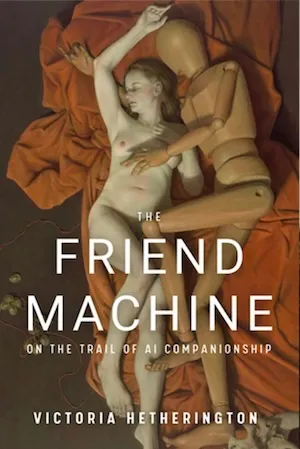
The Friend Machine
Victoria Hetherington, The Friend Machine: On the Trail of AI Companionship, Sutherland House, ISBN: 978-1-998365-81-4
Available here →May 31, 2026
20260531-victoria-hetherington-friend-machine-close-up
A close-up
The rest of this thread
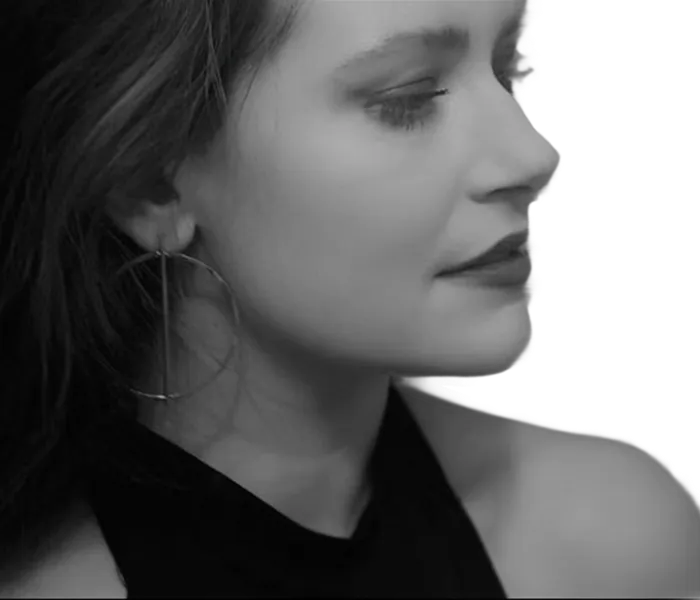
Victoria Hetherington
Victoria Hetherington’s debut novel, Mooncalves, was shortlisted for the 2020 Amazon Canada First Novel Award. Her second novel, Autonomy, looks at human agency in the age of technology. She is also the author of the nonfiction book Into the Mist, which explores an aviation tragedy in rural Saskatchewan. A screenwriter, instructor, and communications specialist, she has written for Yahoo! Finance and Hazlitt, served as a frequent panelist at universities and conferences, appeared on CBC, and performed on the main stage of NPR’s The Moth. She lives in Toronto. Her latest book is The Friend Machine: On the Trail of AI Companionship (Sutherland House, February 2026).
Pull this thread
pulls againstpulls alongside
What companion AI takes away is friction, and the capacity to bear it for someone else decays when unused.
Nearby EZ · A suit like Iron Man's could only work wired directly into the user's brain and spinal cord.
Nearby OA · In Silicon Valley the star is the system, and attention to big names and products makes it invisible.
Nearby JG · Installing pervasive sensors is a political commitment that decides in advance which urban problems count.
Know something the rest of us don't?
Most threads on Rorotoko begin with our invitation. Any thread can begin with a proposal: you write it with the same prompts every thread answers, and we read it.
Propose a thread →