
Craig Stanford
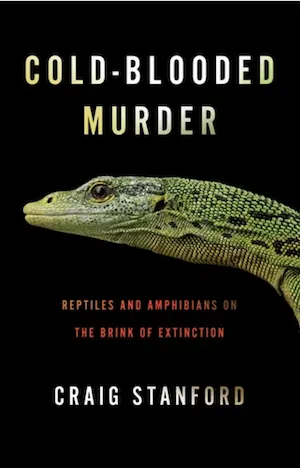
Cold-Blooded Murder
There was a debate about the title. I'm really good at writing books, I'm not good at marketing them, and the only aspect of marketing I'm good at is the title, and I thought Cold-Blooded Murder would be a really catchy one. It's Columbia University Press, an academic press, so it went out for review to four scholars. Three of the four wanted the title changed, because technically these animals aren't cold-blooded. Reptiles and amphibians are no longer called cold-blooded — "cold-blooded" means ectotherm, as opposed to endotherms like us, who generate our own internal heat. But reptiles are poikilotherms, which means they can regulate their body temperature by moving in and out of the sun or shade. So these academic peer reviewers felt that "cold-blooded" was inaccurate, and I obviously felt — so what? It's such a great title. The editorial board at Columbia had their own argument about it, and in the end, they decided to go with whatever the marketing team wanted. I knew I'd won then.
I'd wanted to write the book for a long time. I wrote a book before Cold-Blooded Murder that was published by my nonprofit, called The Turtle Crisis. Nobody has heard of about the rarest turtles on Earth, what's happening to them, and the story behind saving them. Four chapters in this book are adapted from that one. But I wanted to write about these animals that are much less glamorous than pandas or tigers or elephants. Animals people should be equally concerned about in terms of the loss of Earth's biodiversity. That was the gist of it.
There are only about 360 turtle species on Earth. There aren't very many. There are more than 7,000 lizard species, four thousand snakes, and most of them are in decline. My other work is about primates and great apes. I worked with the late Jane Goodall for many, many years. Ironically, turtles and primates are the two most threatened groups of higher animals on the planet, in terms of the percentage of species at risk of extinction — nearly 60% of each group.
Reptiles and amphibians are in trouble for a variety of reasons. Most are connected to habitat loss and degradation because of human activities. Many animals, including some reptiles, are eaten. They are items in the diet, especially in Asia. So in the book I went through case studies, all connected by a few common threads, but each with its own distinctive story. For example a lizard or snake killed on sight because it has a dangerous bite, or because it's perceived as dangerous even though it's not. They're reptiles, so people don't typically feel warm and cuddly toward them. That's a big problem. They are food items, killing them for the sake of killing them, and loss of habitat.
A big threat that I write about is the commercial pet trade, which is very sinister. We all hear about the drug trade all the time. I do a lot of work in the conservation world, especially in Mexico, and I just came back from a conference in Hong Kong. A huge fraction of Mexico's wildlife, parrots, turtles, anything that can be kept as a pet, is being poached in Mexico and smuggled out to Hong Kong. Hong Kong is the hub. Illicit dealers receive these animals, and within hours they've shipped them on to China, where there's a huge market. People in China used to only eat turtles; now they also love them as pets. One chapter is about the ploughshare tortoise, this incredibly beautiful big animal, the rarest tortoise in the world — an individual female might sell for 100,000 US dollars in China. People invest in them in a country where they don't trust the banks. In a crazy way, turtles and tortoises are an investment, because they gain value over the years and live a very long time. It's like buying stocks, in a sense. The number of Chinese reptile collectors with money to buy is growing every year, so that's a big problem. Pet trade, food, killing on sight, habitat loss. These are some of the problems they face.
Ongoing thread. More from Craig Stanford to follow.
Curator: Bora Pajo
Cold-Blooded Murder
Stanford, C. (2026). Cold-blooded murder: Reptiles and amphibians on the brink of extinction. Columbia University Press.
Available here →June 12, 2026
20260612-stanford-cold-blooded-murder-in-a-nutshell
In a nutshell
The rest of this thread
Craig Stanford
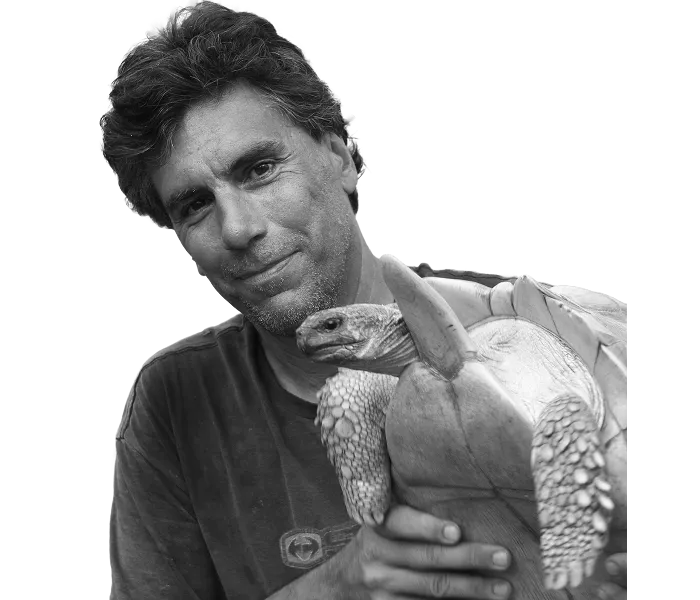
Craig Stanford is an evolutionary biologist and wildlife conservationist. He is Professor of Biological Sciences at the University of Southern California, and Research Associate at the Natural History Museum of Los Angeles County. He has conducted field studies of animals in North and South America, South and Southeast Asia and East Africa. His research has been supported by grants from the National Science Foundation, the Fulbright Foundation, and the National Geographic Society, among others. Stanford is the author of nearly 200 scientific publications and 20 scholarly and popular books. He lives in Altadena, California with two very large Maine Coon cats.
Pull this thread
pulls againstpulls alongside
Turtles are as endangered as primates, and their apparent invulnerability is exactly what makes them easy to take.
Against JI · Conservation is one of the routes by which capitalist worldviews became environmental, not a defense of nature against capitalism. On: There is a nature independent of human action that environmental thought can appeal to
Against PW · Nature has ended, and environmentalism should welcome it, managing wildness rather than fencing it off. On: There is a nature independent of human action that environmental thought can appeal to
Against TM · The concept of nature has had its day and is now an obstacle. On: There is a nature independent of human action that environmental thought can appeal to
Against EO · Fire, heat and matter are participants in skill, which is never transmitted between humans alone. On: There is a nature independent of human action that environmental thought can appeal to
Alongside BM · De-extinction is a failure to learn what drove species extinct, and it threatens the wildness it claims to save. On: There is a nature independent of human action that environmental thought can appeal to
Alongside SU · The Gulf Stream is wilderness in the same sense as Niagara or the Grand Canyon. On: There is a nature independent of human action that environmental thought can appeal to
Know something the rest of us don't?
Most threads on Rorotoko begin with our invitation. Any thread can begin with a proposal: you write it with the same prompts every thread answers, and we review it.
Propose a thread →