
Craig Stanford
Cold-Blooded Murder
In interviews I get asked a lot about how I connect these two worlds — primates and reptiles. I've made the effort to connect them, but it's a bit of a stretch. They both live a long time, like we do. They both have a reproductive strategy — primates, especially us, and turtles — of living a long time, reproducing very slowly. But once your offspring reach a certain age, they have a pretty high survival rate. Those are parallels, but to be honest, that's just an answer I put together for interviews.
The reality is that I grew up in a little town in New Jersey, in the New York City area, catching frogs and turtles and snakes, like a lot of little kids do. I always had reptiles in my bedroom, and turtles and tortoises in my backyard. Then I went on with my life and career. I'd thought about studying birds. I always wanted to study animals. I got interested in primates as an undergraduate, pursued that in graduate school for my PhD, did a lot of work over many years, got well recognized for it. At some point, when I had all the promotions a professor can have — I was probably 45 years old or something — I just realized: hey, now is the time, I can do whatever I want. I have tenure and so forth.
So I started to email people. This is a really sweet story for me. When I was about 13, in that town in New Jersey, before the internet, with a tiny library of maybe 5 books — I'm not from an educated family, I come from a working-class family. They were very supportive and tolerant of my fetish, but they didn't really get it. I had no resources, so I wrote a letter to the Bronx Zoo in New York. The Bronx Zoo was the big local zoo for me. On my birthday, my parents would take me, it was a big deal. I addressed the letter to the reptile department, literally just "the reptile department, Bronx Zoo," and asked a bunch of questions about animals I had in my bedroom — geckos, turtles, an alligator. I got a letter back from a young curator. His name was John Behler. I was 13; he was probably only 25 at the time. He wrote me this lovely letter, an actual letter, answering all my questions, and I'm sure he got many letters from kids. I wrote him back, and we had this correspondence that went on for a couple of years. Eventually he would write the answers in the margins of my letters, because my letters went on and on and on. It was really formative for me — the very first contact I ever had with a professional biologist.
Fast forward 30, 35 years, when I decided to get back into this world. It had been a hobby; I had tortoises in my backyard here in LA, where the weather is warm. I wrote an email to John Behler, the same John Behler. I didn't identify myself, just said I'm so-and-so and I want to get involved with reptiles and tortoises. He again emailed me this long answer, with contact information — talk to this person, talk to that person. Which I did, and everybody was very welcoming. In my own primate field, connected to Jane Goodall, we have a bit of a research mafia. We want to know what lab you came from, who trained you. These reptile people were so nice and welcoming.
I always wanted to say to Behler in an email — by the way, when I was 13 I wrote to you, like probably hundreds of other kids, and I'm so grateful. Because of the time you took, whenever I get an email from a kid, which I get pretty often, I always respond. I don't just respond and say, "Google this, why are you asking me?" I always respond with an answer. But at some point he stopped responding, and it was because he had died of heart disease. I never met him or told him our connection, which was too bad. I've met his widow a few times. She comes to our conferences. She said, yes, there were many kids just like that who corresponded with him. Many people were very giving of their information, and some are now my closest colleagues, wonderful friends. I see them mainly at conferences, but we travel the world together to do this thing we're passionate about.
Kids do write to me. The internet has way more to offer than I do, but I still get emails. Half of them are from kids who've been given a school assignment to reach out to a professional biologist. Some people really do have genuine questions. I'm also chair of a biodiversity committee at the International Union for the Conservation of Nature (IUCN), which is affiliated with the United Nations. We have a listserv, and people write us. Sometimes it's just "I have a sick turtle," but sometimes they're interesting questions. Maybe not once a week, but close to once a week, I get a message. I relate to it, because I think these kids could be in a tiny town in Ohio, and they have no access — other than Google, no access to this thing they're passionate about. As I didn't. You need to encourage them.
Curator: Bora Pajo
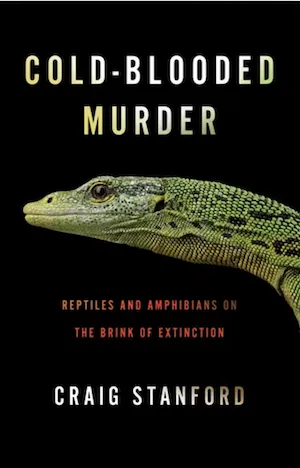
Cold-Blooded Murder
Stanford, C. (2026). Cold-blooded murder: Reptiles and amphibians on the brink of extinction. Columbia University Press.
Available here →July 25, 2026
20260725-stanford-cold-blooded-murder-the-wide-angle
The wide angle
The rest of this thread
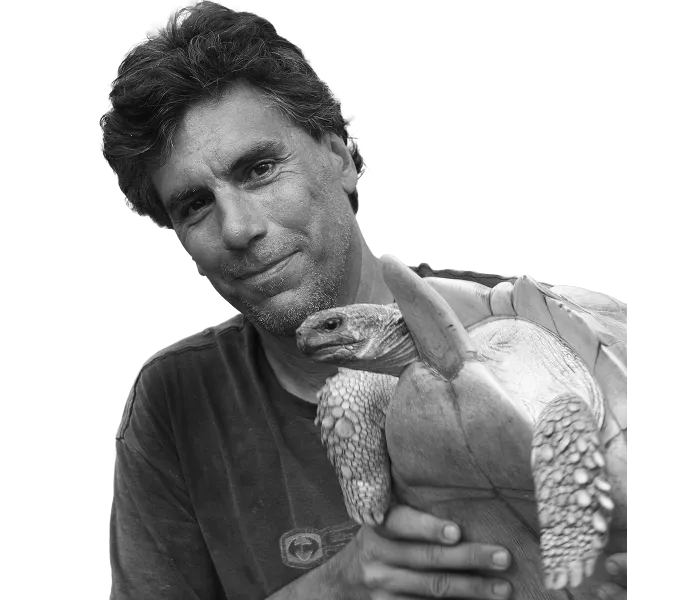
Craig Stanford
Craig Stanford is an evolutionary biologist and wildlife conservationist. He is Professor of Biological Sciences at the University of Southern California, and Research Associate at the Natural History Museum of Los Angeles County. He has conducted field studies of animals in North and South America, South and Southeast Asia and East Africa. His research has been supported by grants from the National Science Foundation, the Fulbright Foundation, and the National Geographic Society, among others. Stanford is the author of nearly 200 scientific publications and 20 scholarly and popular books. He lives in Altadena, California with two very large Maine Coon cats.
Pull this thread
Turtles are as endangered as primates, and their apparent invulnerability is exactly what makes them easy to take.
Know something the rest of us don't?
Most threads on Rorotoko begin with our invitation. Any thread can begin with a proposal: you write it with the same prompts every thread answers, and we review it.
Propose a thread →