
Craig Stanford
Cold-Blooded Murder
To me, the issue is poignant, because these animals seemed so invulnerable. Turtles and tortoises seem so well-protected against the world with their shell. They pull their head in, and it's like they're in their own little universe, nothing can get to them. I was in New Jersey last week, and I went to some of my old haunts from when I was a kid, and found turtles — box turtles, which you also have in Ohio — just sitting on the floor of the forest. They pull in. It might as well be a pretty rock; they're just protected.
But the reality is they're incredibly vulnerable. They wander out onto highways, they get hit by cars, they get picked up by people. There's an intense pet trade of shipping these animals to China. There are local people — Americans, in Florida, Louisiana, Alabama — who are hired by Chinese middlemen to poach these animals out of lakes and ponds and forests. They put them into U.S. Postal Service boxes, unmarked, and ship them to China. Some get intercepted. Most do not. They end up in a pet shop somewhere, or a dealer's shop in Hong Kong or China. It's a global problem that begins with the poignant thing of seeing what looks like a jewel box wandering around in a forest, or sitting on a log in a lake.
When I went back to these places last week — I've been going there since I was a teenager, so 45 to 50 years ago — I'm sure some of the turtles are the same. I took photos. I haven't compared them yet with ones from years ago, but some are the same turtles. They're wandering around the same little patch of forest for half a century. So the idea that they can just be picked up or squashed by a car is, to me, very touching. That runs through all of these essays. The other thing is the cultural differences. Some cultures respect these animals, some just want to eat them, some only see the monetary value in them. A lot of the book is about that.
The chapters focus on the backstory. There's usually somebody or some people in each chapter. There's a guy in Colombia, a biologist learning to breed these tiny arrow poison frogs that indigenous people use to make poison spears. By now they're super popular in the pet trade. They're a cool status pet and he's trying to breed them in captivity so the demand on wild animals is less, or gone. They'll be healthier, free of parasites, and he'll get permits to ship them to the U.S. or Europe. I try to bring out a lot of these stories, and in many cases they are very poignant.
There is the story of the Komodo dragon, the world's largest lizard — a 10-foot-long, 3-meter-long animal that lives only on two little islands in Indonesia. I've been there to see them. They are on the brink of extinction. They're now ecotourism targets. People pay big money to go see them. That's good, because it makes them a sustainable resource for the Indonesian government. But local people who don't necessarily benefit from ecotourism don't see the value, so there's still poaching. They're in the international pet black market, incredibly, because they don't get intercepted when they're shipped out by boat or by plane. There may be a thousand on those two islets, something like that. They're an example of a glamour reptile, because they're just so big — and the name "Dragon," obviously. But they're in terrible trouble too.
Curator: Bora Pajo
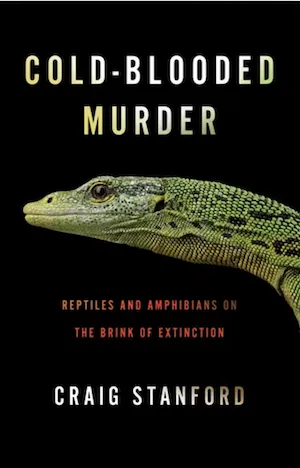
Cold-Blooded Murder
Stanford, C. (2026). Cold-blooded murder: Reptiles and amphibians on the brink of extinction. Columbia University Press.
Available here →July 25, 2026
20260725-stanford-cold-blooded-murder-a-close-up
A close-up
The rest of this thread
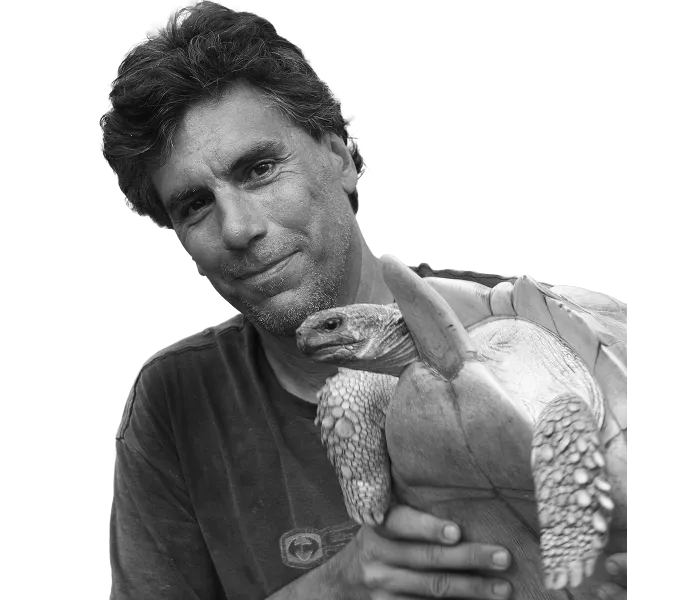
Craig Stanford
Craig Stanford is an evolutionary biologist and wildlife conservationist. He is Professor of Biological Sciences at the University of Southern California, and Research Associate at the Natural History Museum of Los Angeles County. He has conducted field studies of animals in North and South America, South and Southeast Asia and East Africa. His research has been supported by grants from the National Science Foundation, the Fulbright Foundation, and the National Geographic Society, among others. Stanford is the author of nearly 200 scientific publications and 20 scholarly and popular books. He lives in Altadena, California with two very large Maine Coon cats.
Pull this thread
Turtles are as endangered as primates, and their apparent invulnerability is exactly what makes them easy to take.
Know something the rest of us don't?
Most threads on Rorotoko begin with our invitation. Any thread can begin with a proposal: you write it with the same prompts every thread answers, and we review it.
Propose a thread →