
The wide angle
August 17, 2026
Markets of Pain
I am a historian of agriculture and the economy. What I am drawn to in all my work is how people in seemingly marginal places, growing seemingly unimportant crops, animate the largest stories we have: state-making, geopolitics, and even the intimate histories of our bodies and our health.
My first book, Hungry Nation, was about food, famine, and the making of modern India. Working on it, I kept bumping into crops that did not fit a story about subsistence: small, high-value commodities that tied Indian villages to distant industries. Some of these are strange, like guar gum, a humble bean that ends up in ice cream and fracking fluid. But there are also more dramatic crops, like opium—the most storied commodity in South Asian history, which everyone assumed had vanished with the empires that traded it.
That was far from the case. Long after the heyday of the Asian opium trade, India remained the world's largest producer of licit opium gum, scraped by hand from poppy capsules almost exactly as it was done two centuries ago. I began this research around 2015, just as the wreckage of the American opioid crisis was becoming impossible to ignore. Here were two ends of a single system: overdose deaths in the United States, and cultivators in central India whose parents and grandparents had supplied the raw material for American pharmaceutical firms.
The book sits at the junction of two rich conversations. Historians have written brilliantly about opium and empire in the nineteenth century, and journalists have written searchingly about the American crisis in the twenty-first. Markets of Pain takes up the century in between: the era when opium was disciplined into a legal, regulated, quintessentially modern commodity, and when two postcolonial states, India and Turkey, staked their dreams of development upon it.
The turning point in my research came when I finally went into the literal field. In the poppy-growing districts of central India, I spent time with farming families as they lanced capsules and scraped gum, work their forebears would have recognized instantly. They knew their industry was contracting. Licenses were shrinking; the government warehouses were full; synthetic drugs were displacing their crop. And yet they ascribed enormous value to the poppy—economic value, but also something closer to pride and inheritance. They understood, better than any archive could tell me, that they were producing inside the wreckage of a system. Their conviction about a crop with almost no destination left became the emotional center of this book.
Ongoing thread. More from Benjamin Robert Siegel to follow.
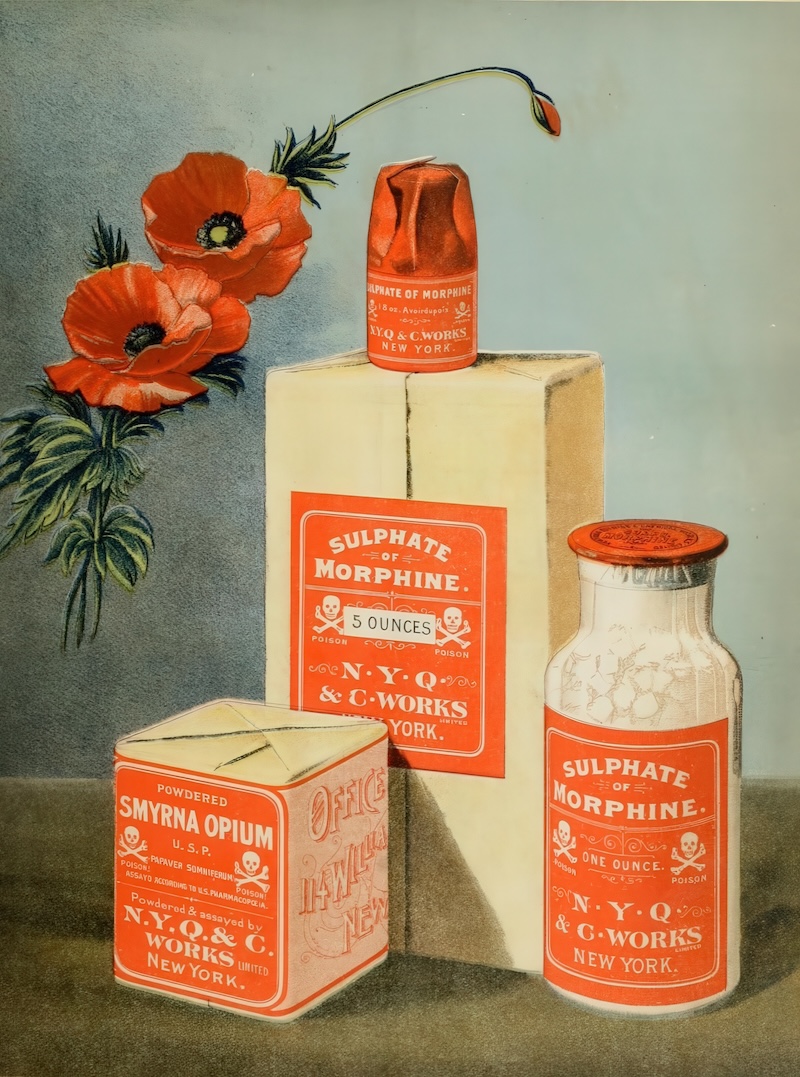
An 1897 advertisement for the New York Quinine and Chemical Works’ preparations of opium and morphine. The Pharmaceutical Era, 1897.
Curator: Bora Pajo
Markets of Pain
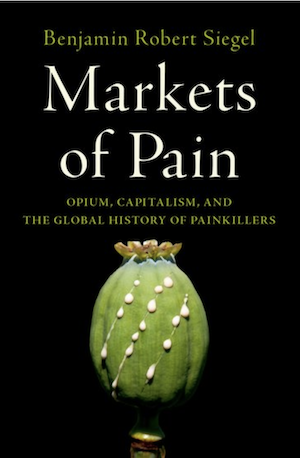
Siegel, B. R. (2026). Markets of Pain: Opium, capitalism, and the global history of painkillers. Oxford University Press.
Get the book →August 17, 2026
20260817-benjamin-siegel-markets-of-pain-the-wide-angle
The rest of this thread

Benjamin Robert Siegel
Benjamin Robert Siegel is Associate Professor of History at Boston University and a former Time magazine correspondent in Delhi and Hong Kong. He writes about the global commodity systems shaping modern life, from the drugs in our medicine cabinets to the food on our plates. He is the author of Hungry Nation: Food, Famine, and the Making of Modern India (Cambridge, 2018) and Markets of Pain: Opium, Capitalism, and the Global History of Painkillers (Oxford, 2026), and is writing The Price of Protein, on our manufactured hunger for protein and the industrial systems which help make it. He lives in Jamaica Plain, Massachusetts, and Lecco, Italy.
Propose a thread
Know something the rest of us don't?
Most threads on Rorotoko begin with our invitation. Some begin with a proposal. Both use the same prompts and the same editing, with your own pages in the archive. Proposed threads carry a small Sponsored label and a fee.
Propose a thread →