
Benjamin Robert Siegel
Markets of Pain
On the first page of this book is a dramatic rally. On a sweltering August day in the Indian town of Indore, ten thousand opium cultivators have gathered to hear a politician make a lofty promise. He knows their crop intimately. His own family has lanced poppies, scraped the dried gum, and handed small harvests to a state bureaucracy that always paid too little. The farmers have heard rumors that their industry is reaching its end. He reassures them: more licenses next season, loans, crop insurance, help moving their opium to eager markets overseas. The promises are empty—the government's warehouses are moldering with opium it cannot sell. Above the din, the farmers roar their approval anyway.
Every detail in this scene says 1880s. It is instead 1981. Months after the launch of MTV and the space shuttle, in the year AIDS was recognized and the personal computer first sold, Indian peasants were still scoring poppies by hand—no longer for the ports of China, but for the American pharmaceutical manufacturers who turned their gum into codeine cough syrup and morphine drips.
We have filed opium away as a nineteenth-century story, a colonial story, a story that ended and which belongs to a different world. Markets of Pain shows how it was instead reorganized by treaties, monopolies, factories, and shipping manifests, and ran into our own lifetimes. The rally captures everything the book is about: peasant labor tied to global capital, the state's grand promises, and a world system already coming apart beneath the grandiose speeches.
I hope that when a reader finishes this book, they will first grow somewhat suspicious of the word "crisis." Talking about crisis is often a way of not talking about the longer transformations that produced it; a crisis has villains and victims, while a system has a history that can be untangled. And I hope they come away feeling connected rather than overwhelmed. The medicines we take, the food we eat, the ways we consume—these link us to people and places very far away, through systems of production and commerce much larger than any of us. But those systems are not unknowable. They have specific stories, and the stories can be discovered and form the raw material of new politics. If readers close this book feeling empowered to do that untangling, it will have done its work.
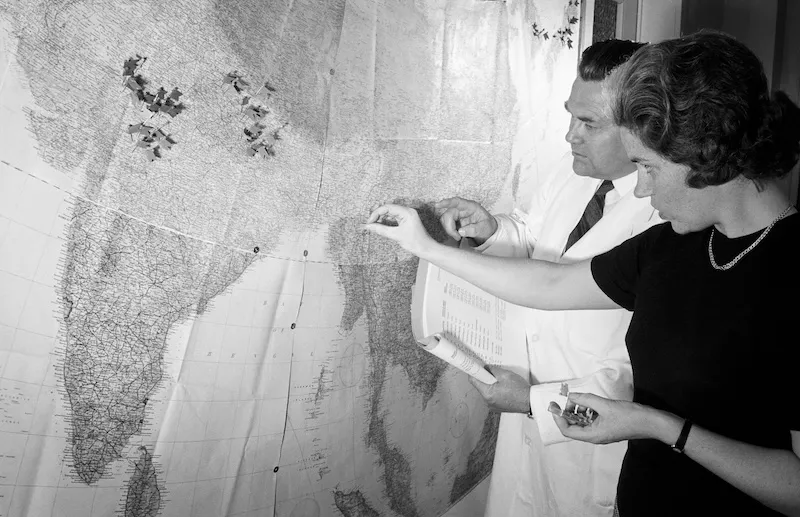
Dr. Olav Brænden, head of the United Nations drug laboratory in Geneva, and laboratory member Jane Beck mark opium-producing regions in India, 1965. UN Photo/PP.
Curator: Bora Pajo
Markets of Pain
Siegel, B. R. (2026). Markets of Pain: Opium, capitalism, and the global history of painkillers. Oxford University Press.
Get the book →August 25, 2026
20260825-benjamin-siegel-markets-of-pain-a-close-up
A close-up
The rest of this thread

Benjamin Robert Siegel
Benjamin Robert Siegel is Associate Professor of History at Boston University and a former Time magazine correspondent in Delhi and Hong Kong. He writes about the global commodity systems shaping modern life, from the drugs in our medicine cabinets to the food on our plates. He is the author of Hungry Nation: Food, Famine, and the Making of Modern India (Cambridge, 2018) and Markets of Pain: Opium, Capitalism, and the Global History of Painkillers (Oxford, 2026), and is writing The Price of Protein, on our manufactured hunger for protein and the industrial systems which help make it. He lives in Jamaica Plain, Massachusetts, and Lecco, Italy.
Know something the rest of us don't?
Most threads on Rorotoko begin with our invitation. Some begin with a proposal. Both use the same prompts and the same editing, with your own pages in the archive. Proposed threads carry a small Sponsored label and a fee.
Propose a thread →