
Michael Pollack
Sidewalk Nation: The Life and Law of America's Most Overlooked Resource
Like many Americans, I spent a lot of time during the height of the Covid-19 pandemic walking around my neighborhood for exercise, socialization, and commercial activity. I began to realize how essential the sidewalks were for everyone—not just as a way to get from place to place, but as a resource and a platform for so many other valuable uses and activities.
As a law professor, I focus in my teaching and writing on property law, constitutional law, local governments, and how those institutions and laws shape our ability to participate in civil society and to flourish as individuals and communities. It became clear to me that the sidewalk was central to this broader project, and as I looked at the literature, it became clear to me that there was an important gap I could help fill. Sociologists and historians and geographers have done really important work examining sidewalk life, but a legal perspective was missing.
I began with my core areas of expertise and interest: the property law of sidewalks. That's where I uncovered the mismatch between how sidewalk responsibilities are often allocated today (to the adjacent owner) and how property law would tell us those sidewalk responsibilities should be allocated (to the public and the government). My work on local institutions also led me to dig into the highly fragmented way in which government oversight for sidewalks manifests—as silos within an alphabet soup of agencies that often don't coordinate as well as we'd hope.
But there's even more. Sidewalks are where an extraordinary amount of landmark First Amendment law has been made—defining the contours of our rights to speak and picket and engage in political activity—and where speech and expressive conflicts continue to arise. They're also spaces where we are all heavily surveilled and policed and which are therefore central to any discussion of the Fourth Amendment and our rights to privacy.
My goal is to bring all of this to the attention of the public, scholars, and government decisionmakers: to make clear that so many areas of law and policy intersect and collide on the sidewalk. And, it turns out, most of these issues are not definitively resolved or dictated by the Constitution or by any other external body of law. Instead, they boil down to policy choices that we all get to shape as voters, advocates, and officials.
Ongoing thread. More from Michael Pollack to follow.
Curator: Bora Pajo
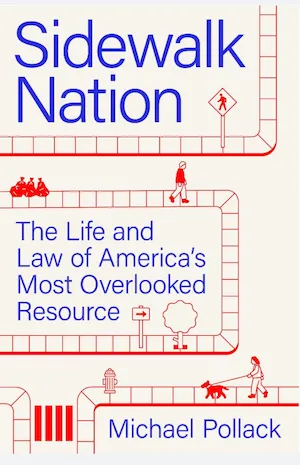
Sidewalk Nation: The Life and Law of America's Most Overlooked Resource
Pollack, M. (2026). Sidewalk Nation: The life and law of America's most overlooked resource. Harvard University Press.
Get the book →August 24, 2026
20260824-pollack-sidewalk-nation-the-wide-angle
The wide angle
The rest of this thread

Michael Pollack
Michael Pollack is a Professor of Law and the Associate Dean for Faculty Development at the Benjamin N. Cardozo School of Law in New York City. Prior to joining the Cardozo faculty in 2017, Professor Pollack was a law clerk to Supreme Court Justice Sonia Sotomayor and to Judge Janice Rogers Brown of the Court of Appeals for the D.C. Circuit, an attorney at the Department of Justice's Federal Programs Branch in Washington, D.C., and a Bigelow Fellow at the University of Chicago Law School.
Know something the rest of us don't?
Most threads on Rorotoko begin with our invitation. Some begin with a proposal. Both use the same prompts and the same editing, with your own pages in the archive. Proposed threads carry a small Sponsored label and a fee.
Propose a thread →