
Michael Pollack
Sidewalk Nation: The Life and Law of America's Most Overlooked Resource
Sidewalk Nation tells a multifaceted legal story, but it does so through some very human-scale stories. Half of the book is built around observations and interviews I conducted in cities and towns in New York, Texas, Louisiana, and Colorado. These paint a portrait of the American sidewalk, of what's working well and less well, of what cities and towns can learn from each other, and of what our sidewalks reveal about our choices and our communities. Here's a short excerpt from my discussion of New Orleans:
In wealthier neighborhoods, sidewalks and walkability operate as important amenities in terms of quality of life, air quality, environmental quality, public health, property values, community formation, and the like. But in poorer, underprivileged, and underserved neighborhoods, sidewalks are often in no condition to serve these critical functions well. And just to take New Orleans specifically, white households account for 83 percent of the city's net worth, whereas Black households account for just 10 percent of it….
This sidewalk disparity has another major consequence: These same communities tend to be disproportionately reliant on sidewalks because residents are comparatively less likely to own or have access to private cars. According to 2020 data, eighteen percent of all households in New Orleans don't have a car. Compare this number to Houston, where only nine percent of households lack cars, a figure which reflects that city's serious car dependency. But look under the hood at those numbers and the racial disparities jump out. Only about eight percent of New Orleans' white households lack access to a car, but three times as many Black households in the city—fully a quarter of Black households there—find themselves in that circumstance. These disparities mirror national data to a tee, where six percent of white households and eighteen percent of Black households are without cars. (New York City, perhaps unsurprisingly, is an outlier here, with 55 percent of households lacking access to a car. But it's worth noting that New York City also shows no significant racial disparity: 52 percent of white households and 57 percent of Black households are without cars.)
Without a car, the only ways to get around are on the sidewalk and on public transportation. And where it exists, public transportation isn't a substitute for good sidewalks, but rather a complement to them. Bus stops sit on sidewalks, and getting to and from a bus stop and one's destination requires at least some pedestrian travel on the sidewalk. The catch, though, is that public transportation is itself not always evenly distributed within cities. The New Orleans Regional Transit Authority runs the city's bus and streetcar system, and as I've mentioned, the streetcars run along a few major avenues, most of which are in wealthier and whiter areas. (The exception is the Canal Street line that connects the central business district to inland neighborhoods like Mid-City and Tremé.) As for the buses, most neighborhoods have just one or two lines running through them on a central avenue, leaving most of the streets without bus access at all. In the Lower Ninth Ward, for example, a resident could easily find themselves a mile or more from the nearest bus stop. The same is true in demographically similar neighborhoods like Gentilly, Seventh Ward, Holly Grove, Desire, Florida, and more. The consequence is that sidewalks are especially critical resources in these communities where people often lack access to both cars and to public transportation that is reliably within reach.
Curator: Bora Pajo
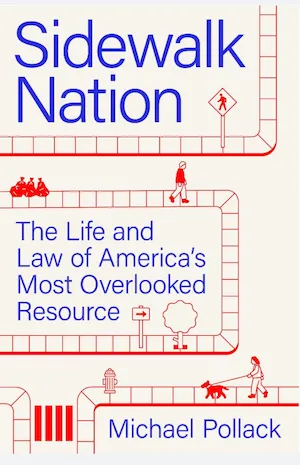
Sidewalk Nation: The Life and Law of America's Most Overlooked Resource
Pollack, M. (2026). Sidewalk Nation: The life and law of America's most overlooked resource. Harvard University Press.
Available here →September 10, 2026
20260910-pollack-sidewalk-nation-a-close-up
A close-up
The rest of this thread

Michael Pollack
Michael Pollack is a Professor of Law and the Associate Dean for Faculty Development at the Benjamin N. Cardozo School of Law in New York City. Prior to joining the Cardozo faculty in 2017, Professor Pollack was a law clerk to Supreme Court Justice Sonia Sotomayor and to Judge Janice Rogers Brown of the Court of Appeals for the D.C. Circuit, an attorney at the Department of Justice's Federal Programs Branch in Washington, D.C., and a Bigelow Fellow at the University of Chicago Law School.
Pull this thread
Making the abutting property owner responsible for the public sidewalk is the central error of American sidewalk law.
Know something the rest of us don't?
Most threads on Rorotoko begin with our invitation. Any thread can begin with a proposal: you write it with the same prompts every thread answers, and we review it.
Propose a thread →