
In a nutshell
September 25, 2026
A Is for Amoeba: The Story of Life in a Single Cell
A Is for Amoeba is my biography of the amoeba, the tiny splotch of life that is recognized by everyone from the simplest sketch of a wavy outline with a spot in the middle. From its graceful movements to its amazing sensitivity, the amoeba is the perfect guide to the business of being alive on Earth. Contrary to their reputation as the simpletons of biology, amoebas are highly sensitive organisms with huge genomes (the largest of any organism) and spectacular problem-solving skills. To make sense of this contradiction requires objectivity and imagination. We need to think about what it is like to be an amoeba and to see how evolution has crafted a cell that solves the great puzzles of life: how to feed, how to reproduce, and how to survive the violence of nature. The imagination part of this charge is a big ask, because it is so difficult to bridge the gap between our instinctive perception of the macroscopic world and the parallel microscopic universe. We can picture a bird of prey diving on a songbird by closing our eyes, but amoebas chasing bacteria seem to vanish as soon as we look up from the microscope. Just as the distances between stars make no sense, we lack the wiring to contemplate microbial life in an emotional fashion. And this is one of the aims of my book: to explore the biology of these organisms in a way that we can begin to appreciate their essence.
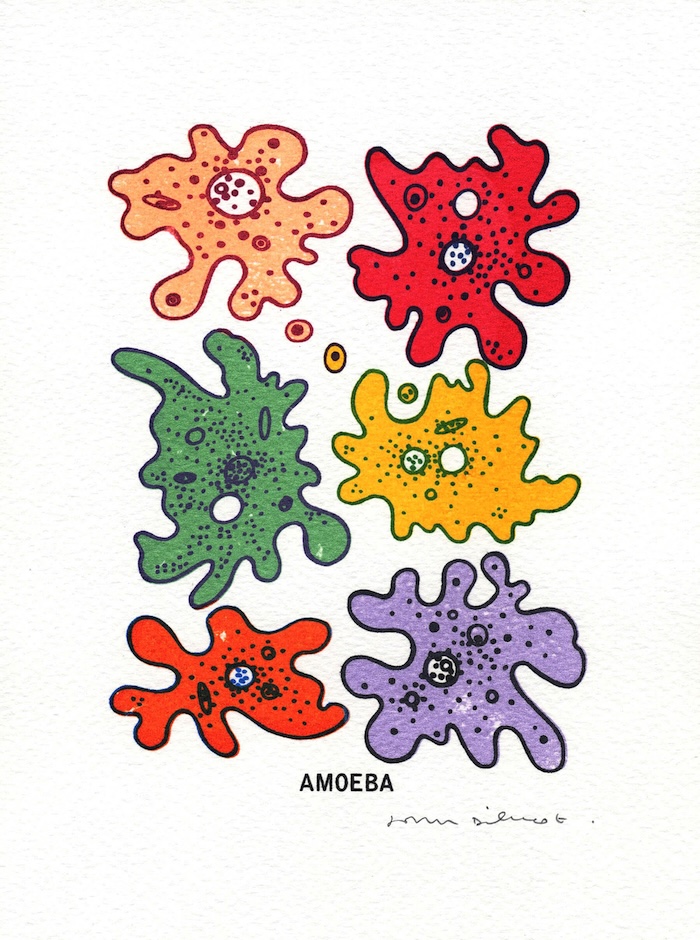
Human characters play an interesting role in the amoeba story too, with a cast of brilliant biologists including a suspected murderer, a criminal pedophile, and a German scientist who died after he deliberately infected himself with an amoeba to prove that it caused dysentery. Another bizarre amoebophile was Wilhelm Reich, the troubled inventor of the orgone accumulator or orgasmatron. Philosophers and psychologists have been hooked by amoebas too. Friedrich Nietzsche was fascinated by the willpower of amoebas and Sigmund Freud likened their movements to expressions of the human ego.
Ongoing thread. More from Nicholas P. Money to follow.
Curator: Bora Pajo
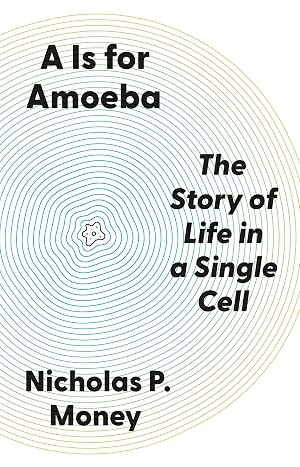
A Is for Amoeba: The Story of Life in a Single Cell
Money, N. P. (2026). A is for amoeba: The story of life in a single cell. Princeton University Press.
Get the book →September 25, 2026
20260925-money-a-is-for-amoeba-in-a-nutshell
The rest of this thread

© Gia Mariani
Nicholas P. Money
Nicholas P. Money is professor of biology at Miami University in Ohio and the author of many books, including Molds, Mushrooms, and Medicines: Our Lifelong Relationship with Fungi, The Rise of Yeast: How the Sugar Fungus Shaped Civilization, and Mushrooms: A Natural and Cultural History. He also wrote the Very Short Introductions to Microbiology and to Fungi for Oxford University Press. Beyond his scientific interests, Nicholas Money is infatuated with the poetry of John Milton.
Feature your book
Publishing with a small press, or on your own?
A Sponsored Thread runs like every other thread on Rorotoko: three parts on three dates, the same editorial review, your own pages in the archive. Marked Sponsored. $199, paid only once accepted.
Feature your book →