
Stephen Wade
Our Common Life: Folksong from the Front Porch to the Concert Hall
Our Common Life: Folksong from the Front Porch to the Concert Hall explores the workings of informal culture. The individuals described in its pages are largely musicians, some born in the closing decades of the nineteenth century and others in the first decades of the twentieth. In exemplifying folk tradition, they show us something constant and supremely supple at the same time, guided with custom and wisdom adapting to changing circumstances, not through formal means such as regulations and laws, but through observing and doing and responding and venturing, ready for anything and everything that may come along. Based on first-person fieldwork coupled with archival research, the book views how folk and vernacular creativity, fundamental to these artists and their processes, speaks to a resourcefulness inscribed in the nation’s founding charter and expressed in its common life.
Among the creators and conservators who inhabit these pages are Sid Harkreader, Kirk McGee, Ola Belle Reed, Jewel Fagan Haynes, Cordell and Olean Kemp, Bill Monroe, Helen Marie Rowe, Virgil and Mabel Anderson, Joe and Odell Thompson, Hobart Smith, John Jackson, Huddie Ledbetter, Uncle Dave Macon, Dorris Macon, Raeburn Flerlage, David “Honeyboy” Edwards, Jim Schwall, Archie Green, Lloyd Lewis, Thaddeus Willingham, Jack Conroy, and Fleming Brown. As Will Keys, another of the musicians featured here, once told me about his way of playing, “It’s AWYC. Any Way You Can.” These individuals and their stories communicate how folklore offers a way of understanding the world.
In the colloquial, the informal, the casual, and the everyday, dwells as ethnomusicologist Sidney Robertson wrote in a 1937 letter: “I have driven 29,000 miles in twenty states in the last eighteen months and I feel as if I had discovered, not America exactly, but Americans.”
The wide angle
Folklore is both a social reality and a scholarly pursuit, something both lived and contemplated. Much of this book centers on folk pedagogy, of how this music is learned and transferred. Certainly, my own experience as a player led me to so many of the persons found in these pages. These were the individuals who schooled me, in the sense that my teacher’s teacher, Doc Hopkins, a veteran WLS National Barn Dance performer, once said, “I can’t teach you, but I can show you.” They offered an informal education, and an indelible one.
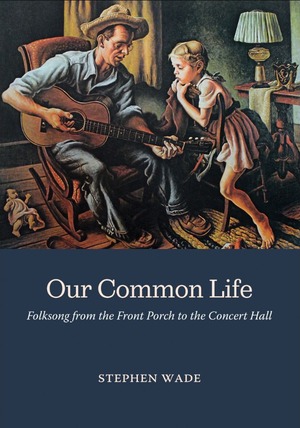
The book’s cover image called The Music Lesson by painter Thomas Hart Benton, and completed in 1943, represents two identifiable individuals, a father and child by the names of Gale and Emily Huntington. They lived on Martha’s Vineyard where the senior Huntington was a school teacher, nautical song collector, and fisherman. He also played in Benton’s string band. His daughter, Emily, spent her life there too. This arc from living individuals to their representation in a formal painting anticipates so many of the persons found in this book. Repeatedly, their music transfers from enclaved communities to the wider society and back again.
A close-up
The book’s first chapter, which discusses the idea of the common life, explores enduring and often contrasting views on pluralism and assimilation, on balkanization and cultural sharing. In 1892, social reformer and Hull-House founder Jane Addams discussed in her words, “our common life.” One example that speaks to this idea centers on a self-described “Hull-House girl.” Her name was Hilda Polacheck, a Polish Jewish immigrant who came to the United States in that year. Shortly after her arrival in the west side Chicago neighborhood near the settlement house, Hilda described her first Christmas in America.
An Irish playmate had invited her to one of Jane Addams’s annual Christmas parties at the settlement house. For Hilda, who grew up in a Polish shtetl, the idea of going out on a Christmas night was fraught with danger. “I can’t go out,” she told her friend. “I might get killed.” Her friend assured her that she had attended this party in years past and no one ever lost their life there. So, without telling her mother or her siblings, Hilda went to the event and savored it all: the lit candles on the trees, the singing of carols, and the warmth that Jane Addams radiated toward all those present. Hilda wrote, “I became an American at this party. I was with children who had been brought to America from all corners of the earth. The fathers and mothers of all of us had come in search of a free and happy life. And we were having a good time at a party. We were all poor. Most of us were underfed. Some of us had torn shoes. But we were not afraid of each other.”
Hilda’s story comes to us from a past unedited by the future, here for us, now.
Curator: Bora Pajo
Our Common Life: Folksong from the Front Porch to the Concert Hall
Wade, S. (2026). Our common life: Folksong from the front porch to the concert hall. University of Illinois Press.
Get the book →October 4, 2026
20261004-wade-our-common-life-in-a-nutshell
In a nutshell
The rest of this thread
.jpeg)
Stephen Wade
Stephen Wade is a musician, author, and a Grammy-nominated recording artist best known for his long running stage performances of Banjo Dancing and On the Way Home. He is the author of the award-winning book The Beautiful Music All Around Us: Field Recordings and the American Experience.
Know something the rest of us don't?
Most threads on Rorotoko begin with our invitation. Some begin with a proposal. Both use the same prompts and the same editing, with your own pages in the archive. Proposed threads carry a small Sponsored label and a fee.
Propose a thread →