
Matthew Botvinick
AI and Political Freedom: The Risk to Democracy and How to Respond
A technological republic – if we can keep it
After I had written the first draft of AI and Political Freedom, I was reading another book about AI that had recently hit the bestseller lists: The Technological Republic by Palantir’s Alex Karp and Nicholas Zamiska. At first, I felt encouraged. Here, at last, were some leaders in the AI industry talking out loud about the importance of democracy. At around the same time The Technological Republic came out, I had noticed other AI leaders using the d-word, as well. This was something of a relief to me, after having watched many Silicon Valley leaders adopt what has come to be euphemistically called a “transactional” approach with the Trump administration, even as that administration took actions that threatened to undermine democracy and the rule of law.
However, a closer look at the Karp book, and also the line that those other Silicon Valley leaders were newly adopting, left me frustrated. The argument in The Technological Republic, to put it in a nutshell, is that the tech industry, including AI labs, really should partner with the government, in order to support intelligence and defense operations. This is the right thing to do, the argument asserts, because ‘democracy must win.’ That is, democracies must win out in a geopolitical struggle against non-democratic rivals, most prominently the People’s Republic of China.
This argument is sound, as far as it goes. I actually agree that democracies should have the benefit of advanced technology, in pursuing legitimate national security objectives, and there really is a race afoot with authoritarian governments including China’s. However, what the Karp book fails to acknowledge, which also goes unacknowledged in most of the related appeals from other tech leaders, is that it will be a pyrrhic victory if ‘our side’ wins, but we do not take the steps to assure that our own countries themselves remain democracies.
The two problems – making sure that ‘democracy wins’ on the world stage, and making sure that our nations themselves in fact remain democratic – are not independent. Handing governments powerful AI tools is a risky prospect. Even in the U.S., there is a long history of government surveillance powers being abused and weapons being used to suppress dissent. Even the most patriotic technologist should therefore recognize that ‘giving government the AI tools they need to win’ comes inextricably linked to the challenge of assuring that those tools are used in a way that respects popular sovereignty and the rule of law.
We should always worry when political discussion and decision making focuses on only one aspect of a complex challenge, and keeps us from seeing the necessary tradeoffs and balances we must, in the end, contend with. Karp’s book makes this mistake. We – meaning citizens both inside and outside the AI industry – should push back, arguing for a consideration of the full picture. Yes, we should support our governments’ legitimate national security functions. But if we want things to go well, we will have to bear in mind two things at once: We want democracy to win, but we also want to keep the democracies we have. Only by keeping our minds focused on both sides of that dual challenge do we stand a chance of retaining our way of life.
Curator: Bora Pajo
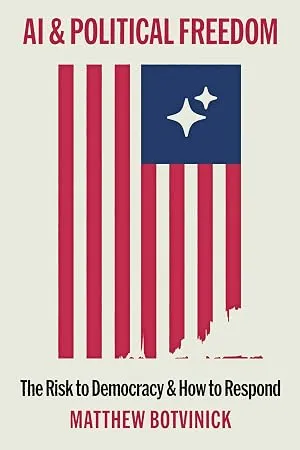
AI and Political Freedom: The Risk to Democracy and How to Respond
Botvinick, M. (2026). AI and political freedom: The risk to democracy and how to respond. Princeton University Press.
Available here →October 26, 2026
20261026-botvinick-ai-and-political-freedom-a-close-up
A close-up
The rest of this thread

Matthew Botvinick
Matthew Botvinick has spent three decades at the intersection of artificial intelligence and the human mind. Trained as a physician and scientist (M.D., Cornell; Ph.D., Carnegie Mellon), he trained his first neural network in 1993, held faculty positions at Penn and Princeton, and served as Senior Director of Research at Google DeepMind. Troubled by the global democratic recession, he turned to law, earning a J.D. at Yale Law School, where he is a Senior Fellow. He now leads the AI and Rule of Law team at Anthropic. AI and Political Freedom is his first book.
Pull this thread
AI safety requires constitutional democracy, so repairing democratic institutions is AI safety work.
Know something the rest of us don't?
Most threads on Rorotoko begin with our invitation. Any thread can begin with a proposal: you write it with the same prompts every thread answers, and we review it.
Propose a thread →