
Yehao Wang and Diying Huang
A Jurassic giant with its mouthparts showing
A giant Jurassic dipluran shows that hidden mouthparts evolved more than once.
Look at those mandibles.
The mandibles of Sinojapyx giganteus are robust and thick, armed with strongly curved, coarse teeth, and part of them sits outside the head capsule. In living diplurans, the mandibles are enclosed by the head capsule and only extend a little when feeding. The mandibles of this Jurassic giant are structurally closer to the ectognathous condition of other hexapods: they are not fully hidden by the head. That single detail turns "is entognathy homologous?", a purely theoretical question, into an empirical one that a fossil can test. Together with the stout, symmetrical, smooth-edged pincers, it lets us sketch how the animal lived: much like a centipede or scorpion today, it probably lurked in the leaf litter or soil crevices of Daohugou's warm, humid forests, ambushing small invertebrates with its mandibles and pincers and sitting at the top of the soil food web. The transitional shape of the cerci, on their way from sensory appendages to efficient capturing weapons, is written in that symmetrical, toothless structure.
The next question I would most like answered: did entognathy evolve independently in the three groups under the same selective pressures?
If Diplura, Collembola, and Protura each "pulled" their mouthparts into the head capsule during their own move into underground life, did they face similar environmental pressures, feeding modes, and developmental paths? Or are there several different ways of building a hidden mouth, all of which simply look alike from the outside? To answer that, we need more fossils like Sinojapyx giganteus, especially earlier members of Diplura, to pin down when and in what form each episode of "entognathisation" began. That is one reason our team keeps working in Daohugou and in older deposits.
Curator: Bora Pajo
A Jurassic giant with its mouthparts showing
Wang, Y., Cai, C., Sánchez-García, A., Sendra, A., & Huang, D. (2026). A giant Jurassic hunter: The earliest dipluran and its implications for hexapod body pattern evolution. Proceedings of the Royal Society B: Biological Sciences, 293(2080), 20261207. https://doi.org/10.1098/rspb.2026.1207
Available here →November 5, 2026
20261105-huang-a-jurassic-giant-with-its-mouthparts-showing-a-close-up
A close-up
The rest of this thread
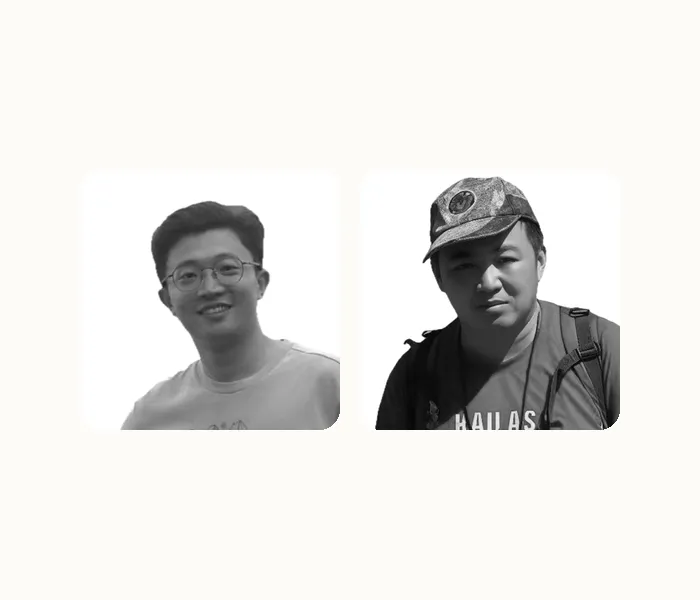
Yehao Wang and Diying Huang
Yehao Wang is a Ph.D. student at the Nanjing Institute of Geology and Palaeontology, Chinese Academy of Sciences, primarily engaged in research in evolutionary biology.
Diying Huang is a Professor at the Nanjing Institute of Geology and Palaeontology, Chinese Academy of Sciences. His research focuses on exceptionally preserved fossil assemblages and evolutionary palaeobiology. He has published over 580 papers, including in Nature, Nature Ecology & Evolution, PNAS, and Nature Communications. He serves as Editor-in-Chief of Palaeoentomology, Mesozoic, and Palaeontologia Sinica. He currently serves as President of the International Palaeoentomological Society and a voting member of the Jurassic Subcommission of the International Commission on Stratigraphy.
Pull this thread
Hidden mouthparts evolved separately in three hexapod groups rather than once in a shared ancestor.
Know something the rest of us don't?
Most threads on Rorotoko begin with our invitation. Any thread can begin with a proposal: you write it with the same prompts every thread answers, and we review it.
Propose a thread →