
Yehao Wang and Diying Huang
A Jurassic giant with its mouthparts showing
A giant Jurassic dipluran shows that hidden mouthparts evolved more than once.
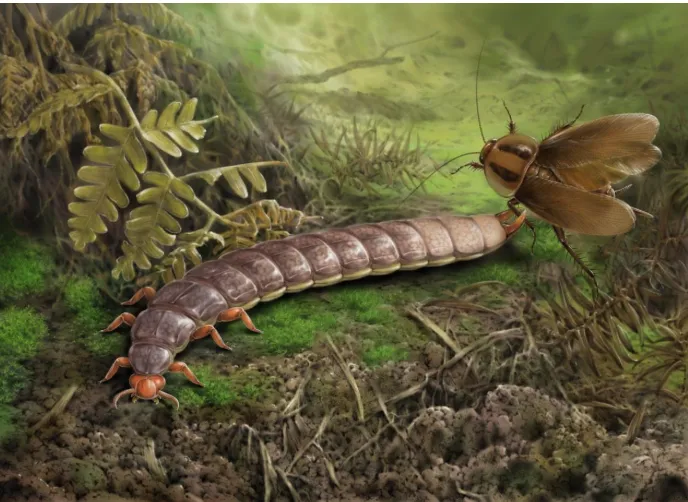
Sinojapyx giganteus shows us something no living dipluran can: its jaws sit outside its head.
In diplurans alive today, the mouthparts are tucked away inside the head capsule, a condition called entognathy. Because of it, people long lumped three non-insect hexapod groups (Diplura, Collembola, and Protura) under a single name, "Entognatha," and assumed that hidden mouthparts were a one-time invention inherited from their common ancestor.
Sinojapyx giganteus breaks that picture. Its body is a textbook dipluran, down to the details the paper lists: a pair of multi-segmented antennae; three thoracic segments, each bearing a pair of five-segmented legs; ten abdominal segments, with a pair of conical styli on the undersides of segments I to VII; and a pair of cerci at the rear. Yet its mandibles clearly protrude from the head. That is the ectognathous condition, the same setup seen in insects.
So what does this mean? If the earliest hexapods already had exposed mouthparts, then entognathy is not a shared inheritance from the hexapod ancestor. Instead, it evolved independently in Diplura, Collembola, and Protura. In other words, the "Entognatha" similarity we see today is probably the result of multiple origins, different lineages arriving at the same solution, rather than a single common legacy. This leads to a revised picture of how the hexapod body plan arose: ectognathy is the ancestral state, entognathy is derived, and it evolved at least three times.
For a general reader, the point is this: groups that look "primitive" may still carry older traits, and features that look "uniform" across a group may be nothing more than convergent evolution. Sinojapyx giganteus is the oldest dipluran fossil known, and the only specimen whose fossil form directly challenges the idea that "Entognatha" is a single evolutionary lineage. For the first time, we can discuss the ancestral mouthparts of hexapods with a real fossil in hand, rather than relying on inference alone. A single specimen, dug out of 165-million-year-old lakebed deposits in Inner Mongolia, directly challenges the textbook assumption, and shows that entognathy evolved independently.
Ongoing thread. More from Yehao Wang and Diying Huang to follow.
Curator: Bora Pajo
A Jurassic giant with its mouthparts showing
Wang, Y., Cai, C., Sánchez-García, A., Sendra, A., & Huang, D. (2026). A giant Jurassic hunter: The earliest dipluran and its implications for hexapod body pattern evolution. Proceedings of the Royal Society B: Biological Sciences, 293(2080), 20261207. https://doi.org/10.1098/rspb.2026.1207
Available here →November 5, 2026
20261105-huang-a-jurassic-giant-with-its-mouthparts-showing-in-a-nutshell
In a nutshell
The rest of this thread

Yehao Wang and Diying Huang
From left to right
Yehao Wang is a Ph.D. student at the Nanjing Institute of Geology and Palaeontology, Chinese Academy of Sciences, primarily engaged in research in evolutionary biology.
Diying Huang is a Professor at the Nanjing Institute of Geology and Palaeontology, Chinese Academy of Sciences. His research focuses on exceptionally preserved fossil assemblages and evolutionary palaeobiology. He has published over 580 papers, including in Nature, Nature Ecology & Evolution, PNAS, and Nature Communications. He serves as Editor-in-Chief of Palaeoentomology, Mesozoic, and Palaeontologia Sinica. He currently serves as President of the International Palaeoentomological Society and a voting member of the Jurassic Subcommission of the International Commission on Stratigraphy.
Pull this thread
Hidden mouthparts evolved separately in three hexapod groups rather than once in a shared ancestor.
Know something the rest of us don't?
Most threads on Rorotoko begin with our invitation. Any thread can begin with a proposal: you write it with the same prompts every thread answers, and we review it.
Propose a thread →