
Yehao Wang and Diying Huang
A Jurassic giant with its mouthparts showing
A giant Jurassic dipluran shows that hidden mouthparts evolved more than once.
The specimen was collected about twenty years ago in Daohugou, Inner Mongolia, but it was many years before we really looked at it closely.
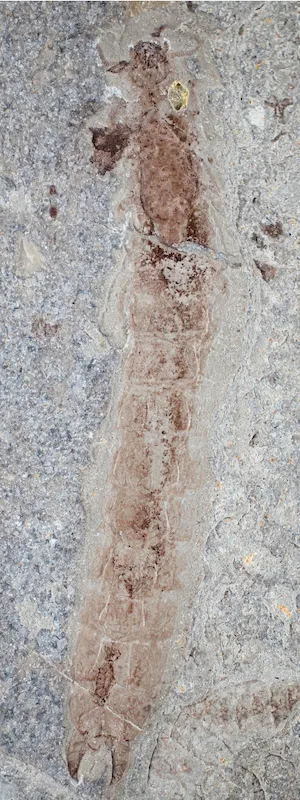
The Daohugou Biota has yielded hundreds of thousands of insect fossils, and our team has worked there for decades. After this specimen was collected, it sat quietly in the collections until we systematically screened Daohugou's hexapod material and noticed it again. Under the microscope, at that first close look, the most immediate impression was "big"—over 5 cm in body length, extremely rare for a dipluran. Next came the stout, pincer-like cerci at the rear, and the powerful mandibles with strongly curved, coarse teeth at the front. But what really made us stop was the mouthparts: part of the mandibles sat outside the head capsule. For a dipluran, that is something that almost should not happen.
The hardest decision was where to place it on the evolutionary tree.
We ran it through a phylogenetic matrix for diplurans. Its body features—especially the shape of the cerci—placed it clearly in the stem group of Japygoidea: the pincers are symmetrical, smooth and toothless on the inner side, and the rear abdomen is neither obviously shortened nor heavily sclerotized. These are "transitional" traits that living japygoids lack. The hardest call was this: is the ectognathous mouthpart a unique derived trait of this fossil, or a retained ancestral state of diplurans? We concluded the latter, because hexapods are themselves a specialised group of crustaceans, so their ancestral state should be ectognathous, and this specimen's ectognathous mandibles are structurally closer to the general hexapod condition than to any specialisation. That judgment directly supports the conclusion of "multiple origins of entognathy," and it was the step the whole paper had to handle most carefully: the mouthpart state of a single specimen would have to carry the weight of rewriting the ancestral state of an entire group. In the end, we settled its position through the morphological matrix and item-by-item comparison with living groups.
Ongoing thread. More from Yehao Wang and Diying Huang to follow.
Curator: Bora Pajo
A Jurassic giant with its mouthparts showing
Wang, Y., Cai, C., Sánchez-García, A., Sendra, A., & Huang, D. (2026). A giant Jurassic hunter: The earliest dipluran and its implications for hexapod body pattern evolution. Proceedings of the Royal Society B: Biological Sciences, 293(2080), 20261207. https://doi.org/10.1098/rspb.2026.1207
Available here →November 5, 2026
20261105-huang-a-jurassic-giant-with-its-mouthparts-showing-the-wide-angle
The wide angle
The rest of this thread

Yehao Wang and Diying Huang
Yehao Wang is a Ph.D. student at the Nanjing Institute of Geology and Palaeontology, Chinese Academy of Sciences, primarily engaged in research in evolutionary biology.
Diying Huang is a Professor at the Nanjing Institute of Geology and Palaeontology, Chinese Academy of Sciences. His research focuses on exceptionally preserved fossil assemblages and evolutionary palaeobiology. He has published over 580 papers, including in Nature, Nature Ecology & Evolution, PNAS, and Nature Communications. He serves as Editor-in-Chief of Palaeoentomology, Mesozoic, and Palaeontologia Sinica. He currently serves as President of the International Palaeoentomological Society and a voting member of the Jurassic Subcommission of the International Commission on Stratigraphy.
Pull this thread
Hidden mouthparts evolved separately in three hexapod groups rather than once in a shared ancestor.
Know something the rest of us don't?
Most threads on Rorotoko begin with our invitation. Any thread can begin with a proposal: you write it with the same prompts every thread answers, and we review it.
Propose a thread →