
Miroslav Kocifaj
What one mirror in orbit does to the night sky
Thirty kilometres from the lit spot, one orbital mirror still brightens the sky beyond full moonlight.
When we first heard about Reflect Orbital's plans we did not take them as science fiction. We took them as a radiative transfer problem, and not a simple one. In our group, with František Kundracik at Comenius University, we model skyglow from cities, following the light through the atmosphere one order of scattering after another. Our MSOS code was built for sources on the ground that emit in all directions. A mirror in orbit is a very different source. It sits at the top of the atmosphere and sends its light down in a narrow beam, and the code had to be adapted for that. We knew about the problem and planned to work on it. Things moved much faster when Gáspár Bakos from Princeton University contacted us. He had been working on this question for some time already, and from then on the three of us, Gáspár, František and I, worked on it together.
A mirror 600 km up reflects sunlight onto a circle 2.5 km in radius. An observer standing outside this spot and looking in a given direction sees the sum of all photons scattered along that direction, whether once or several times. Our MSOS model computes this on a 3D grid. Adapting it meant placing the source at the top of the atmosphere, pointing down. It is not enough to rotate the coordinate system, because the atmosphere is stratified. We computed nine orders of scattering, more than necessary, to be sure of convergence, and from the result we extracted sky luminance maps for observers at the distances that the grid provides, 5.4, 14.1, 34.1 and 80 km from the axis of the beam. To compare the result with moonlight, we computed the sky under a full Moon with our UniSky simulator.
For an observer 14 km from the centre of the spot, on ordinary ground and on a moonless night, the beam appears as a bright column of light rising from the horizon up to the zenith. The brightest part of the sky there reaches about 15.5 magnitudes per square arcsecond, roughly five times the luminance of the sky under a full Moon.
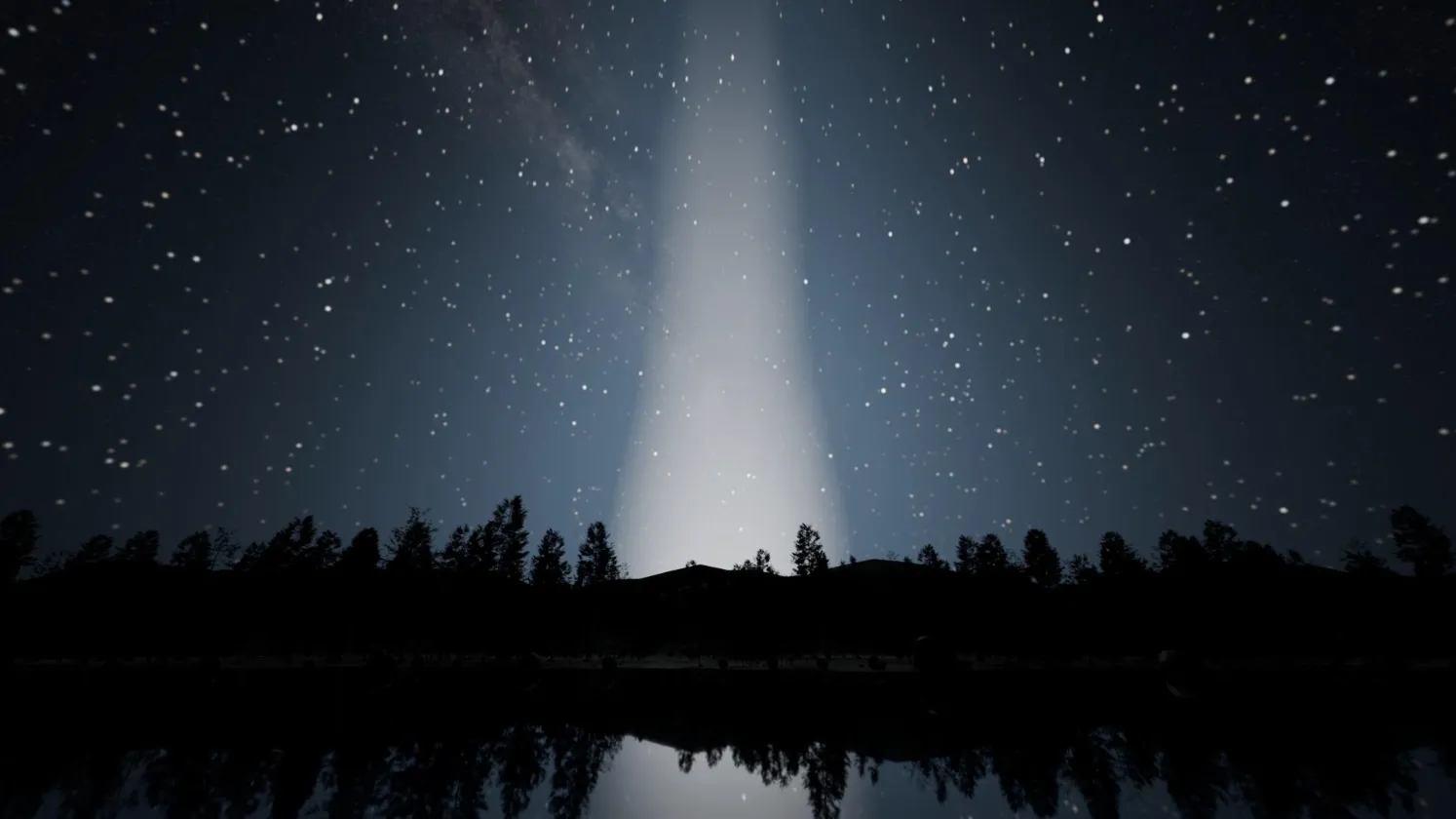
Closer to the spot, at 5.4 km, a camera set up for a dark-sky exposure records a white frame, and even with a shorter exposure the beam dominates the sky and is far brighter than a moonlit sky. The renderings on the Starry Princeton website were made with a ray-tracing program using our luminance maps together with a calibrated map of the natural sky (catalogue stars, the Milky Way and airglow).
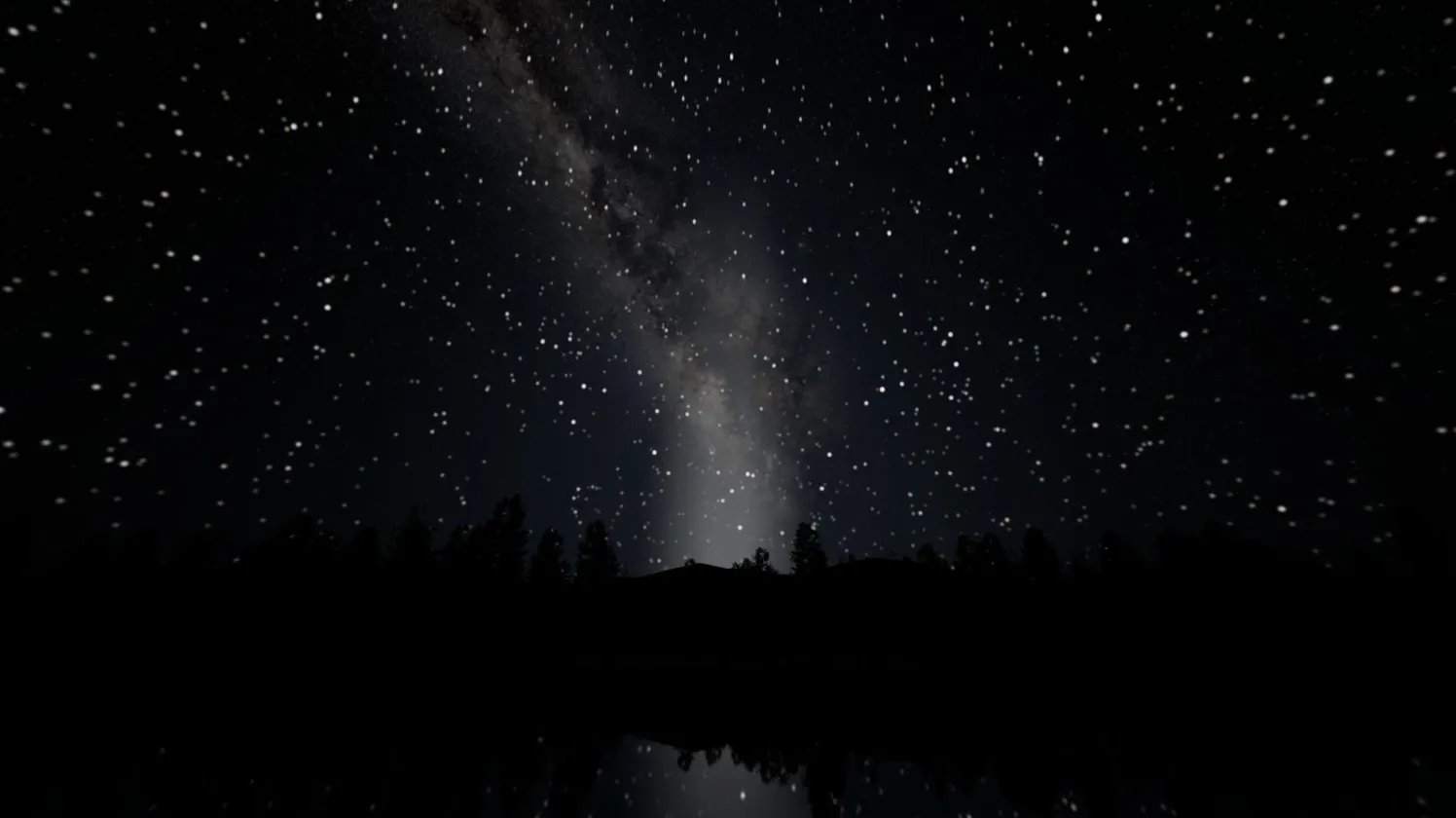
For an observatory within about 30 km of a spot, the night sky would be seriously compromised while the beam is on. People living under the beam would have their homes, gardens and fields lit like a street at night. We did not study the effects on animals and plants, which would need a study of their own.
The obvious next problem is clouds, since about two thirds of the Earth is cloudy at any given time. For light from cities we have shown that clouds amplify skyglow near the source and attenuate it further away, and that this depends on how the source emits light and on its distance. For a source above the atmosphere this still has to be worked out. A cirrus layer at 10 km illuminated from above could make the light pollution visible from much further than anything we computed for clear air, whereas a dense cloud layer would usually block the beam from reaching the ground. Because cloud cover is variable, the problem has to be treated statistically, as a mean sky state for a given cloud type, coverage, height and opacity.
Curator: Bora Pajo
What one mirror in orbit does to the night sky
Kocifaj, M., Bakos, G. Á., & Kundracik, F. (2026). Atmospheric light pollution by proposed Reflect Orbital space mirrors. The Astrophysical Journal Letters, 1008, L25. https://doi.org/10.3847/2041-8213/ae9551
Available here →November 17, 2026
20261117-kocifaj-what-one-mirror-in-orbit-does-to-the-night-sky-the-wide-angle
The wide angle
The rest of this thread
Miroslav Kocifaj
Miroslav Kocifaj, PhD, DSc, is a senior scientist at the Slovak Academy of Sciences and at the Faculty of Mathematics, Physics and Informatics of Comenius University in Bratislava, and Editor-in-Chief of the Journal of Quantitative Spectroscopy and Radiative Transfer. He studied optics and received his PhD in astronomy from Comenius University. His work concerns light scattering by small particles, radiative transfer in the atmosphere and the modelling of night-sky brightness produced by artificial light. He received the Galileo Award of DarkSky International in 2024 and is the author of more than two hundred peer-reviewed papers.
Pull this thread
One orbital sunlight mirror would make the night sky brighter than a full moon for tens of kilometres around.
More in Books
Know something the rest of us don't?
Most threads on Rorotoko begin with our invitation. Any thread can begin with a proposal: you write it with the same prompts every thread answers, and we review it.
Propose a thread →