
Miroslav Kocifaj
What one mirror in orbit does to the night sky
Thirty kilometres from the lit spot, one orbital mirror still brightens the sky beyond full moonlight.
Reflect Orbital is a company in California that plans to reflect sunlight from orbit onto places on the night side of the Earth. The first satellite, Eärendil-1, carries a mirror 18 metres on a side, and the company's application to the FCC describes it as a pathfinder for a constellation of 50,000 mirrors of 54 by 54 metres, each one illuminating a spot on the ground roughly 5 km across. The customer would get light after sunset. We wanted to know what the people around the spot would get, and the people further away, because none of them ordered it.
Inside the spot the mirror is a point source of about magnitude −16.7, four magnitudes brighter than the full Moon, so forty times brighter. The illuminance on the ground is roughly 9.5 lux, and the sky, lit by single scattering of the incoming beam, has a luminance of up to 2.9 cd/m². For comparison, the zenith has that luminance shortly after sunset, when the Sun is still only about 5° below the horizon. No star is visible under those conditions, not even the brightest ones.
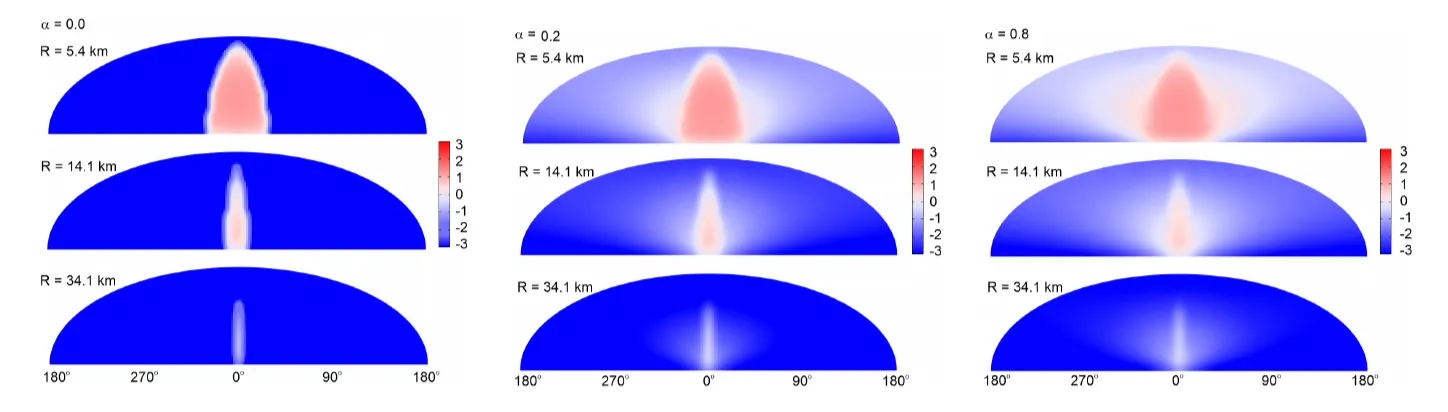
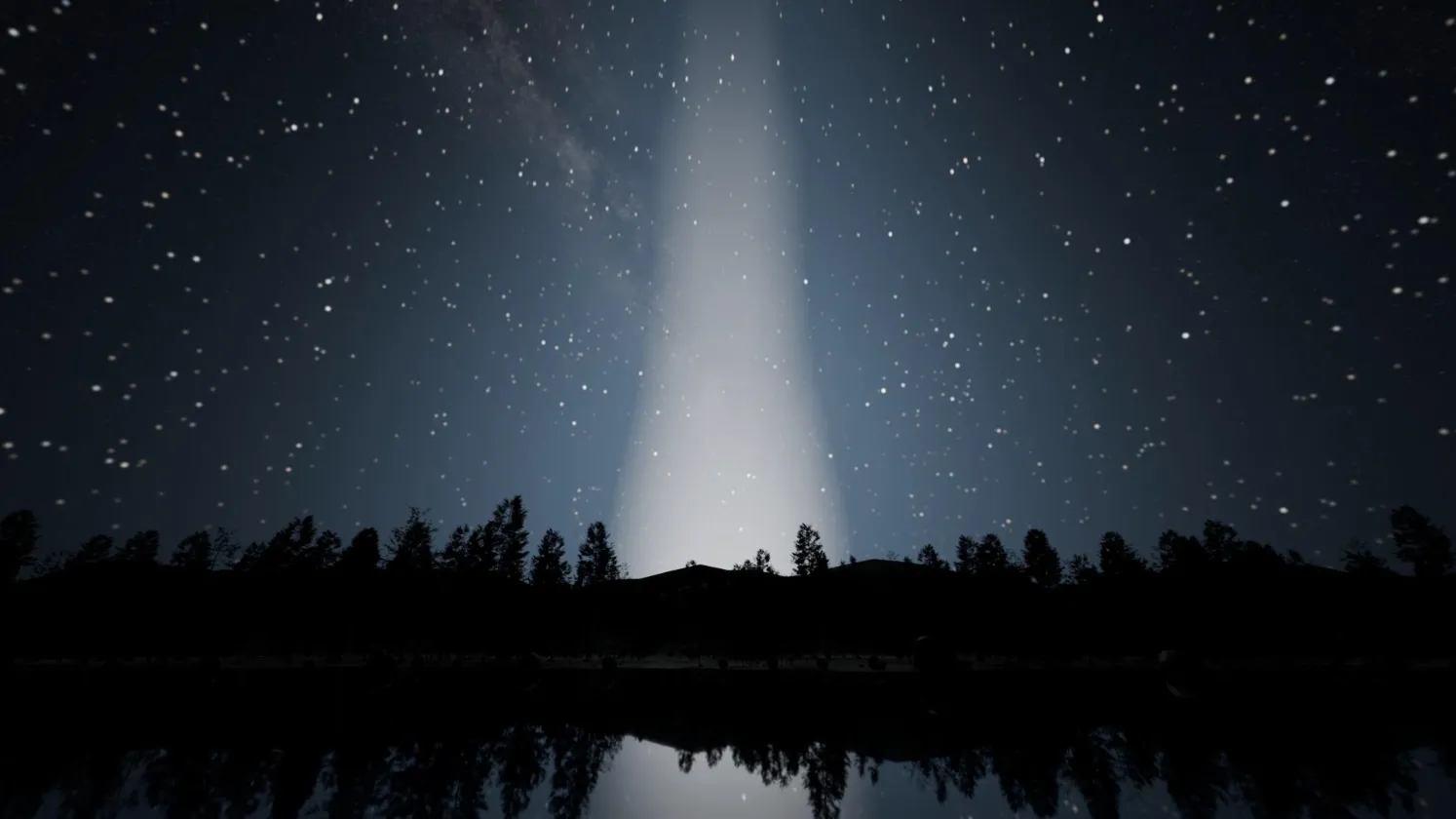
Outside the spot it gets more interesting. About a third of the luminous energy is removed on its way down (for the optical depth of 0.4 we assumed), scattered by air molecules and aerosol particles or absorbed by the aerosol. Then the illuminated ground reflects a fraction of what reaches it back into the atmosphere (20 percent for a typical landscape, 80 percent for fresh snow), and that light scatters as well. From a distance the beam therefore appears as a bright pillar of light above the horizon, with broad side lobes, about ±45° in azimuth, and a diffuse glow over much of the rest of the sky. We found that for an observer 14 km from the centre of the spot, nearly the whole sky, everything except the horizon on the opposite side, is brighter than under a full Moon. For an observer at 34 km the pillar itself is still brighter than the full-Moon sky. And for the case of 400 mirrors pointed at one spot (about the number needed to bring the illumination up to the level at which solar panels start to operate), the glow is still clearly visible from 80 km.
The full Moon gives about 0.25 lux on the ground, while 10 lux is the kind of illumination you have under street lighting. One mirror gives 10 lux over about 20 square kilometres, and unlike a town of that size it does not light only the streets, it lights the meadows and the roofs and the forest at the same level. Moonlight everybody knows from experience. One mirror makes the sky brighter than a full Moon does within a circle of 14 km radius on normal ground, and up to 30 km on snow. With the difference that moonlight comes on a predictable schedule, and sets.
Until now there were only order-of-magnitude estimates. One might expect a beam directed downward from orbit to scatter much less than the light from street lamps, which emit sideways and upward. Physically there is no basis for that. A photon coming down passes the same molecules and the same aerosol particles as a photon going up, and the probability of being scattered depends on the optical thickness of the air mass it crosses, not on the direction it came from. We solved the full three-dimensional radiative transfer problem for this geometry.
The results depend on the aerosol optical depth, the aerosol type and the ground albedo, so we ran the calculation for two aerosol types and three ground albedos. An aerosol optical depth of 0.3, which we used as the baseline, is typical for many regions of the world. In the direction of the beam, changing the ground albedo changes the mirror-to-Moon luminance ratio by less than 10 percent out to 20 or 30 km. We also assumed a cloudless sky, which is the most favourable case.
Ongoing thread. More from Miroslav Kocifaj to follow.
Curator: Bora Pajo
What one mirror in orbit does to the night sky
Kocifaj, M., Bakos, G. Á., & Kundracik, F. (2026). Atmospheric light pollution by proposed Reflect Orbital space mirrors. The Astrophysical Journal Letters, 1008, L25. https://doi.org/10.3847/2041-8213/ae9551
Available here →November 17, 2026
20261117-kocifaj-what-one-mirror-in-orbit-does-to-the-night-sky-in-a-nutshell
In a nutshell
The rest of this thread
Miroslav Kocifaj
Miroslav Kocifaj, PhD, DSc, is a senior scientist at the Slovak Academy of Sciences and at the Faculty of Mathematics, Physics and Informatics of Comenius University in Bratislava, and Editor-in-Chief of the Journal of Quantitative Spectroscopy and Radiative Transfer. He studied optics and received his PhD in astronomy from Comenius University. His work concerns light scattering by small particles, radiative transfer in the atmosphere and the modelling of night-sky brightness produced by artificial light. He received the Galileo Award of DarkSky International in 2024 and is the author of more than two hundred peer-reviewed papers.
Pull this thread
One orbital sunlight mirror would make the night sky brighter than a full moon for tens of kilometres around.
More in Research
More in Books
Know something the rest of us don't?
Most threads on Rorotoko begin with our invitation. Any thread can begin with a proposal: you write it with the same prompts every thread answers, and we review it.
Propose a thread →