
Ben Green
Algorithmic Realism: Data Science Practices to Promote Social Justice
In practice, though, these tools mostly fail to deliver on their promises.
Algorithmic Realism is about how to build algorithms and AI in the public interest.
Over the last decade, we have been surrounded by claims that data-driven technologies are going to transform the world for the better. Smart cities! Big data! AI! In practice, though, these tools mostly fail to deliver on their promises. In many cases, they make social conditions worse. Think about facial recognition tools that increase surveillance, algorithms that incorrectly kick people off of benefits, and AI tools that decrease student learning.
My book confronts this gap between promises and realities to answer the question: How can data scientists develop tools that actually improve society?
The central contribution of Algorithmic Realism is providing a methodology that guides data scientists in leveraging their skills in service of social justice. The methodology—“algorithmic realism”—directs data scientists to focus on the real-world impacts of algorithms. Its central premise is that “the ultimate test of an algorithm’s attributes is the impacts it generates in practice.”
This principle may sound straightforward, but following through on it requires a fundamental transformation of data science. That’s because the default practice in data science is to focus on mathematical properties of algorithms. For as much as data scientists are motivated by improving society, very little of their training and work connects meaningfully to social impacts.
To help data scientists put algorithmic realism into practice, I provide a detailed workflow that covers the entire lifecycle of a data science project, from identifying a real-world problem to implementing, evaluating, and eventually retiring an algorithm. Through step-by-step guidance, I hope to empower data scientists with practical strategies for applying their technical expertise in service of social justice.
Looking beyond its practical details, Algorithmic Realism offers a distinct positive outlook on the future of algorithms and AI. I’m deeply critical of Big Tech and its reckless behavior. But that doesn’t mean we have to abandon all hope for technology. Instead, it means we need to alter how technology gets developed. We can’t let tech companies scare us into thinking that the choice is between “innovation” and “no innovation.” Instead, the choice is about what type of innovation we want to support.
My book provides a roadmap for technology production guided by the public interest rather than shareholders and investors. We can have technology that prevents low-income renters from being harassed by their landlords, increases enrollment in social services, and empowers social movements fighting back against surveillance. But to get there, we need to change who develops technology, and what practices they follow.
Ongoing thread. More from Ben Green to follow.
Curator: Bora Pajo
The rest of this thread
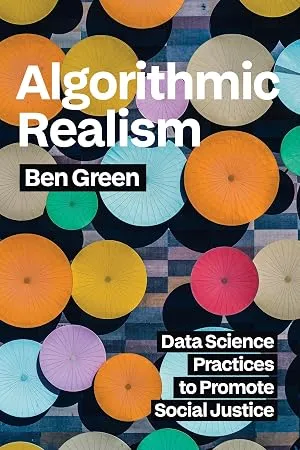
Algorithmic Realism: Data Science Practices to Promote Social Justice
Green, B. (2026). Algorithmic realism: Data science practices to promote social justice. MIT Press.
Available here →November 23, 2026
20261123-green-algorithmic-realism-in-a-nutshell
In a nutshell

Ben Green
Ben Green is an Assistant Professor of Information and Public Policy at the University of Michigan and a Faculty Associate at the Berkman Klein Center for Internet & Society at Harvard. Through his research, writing, and advocacy, Ben contributes practical lessons for achieving a world in which AI improves society rather than exacerbating inequality and oppression. He is the author of two books from the MIT Press: Algorithmic Realism: Data Science Practices to Promote Social Justice (2026) and The Smart Enough City: Putting Technology in Its Place to Reclaim Our Urban Future (2019).
More in Books
Know something the rest of us don't?
Most threads on Rorotoko begin with our invitation. Any thread can begin with a proposal: you write it with the same prompts every thread answers, and we review it.
Propose a thread →