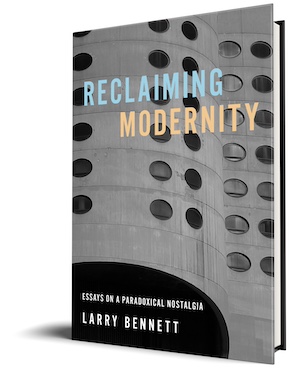
Larry Bennett Reclaiming Modernity: Essays on a Paradoxical Nostalgia University of Illinois Press 200 pages 6 x 9 pages, ISBN: 978-0252046407
In a nutshell
Reclaiming Modernity explores a pervasive but largely unexamined mental attitude, Americans’ fond recollection of the not-so-distant past, and elements of material culture associated with that near past. I call this mental attitude nostalgia for modernity.
The core of Reclaiming Modernity is its three chapters discussing the historical preservation of modernist buildings, resident recollections of what I characterize as “two lost cities,” early to mid-20th century Brooklyn and Detroit, and the late 20th century revivals of two pieces of mid-20th century audio equipment, the phonographic turntable and the 33&1/3 rpm “LP.” My previous writing has focused on the evolution of 20th and 21st-century cities, and in each of these chapters, urban modernity is a key part of the analysis. These chapters are also keyed to three notions of modernity: “artistic modernity” and 20th-century architecture, “cosmopolitan modernity,” 20th-century urbanites’ sense of cities and the pleasures of urban life, and “existential modernity,” the individual’s “use” of popular culture as a means of personal expression.
As many of Rorotoko’s audience surely recognize, nostalgia is an extremely fraught subject, frequently typified as a pointlessly romantic yearning for a past, better world, a world that, in the view of many observers, never existed. Modernity is also a contested topic, though in this case, I think there is more of a debate between proponents and critics. Modernity’s proponents emphasize the social benefits that have come from advances in science and technology, the virtues of liberal democracy, and the liberating aspects of modernity’s privileging of individual autonomy. The critics of modernity have long focused on its presumed spiritual emptiness and the stultifying effects of big government and giant corporations. These longstanding objections to modernity have been joined by a more recent claim that colonialism and global inequality were intrinsic to the rise of modernity.
Reclaiming Modernity is empirically grounded, giving particular attention to the recent debate in Chicago over whether to preserve or raze a notable “Brutalist” structure, Prentice Women’s Hospital, tracing the remembrances of past Brooklynites and Detroiters, and explaining the unanticipated “comebacks” of the turntable and LP. My takeaway from these explorations is that there are indeed elements of modernity well worth saving and using as normative guides to future social discourse and collective action. These are modernity’s commitment to social progress, universalism, and individual development.

The Bertrand Goldberg designed Prentice Women's Hospital, Shortly Before Its Demolition

The wide angle
As I recount in the Preface to Reclaiming Modernity, while conducting research in Sheffield, England, in the early 1990s, I encountered what I at first took to be a linguistic confusion. This was an inclination among local political figures and some neighborhood activists to describe the local Labour government’s inner city redevelopment efforts as “bringing socialism to Sheffield.” Over time, it seemed to me that what the high-rise neighborhoods encircling central Sheffield had achieved was a modernization, a modernization accompanied by a grab bag of positive and negative consequences: antagonistic planning processes that bred distrust of municipal leadership; larger, better-appointed dwellings; ultimately, reduced streetlife.
Later that decade and into the 2000s, I spent much time in Chicago public housing developments—exemplars, if you will, of mid-century modernism “on the cheap”—and which at the time were being demolished in favor of low-rise “mixed income” residential communities. This experience extended my reflections on modernist architecture (both its pros and cons), which became the seed of this volume when Northwestern Memorial Hospital proposed to demolish one of Chicago’s most distinctive modernist buildings, Prentice Women’s Hospital. I was particularly fascinated by the debate between hospital officials advocating demolition and preservation advocates. Those preservationists were not necessarily nostalgists, but they did articulate substantial and persuasive appreciations of a seemingly receding modernity. In writing Reclaiming Modernity I have expanded on those appreciations by interrogating other examples of looking back favorably on “things modern.”
In framing my approach to the preservation of “not old” buildings, the often fond recollections of lost modern cities, and the revival of seemingly obsolete music reproduction equipment, I have been especially inspired by three scholars, Marshall Berman, Raymond Williams, and Theodor Adorno. Berman’s All That is Solid Melts into Air is a powerful expression of modernity’s promise (as well as its deficiencies). Decades ago, I spent a few days in Berman’s company, an experience that fundamentally shaped my approach to the study of cities. In The Country and the City, Raymond Williams examines the relationship in English literature between urban centers and the rural world, in so doing discovering a distinctly nostalgic tendency to describe a withering of virtuous “rurality” (and the rise of debased urbanism) “in just the preceding years.” The irony of this trope, according to Williams, is that, generation by generation, it had been reproduced from the time of Ben Jonson to H.G. Wells. In a sense, Reclaiming Modernity turns Williams on his head by examining nostalgia for the passing of a certain kind of (modern) city.
Finally, I will mention Theodor Adorno, the great German polymath who was both a foe of modernity and whose life can be construed as an exemplar of modernity. A critic of industrial capitalism and the 20th-century “culture industry,” and also a fierce advocate of the second Viennese School modernist composers Arnold Schoenberg, Alban Berg, and Anton Webern, I weave pieces of Adorno’s life story and writings into my account of popular music’s ambiguous place in modern society.
A close-up
Like any proud author, my expectation is that the browsing prospective reader might find delight by turning to virtually any page in my book. However, I will limit myself to highlighting two sections of Chapter 2 in Reclaiming Modernity.
From pages 36 to 41, I discuss the movement in modern architecture known as Brutalism, an approach to building that has long stirred controversy. Proponents of Brutalism’s roughly (some would say “crudely”) sculpted, irregular profiles view buildings such as the mid-century city halls of Boston and Toronto as visionary monuments engaging with the complexities of the contemporary world and employing both innovative technologies and newly available materials. Critics point to many Brutalist structures as overscaled and dehumanizing, breaking with longstanding conventions of public architecture for no particular reason other than their architects’ elevated hubris. And in the United States, certainly, the coincidence of Brutalism’s heyday in the 1960s and 1970s with the high-water mark of the Urban Renewal program has further damaged the reputation of Brutalism. In many U.S. cities, the demolition of Victorian era commercial areas, and their replacement by denser and typically modernist architectural groupings—again, I note the Government Center complex in Boston—has often encountered widespread public disapproval. Not all of these “new downtowns” were Brutalist in design, but enough have been to create a popular notion of unnecessary destruction linked to menacing new construction.
Let me jump ahead several pages and past the centerpiece of Chapter 2, which is the debate over the future of Chicago architect Bertrand Goldberg’s uncompromisingly Brutalist Prentice Women’s Hospital. I wrap up this analysis (at pp. 49-50) with the following:
Once more, the distinction between disruptive and benign modernism is worth noting. The former, traceable to the anti-bourgeois stance of nineteenth-century artists such as Baudelaire and Flaubert, has represented a drive to overturn the comfortable assumptions of a rising, culturally dominant middle class. In subsequent decades, this strain of modernity—typically understood as an imperative ‘to shock,’ to attack oppressive social convention—has often aimed at a broader and more amorphous target, society…
In contrast, benign modernism seizes on emergent social trends—in some cases, new social practices such as women moving into the workforce, often technology-derived innovations—and incorporates these trends and devices into a vision of social progress. The particular irony exposed by the debate over Bertrand Goldberg’s design of Prentice Women’s Hospital—and for that matter, by the many controversies involving Brutalist structures—is this strain of design innovation’s merging of disruptive and benign modernism.
Reclaiming Modernity is not a brief on behalf of modernity. It is an exercise in understanding modernity’s impact on the contemporary world and how its defining features continue to attract many of us. Throughout my book, I seek to examine modernity in a careful and multi-faceted way, specifying modernity’s virtues as well as its normative deficiencies and wrong-headed (if well-intentioned) dead ends.
Lastly
This query first leads me to think about the audience for Reclaiming Modernity, as well as my approach as a writer. University press books are widely viewed as esoteric works that may well engage with important subjects, but whose content is not likely to appeal to a wide range of readers.
In this book and in my previous writing, I have sought to break out of that box. To draw on the contents of Reclaiming Modernity, I can attest that there is a huge popular literature—personal memoirs, oral history collections, even realist fiction—that engages with the passing of the great American industrial metropolises of the 20th century. In Chapter Three of this book, I have tapped into that body of writing to describe a fundamental contrast between the “experiences” of 20th-century Brooklyn and Detroit. My point is not to determine which of these places might have been a “better city,” so defined by former residents, but rather to test the notion that urban modernity has been an experience that has varied substantially from place to place. My interpretations of that base literature, the literature of urban recollection, are aimed at communicating with a variety of readers—perhaps students in a class on urban history, local residents (with a taste for history) of either Detroit or New York City, academic experts looking for new perspectives on Detroit or Brooklyn, readers with a broader interest in the evolution of American popular culture—and in my writing I strive to offer straightforwardly comprehensible commentary.
As I respond to this query in late 2025, I am unavoidably mindful of the United States’ toxic political scene, a proximate source of concern that amplifies my disquiet over presumably larger-scale human challenges, notably global climate change. Among many of the critics of the current presidential administration, there is a sense of helplessness, that there are no arguments that seem to counter the rush to the abyss of the policy drivers in Washington, that there are no available, popular policies that either correct the political decay of American democracy or improve the day-to-day performance of our institutions.
I began working on Reclaiming Modernity years before the main contours of the current American crisis were evident. This book is not a response to the current crisis or even, in any conventional sense, a brief for efficacious policies. And yet as I completed my writing, I recognized that there was an encouraging implication of my retrieving and reexamining some of the fundamentals of modernity. In detailing how a range of people have interpreted modernity in a general sense or through the lens of their day-to-day lives, one can discern a set of principles—social progress, universalism, individual development—that are not arcane, and which are also strong building blocks on which to shape actual, widely beneficial collective action. This is the takeaway that I trust some portion of the readers of Reclaiming Modernity will recognize.
.jpg)