
Larry Bennett
Reclaiming Modernity
As I recount in the Preface to Reclaiming Modernity, while conducting research in Sheffield, England, in the early 1990s, I encountered what I at first took to be a linguistic confusion. This was an inclination among local political figures and some neighborhood activists to describe the local Labour government’s inner city redevelopment efforts as “bringing socialism to Sheffield.” Over time, it seemed to me that what the high-rise neighborhoods encircling central Sheffield had achieved was a modernization, a modernization accompanied by a grab bag of positive and negative consequences: antagonistic planning processes that bred distrust of municipal leadership; larger, better-appointed dwellings; ultimately, reduced streetlife. Later that decade and into the 2000s, I spent much time in Chicago public housing developments—exemplars, if you will, of mid-century modernism “on the cheap”—and which at the time were being demolished in favor of low-rise “mixed income” residential communities. This experience extended my reflections on modernist architecture (both its pros and cons), which became the seed of this volume when Northwestern Memorial Hospital proposed to demolish one of Chicago’s most distinctive modernist buildings, Prentice Women’s Hospital. I was particularly fascinated by the debate between hospital officials advocating demolition and preservation advocates. Those preservationists were not necessarily nostalgists, but they did articulate substantial and persuasive appreciations of a seemingly receding modernity. In writing Reclaiming Modernity I have expanded on those appreciations by interrogating other examples of looking back favorably on “things modern.”
In framing my approach to the preservation of “not old” buildings, the often fond recollections of lost modern cities, and the revival of seemingly obsolete music reproduction equipment, I have been especially inspired by three scholars, Marshall Berman, Raymond Williams, and Theodor Adorno. Berman’s All That is Solid Melts into Air is a powerful expression of modernity’s promise (as well as its deficiencies). Decades ago, I spent a few days in Berman’s company, an experience that fundamentally shaped my approach to the study of cities. In The Country and the City, Raymond Williams examines the relationship in English literature between urban centers and the rural world, in so doing discovering a distinctly nostalgic tendency to describe a withering of virtuous “rurality” (and the rise of debased urbanism) “in just the preceding years.” The irony of this trope, according to Williams, is that, generation by generation, it had been reproduced from the time of Ben Jonson to H.G. Wells. In a sense, Reclaiming Modernity turns Williams on his head by examining nostalgia for the passing of a certain kind of (modern) city.
Finally, I will mention Theodor Adorno, the great German polymath who was both a foe of modernity and whose life can be construed as an exemplar of modernity. A critic of industrial capitalism and the 20th-century “culture industry,” and also a fierce advocate of the second Viennese School modernist composers Arnold Schoenberg, Alban Berg, and Anton Webern, I weave pieces of Adorno’s life story and writings into my account of popular music’s ambiguous place in modern society.

The Bertrand Goldberg designed Prentice Women's Hospital, Shortly Before Its Demolition
Curator: Rachel Althof
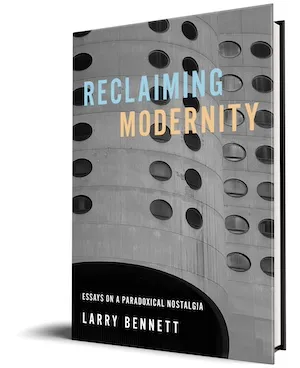
Reclaiming Modernity
Larry Bennett Reclaiming Modernity: Essays on a Paradoxical Nostalgia University of Illinois Press 200 pages 6 x 9 pages, ISBN: 978-0252046407
Available here →December 8, 2025
20251208-bennett-larry-on-reclaiming-modernity-essays-paradoxical-nostalgia-2
The wide angle
The rest of this thread

Larry Bennett
Professor Emeritus of Political Science at DePaul University, Larry Bennett earned his bachelor’s and doctoral degrees at the College of William and Mary and Rutgers University, respectively. Professor Bennett’s books include The Third City: Chicago and American Urbanism (U. of Chicago Press) and Neighborhood Politics: Chicago and Sheffield (Routledge). He has served as interim Executive Director and Chair of the Board of Directors for North Branch Works, a neighborhood economic development advocacy group in Chicago. Since 2007 Professor Bennett has co-edited Temple University Press’s Urban Life, Landscape, and Policy series. In 2026 the MIT Press will publish Unwinding Privatization: Cities and the Restoration of Public Power, which Professor Bennett has co-edited with Alba Alexander, Evan McKenzie, and Michael Pagano.
Pull this thread
Americans' fond recollection of the recent modern past is a defensible appraisal of things actually lost.
Know something the rest of us don't?
Most threads on Rorotoko begin with our invitation. Any thread can begin with a proposal: you write it with the same prompts every thread answers, and we review it.
Propose a thread →