
Larry Bennett
Reclaiming Modernity
Reclaiming Modernity explores a pervasive but largely unexamined mental attitude, Americans’ fond recollection of the not-so-distant past, and elements of material culture associated with that near past. I call this mental attitude nostalgia for modernity.
The core of Reclaiming Modernity is its three chapters discussing the historical preservation of modernist buildings, resident recollections of what I characterize as “two lost cities,” early to mid-20th century Brooklyn and Detroit, and the late 20th century revivals of two pieces of mid-20th century audio equipment, the phonographic turntable and the 33&1/3 rpm “LP.” My previous writing has focused on the evolution of 20th and 21st-century cities, and in each of these chapters, urban modernity is a key part of the analysis. These chapters are also keyed to three notions of modernity: “artistic modernity” and 20th-century architecture, “cosmopolitan modernity,” 20th-century urbanites’ sense of cities and the pleasures of urban life, and “existential modernity,” the individual’s “use” of popular culture as a means of personal expression.
As many of Rorotoko’s audience surely recognize, nostalgia is an extremely fraught subject, frequently typified as a pointlessly romantic yearning for a past, better world, a world that, in the view of many observers, never existed. Modernity is also a contested topic, though in this case, I think there is more of a debate between proponents and critics. Modernity’s proponents emphasize the social benefits that have come from advances in science and technology, the virtues of liberal democracy, and the liberating aspects of modernity’s privileging of individual autonomy. The critics of modernity have long focused on its presumed spiritual emptiness and the stultifying effects of big government and giant corporations. These longstanding objections to modernity have been joined by a more recent claim that colonialism and global inequality were intrinsic to the rise of modernity.
Reclaiming Modernity is empirically grounded, giving particular attention to the recent debate in Chicago over whether to preserve or raze a notable “Brutalist” structure, Prentice Women’s Hospital, tracing the remembrances of past Brooklynites and Detroiters, and explaining the unanticipated “comebacks” of the turntable and LP. My takeaway from these explorations is that there are indeed elements of modernity well worth saving and using as normative guides to future social discourse and collective action. These are modernity’s commitment to social progress, universalism, and individual development.

The Bertrand Goldberg designed Prentice Women's Hospital, Shortly Before Its Demolition
Curator: Rachel Althof
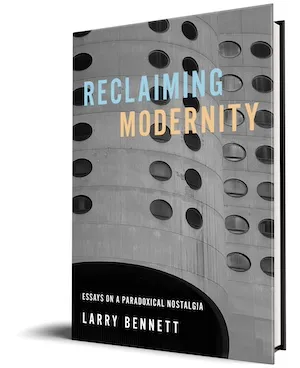
Reclaiming Modernity
Larry Bennett Reclaiming Modernity: Essays on a Paradoxical Nostalgia University of Illinois Press 200 pages 6 x 9 pages, ISBN: 978-0252046407
Available here →December 8, 2025
20251208-bennett-larry-on-reclaiming-modernity-essays-paradoxical-nostalgia-1-1
In a nutshell
The rest of this thread

Larry Bennett
Professor Emeritus of Political Science at DePaul University, Larry Bennett earned his bachelor’s and doctoral degrees at the College of William and Mary and Rutgers University, respectively. Professor Bennett’s books include The Third City: Chicago and American Urbanism (U. of Chicago Press) and Neighborhood Politics: Chicago and Sheffield (Routledge). He has served as interim Executive Director and Chair of the Board of Directors for North Branch Works, a neighborhood economic development advocacy group in Chicago. Since 2007 Professor Bennett has co-edited Temple University Press’s Urban Life, Landscape, and Policy series. In 2026 the MIT Press will publish Unwinding Privatization: Cities and the Restoration of Public Power, which Professor Bennett has co-edited with Alba Alexander, Evan McKenzie, and Michael Pagano.
Pull this thread
Americans' fond recollection of the recent modern past is a defensible appraisal of things actually lost.
Know something the rest of us don't?
Most threads on Rorotoko begin with our invitation. Any thread can begin with a proposal: you write it with the same prompts every thread answers, and we review it.
Propose a thread →