
Larry Bennett
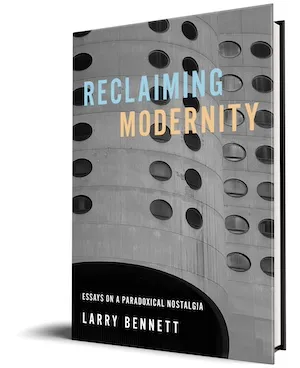
Reclaiming Modernity
Like any proud author, my expectation is that the browsing prospective reader might find delight by turning to virtually any page in my book. However, I will limit myself to highlighting two sections of Chapter 2 in Reclaiming Modernity.
From pages 36 to 41, I discuss the movement in modern architecture known as Brutalism, an approach to building that has long stirred controversy. Proponents of Brutalism’s roughly (some would say “crudely”) sculpted, irregular profiles view buildings such as the mid-century city halls of Boston and Toronto as visionary monuments engaging with the complexities of the contemporary world and employing both innovative technologies and newly available materials. Critics point to many Brutalist structures as overscaled and dehumanizing, breaking with longstanding conventions of public architecture for no particular reason other than their architects’ elevated hubris. And in the United States, certainly, the coincidence of Brutalism’s heyday in the 1960s and 1970s with the high-water mark of the Urban Renewal program has further damaged the reputation of Brutalism. In many U.S. cities, the demolition of Victorian era commercial areas, and their replacement by denser and typically modernist architectural groupings—again, I note the Government Center complex in Boston—has often encountered widespread public disapproval. Not all of these “new downtowns” were Brutalist in design, but enough have been to create a popular notion of unnecessary destruction linked to menacing new construction.
Let me jump ahead several pages and past the centerpiece of Chapter 2, which is the debate over the future of Chicago architect Bertrand Goldberg’s uncompromisingly Brutalist Prentice Women’s Hospital. I wrap up this analysis (at pp. 49-50) with the following:Once more, the distinction between disruptive and benign modernism is worth noting. The former, traceable to the anti-bourgeois stance of nineteenth-century artists such as Baudelaire and Flaubert, has represented a drive to overturn the comfortable assumptions of a rising, culturally dominant middle class. In subsequent decades, this strain of modernity—typically understood as an imperative ‘to shock,’ to attack oppressive social convention—has often aimed at a broader and more amorphous target, society…In contrast, benign modernism seizes on emergent social trends—in some cases, new social practices such as women moving into the workforce, often technology-derived innovations—and incorporates these trends and devices into a vision of social progress. The particular irony exposed by the debate over Bertrand Goldberg’s design of Prentice Women’s Hospital—and for that matter, by the many controversies involving Brutalist structures—is this strain of design innovation’s merging of disruptive and benign modernism. Reclaiming Modernity is not a brief on behalf of modernity. It is an exercise in understanding modernity’s impact on the contemporary world and how its defining features continue to attract many of us. Throughout my book, I seek to examine modernity in a careful and multi-faceted way, specifying modernity’s virtues as well as its normative deficiencies and wrong-headed (if well-intentioned) dead ends.
This query first leads me to think about the audience for Reclaiming Modernity, as well as my approach as a writer. University press books are widely viewed as esoteric works that may well engage with important subjects, but whose content is not likely to appeal to a wide range of readers.
In this book and in my previous writing, I have sought to break out of that box. To draw on the contents of Reclaiming Modernity, I can attest that there is a huge popular literature—personal memoirs, oral history collections, even realist fiction—that engages with the passing of the great American industrial metropolises of the 20th century. In Chapter Three of this book, I have tapped into that body of writing to describe a fundamental contrast between the “experiences” of 20th-century Brooklyn and Detroit. My point is not to determine which of these places might have been a “better city,” so defined by former residents, but rather to test the notion that urban modernity has been an experience that has varied substantially from place to place. My interpretations of that base literature, the literature of urban recollection, are aimed at communicating with a variety of readers—perhaps students in a class on urban history, local residents (with a taste for history) of either Detroit or New York City, academic experts looking for new perspectives on Detroit or Brooklyn, readers with a broader interest in the evolution of American popular culture—and in my writing I strive to offer straightforwardly comprehensible commentary. As I respond to this query in late 2025, I am unavoidably mindful of the United States’ toxic political scene, a proximate source of concern that amplifies my disquiet over presumably larger-scale human challenges, notably global climate change. Among many of the critics of the current presidential administration, there is a sense of helplessness, that there are no arguments that seem to counter the rush to the abyss of the policy drivers in Washington, that there are no available, popular policies that either correct the political decay of American democracy or improve the day-to-day performance of our institutions.
I began working on Reclaiming Modernity years before the main contours of the current American crisis were evident. This book is not a response to the current crisis or even, in any conventional sense, a brief for efficacious policies. And yet as I completed my writing, I recognized that there was an encouraging implication of my retrieving and reexamining some of the fundamentals of modernity. In detailing how a range of people have interpreted modernity in a general sense or through the lens of their day-to-day lives, one can discern a set of principles—social progress, universalism, individual development—that are not arcane, and which are also strong building blocks on which to shape actual, widely beneficial collective action. This is the takeaway that I trust some portion of the readers of Reclaiming Modernity will recognize.

The Bertrand Goldberg designed Prentice Women's Hospital, Shortly Before Its Demolition
Curator: Rachel Althof
Reclaiming Modernity
Larry Bennett Reclaiming Modernity: Essays on a Paradoxical Nostalgia University of Illinois Press 200 pages 6 x 9 pages, ISBN: 978-0252046407
Available here →December 8, 2025
20251208-bennett-larry-on-reclaiming-modernity-essays-paradoxical-nostalgia-3
A close-up
The rest of this thread

Larry Bennett
Professor Emeritus of Political Science at DePaul University, Larry Bennett earned his bachelor’s and doctoral degrees at the College of William and Mary and Rutgers University, respectively. Professor Bennett’s books include The Third City: Chicago and American Urbanism (U. of Chicago Press) and Neighborhood Politics: Chicago and Sheffield (Routledge). He has served as interim Executive Director and Chair of the Board of Directors for North Branch Works, a neighborhood economic development advocacy group in Chicago. Since 2007 Professor Bennett has co-edited Temple University Press’s Urban Life, Landscape, and Policy series. In 2026 the MIT Press will publish Unwinding Privatization: Cities and the Restoration of Public Power, which Professor Bennett has co-edited with Alba Alexander, Evan McKenzie, and Michael Pagano.
Pull this thread
Americans' fond recollection of the recent modern past is a defensible appraisal of things actually lost.
Know something the rest of us don't?
Most threads on Rorotoko begin with our invitation. Any thread can begin with a proposal: you write it with the same prompts every thread answers, and we review it.
Propose a thread →