
Tyler Volk
CO2 Rising
When you go to a doctor and the doctor gives you information about your body, the doctor makes a crucial assumption: Even though you are not a medical expert you do know the basics about how your body’s organs work. The heart pumps blood, the lungs pump air, the brain thinks, the liver filters. But I have found that few possess the equivalent level of understanding about the “organs” of the planetary physiology and the globe-connecting metabolic pathways that go in and out, to and fro, among the oceans, soils, air, and all living things.
Perhaps what gives CO2 within the carbon cycle the power to serve a great entry point into a systems view of global warming and issues about the human future is the simple fact that carbon is material. Carbon can be made tangible to the mind as it moves among the organs of the biosphere. Our bodies are made of carbon. So are the trees. Carbon is in the ocean and used by the myriads of tiny green plankton. Carbon is definitely the “heart” of biological molecules, such as carbohydrates, fats, proteins, and DNA.
I have found that when people learn about the fascinating global web of the carbon cycle and then see how huge has been the human-induced change in the atmosphere’s CO2, then related issues become much more salient and easier to get across: how the greenhouse effect works, why sea level will rise, why summer crops might dry out, why ecosystems will have to be managed to make the transition to a new climate, and why we need to re-think our energy systems as the global economy develops at 3 percent per year via what I call the global industrial growth automaton, for short, GIGA.In offering this book, I wear two hats. The first is that of a scientist.
The second is that of motivated writer. In addition to my work over several decades as researcher and educator, I am also a person dismayed that technological society has become addicted to the fossil fuel drugs. It is highly likely that the GIGA will keep on its seemingly inexorable path, sending the CO2 higher and higher until climate change reaches future stages that are unacceptable and virtually irreversible.
There is only one atmosphere, and we all, more or less, contribute to its chemical state. I try and let the facts about the conditions speak for themselves. I try to avoid any temptation for hysterics or distortions. The facts themselves lead me to conclude that we do have time to make the changes, but that they will be difficult because of the scales involved. Almost counter-intuitively, quite different but still reasonable possibilities for emissions make relatively small differences in atmospheric CO2 by 2050. The technological momentum inherent in each of those possibilities, however, make huge differences in the decades after that. Overall, we have not yet provided ourselves with enough options.
But there is also room for celebration, because the carbon cycle is one of the wonders of the universe, as worthy of careful exposition for the general public as any of the discoveries of astrophysics or brain science. One of my goals is to make the carbon cycle as real as your eating and breathing.
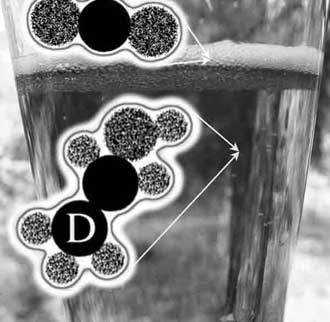
The carbon atom “Dave” (marked “D”) in a molecule of alcohol in a glass of beer. Also shown is a CO2 molecule in the bubbles near the top.
Editor: Erind Pajo
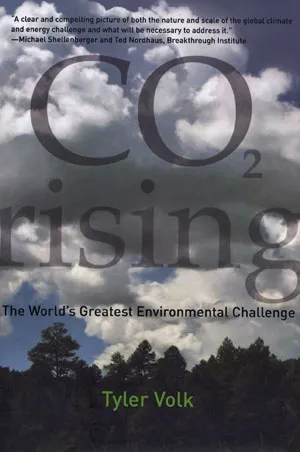
CO2 Rising
Tyler Volk CO2 Rising: The World’s Greatest Environmental Challenge MIT Press 264 pages, 5 3/8 x 8 inches ISBN: 978 0 262 22083 5
Available here →December 2, 2008
20081205-volk-tyler-co2-rising-world-greatest-environmental-challenge-2
The wide angle
The rest of this thread
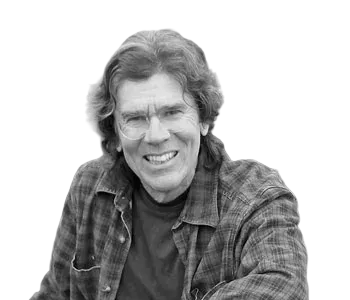
Tyler Volk
Tyler Volk is Professor of Biology and Environmental Studies at New York University. His research involves the global carbon cycle, world energy, the role of life and evolution in the biosphere, and general systems studies. His newest book is Quarks to Culture: How We Came to Be, featured in his recent Rorotoko interview. Recipient of the NYU All-University Distinguished Teaching Award, Volk lectures and travels widely, communicates his ideas in a variety of media, plays lead guitar for the science-inspired rock band The Amygdaloids, and is an avid outdoorsman. Volk’s previous books include CO2 Rising: The World’s Greatest Environmental Challenge, featured in his earlier Rorotoko interview; Metapatterns Across Space, Time, and Mind; and Gaia’s Body: Toward a Physiology of Earth. As to an overarching theme across all these books, he might say, “systems and their mysterious ways, deeply relevant for human life.”
Pull this thread
Emission paths differ little in atmospheric CO2 by 2050 and enormously after.
Know something the rest of us don't?
Most threads on Rorotoko begin with our invitation. Any thread can begin with a proposal: you write it with the same prompts every thread answers, and we review it.
Propose a thread →