
A close-up
May 14, 2026
The Apothecary’s Wife
For the Best Viper Wine. Take a cask of wine. Drop in at least a dozen live vipers. Put the lid on the cask. After a few weeks, it is ready. Dip in a glass and drink it straight off, or if you are more dainty, strain the wine to remove the undissolved bits of skin and bone and then drink it. It is an excellent cure for tremors. And paralysis. Also low vitality, leprosy, and bad skin.
When I first learned that Sir Kenelm Digby (1603-65) gave his wife, Venetia (1600-1633) a daily glass of viper wine, I was as startled as Sir Kenelm’s biographers. Their explanations ranged from “She asked for it because she was afraid that she would lose her beauty” to “He poisoned her because he didn’t want any other man to pursue her.” These explanations sounded more fanciful than credible to me. Furthermore, I came across the story while writing about seventeenth- and eighteenth-century medication. I already knew that some standard treatments sounded preposterous to modern ears (mercury, anyone?). What if I looked at the story of Sir Kenelm and Lady Venetia from the point of view of medicine?
My research revealed that viper wine was not only a common but also popular medication in the seventeenth century. It had been used to treat tremors, paralysis, skin trouble, leprosy, and “low animal spirits” since ancient Greece. Further research established that Sir Kenelm was considered one of the best brewers of it. Everyone asked him for his viper wine recipe. There was nothing surprising, in other words, about Sir Kenelm giving his wife a daily glass of viper wine. On the contrary. Was it poisonous? (See above, mercury). No, as it happens. There is only one poisonous snake in England, the common European viper, and its bite is very rarely fatal (when it bites at all; it prefers to flee). Viper wine might not cure leprosy, but it wouldn’t kill, either.
The story of viper wine exemplifies The Apothecary’s Wife’s argument and purpose. It shows what happens when we think independently, challenge the accepted narrative, and research an explanation for ourselves. It shows that the archive often offers authentic voices that give us an explanation unmediated by the expectations and assumptions of traditional historians. It shows that medical history is inextricably entwined with social history, and that history depends as much on words as on events. It also shows that binaries – women made medicine at home, men made medicine in the shops – do not describe life as it is lived by real people. Convenient? Yes. Accurate? No.
My project has always been to debunk myths and replace them with researched accounts. In The Apothecary’s Wife, I challenge the fable of the Rise of Science, reveal the role of conscious decision-making in creating the dysfunctional twenty-first-century medical system, reject simplistic oppositions as characterizations of human behavior, and provide a researched account that opens up the future to change and innovation.
Curator: Bora Pajo
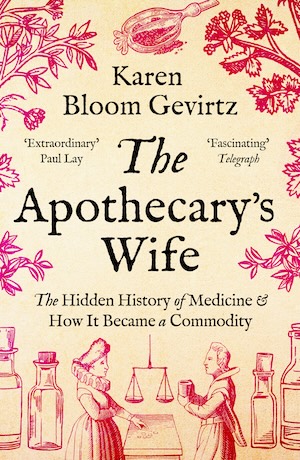
The Apothecary’s Wife
Gevirtz, Karen Bloom. The Apothecary’s Wife: The Hidden History of Medicine and How It Became a Commodity. Head of Zeus/University of California Press, 2025. ISBN 978-0520409910
Get the book →May 14, 2026
20260514-karen-bloom-gevirtz-the-apothecarys-wife
The rest of this thread

Karen Bloom Gevirtz
After nearly thirty years as professor of English, Gender Studies, and Medical Humanities, Karen Bloom Gevirtz left academia and became an independent scholar. She received her BA from Brown University, where she was pre-med and assisted in a neurochemistry lab, and her PhD from Emory University. Internationally recognized for her scholarship on women and writing in seventeenth- and eighteenth-century Britain, she has been awarded grants and fellowships for her at home and abroad. The Apothecary’s Wife was long listed for the inaugural Procedure Award, and is one of Kirkus Review’s Best Nonfiction Books of 2024.
Feature your book, your art, your project
Publishing with a small press, or on your own?
A Sponsored Thread runs like every other thread on Rorotoko: three parts on three dates, the same editorial review, your own pages in the archive. Marked Sponsored. $199, paid only once accepted.
Get featured →