
Yosef Grodzinsky
How Deeply Human Is Language?
As a student, I read a popular history of medicine The Body in Question by English opera director Jonathan Miller, who was a physician by training. I was struck not only by the smoothness of his reflective prose, but also by the recurrent idea that every epoch uses its top contemporary technology as its metaphor for the understanding of ourselves. I will never forget his description of how William Harvey, King Charles I's physician, discovered the principle of the blood's circulation through the body, which could not be made without an understanding of the mechanics of pumps. I am often reminded of Miller's vivid prose when I see how easily people are convinced that our brain is a computer. To an extent, I share this belief, though in a manner that is not as concrete as some others. The computer metaphor permeates our lives for good reasons, but we need to be mindful of how we harness it to enhance our thoughts, and beware of hurdles and pitfalls along the path. This is what I've been trying to do, and I truly hope that the specifics of my view will be apparent to each and every reader.
I do not know who my readers will be, but when I was writing, I was hoping to reach a broad spectrum of readers: people interested in philosophy, science, and technology, curious readers who have heard about modern linguistics and about Noam Chomsky but have never understood what the fuss was about; engineering students who have taken or plan to take a course in natural language processing; linguists who fear that their discipline may soon be erased off the academic map; neurologists and neurosurgeons who have seen the wonders of the talking brain, as well as speech and language therapists who try to fix it when it fails; engineers and developers who may have followed some of the debates on X (formerly Twitter), YouTube, and other media, and want to build better language bots; and, of course, my academic colleagues from all relevant disciplines.
There's something here for everyone, I hope. Enjoy!
Curator: Bora Pajo
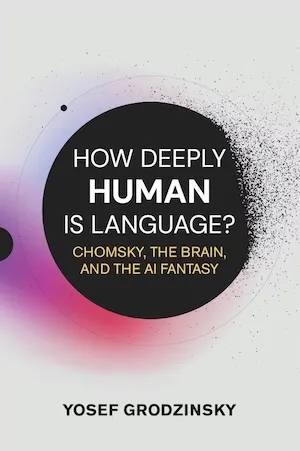
How Deeply Human Is Language?
Grodzinsky, Y. (2026). How deeply human is language? Chomsky, the brain, and the AI fantasy. MIT Press.
Available here →July 15, 2026
20260713-grodzinsky-how-deeply-human-is-language-a-close-up
A close-up
The rest of this thread

Yosef Grodzinsky
Yosef Grodzinsky is currently Director of the Neurolinguistics Lab at the Edmond and Lily Safra Center for Brain Sciences, and a professor emeritus at the Hebrew University of Jerusalem. He is also a scientific associate at the Institute for Neuroscience and Medicine, Forschungszentrum Jülich, and the Cécile and Oskar Vogt Institute for Brain Research, University Hospital Düsseldorf, and a Senior Overseas Visiting Scholar in Shanghai Jiao Tong University. He is a recipient of an Alexander von Humboldt Award, and a Senior Canada Research Chair in Neurolinguistics, which he held at the Departments of Linguistics and Neurology/Neurosurgery at McGill University.
Pull this thread
pulls againstpulls alongside
The neurological record arbitrates the LLM-versus-linguistics fight, and it supports a modular brain with partly innate language.
Nearby EZ · A suit like Iron Man's could only work wired directly into the user's brain and spinal cord.
Nearby VH · What companion AI takes away is friction, and the capacity to bear it for someone else decays when unused.
Nearby OA · In Silicon Valley the star is the system, and attention to big names and products makes it invisible.
Nearby PA · Every past sudden advance in code has humanized work rather than mechanized it, and this one will too.
Nearby JB · Accident proneness died because engineers moved safety from sorting people to redesigning environments.
Know something the rest of us don't?
Most threads on Rorotoko begin with our invitation. Any thread can begin with a proposal: you write it with the same prompts every thread answers, and we read it.
Propose a thread →