
Beryl Satter
Cash on the Block
Cash on the Block shows what goes wrong when we try to solve a problem without understanding its cause. The problem I focus on is the impoverishment of Black urban neighborhoods in the mid-to-late twentieth century. These neighborhoods had been damaged by specific, quantifiable, institutionally racist practices. Racial segregation barred Black Americans from booming, newly constructed suburbs. Banks refused to lend in the older, urban neighborhoods where African Americans were allowed to reside. Housing speculators and loan sharks exploited the resulting credit vacuum, forcing Black homebuyers to pay exorbitant prices for aging housing. Family savings that could have been reinvested in family and community were instead siphoned off by predatory lenders. Employers were lured by tax incentives to abandon Black urban neighborhoods and set up shop in the suburbs. The federal government spent billions on new highways that served suburbs, while slashing funding for urban public transport. And city governments cut spending on schools, parks, libraries, transportation, garbage collection, and other critical community infrastructure as soon as neighborhoods became majority Black.
To improve these communities, we should have addressed the causes of their decline. We needed enforceable laws to stop real estate professionals from “steering” Black buyers and renters away from white neighborhoods, and banks from refusing loans to creditworthy Black borrowers. This could have undercut the conditions supporting predatory lenders, whose dollar damage to Black communities has yet to be quantified nationally. (A 2019 Duke University study found that between 1950 and 1970 in the city of Chicago alone, predatory housing speculators drained approximately $3.5 billion from Black residents.) We could have stopped giving tax breaks to businesses for moving to the suburbs. We could have improved public transportation in all city neighborhoods. While Black urban neighborhoods deserve extra federal and municipal spending to make up for decades of discriminatory treatment, even a fair distribution of current municipal spending could have improved their schools, parks, libraries, and other services and amenities.
My book shows that logical steps of this sort were rarely attempted. Instead, private and governmental policies attempted to foster reinvestment in Black urban neighborhoods indirectly, by channeling government funds to outside lenders and businesses. Economist Michael Zweig labeled this the “ghetto as conduit” strategy, because it used the existence of racially segregated and disinvested (or “ghetto”) neighborhoods as an excuse to funnel money from taxpayers to elites. A well-known example is the “enterprise zone,” where state or federal governments provide tax breaks to businesses that open in disinvested areas. Businesses have repeatedly exploited such programs to extract payments from governments while providing, at best, insecure, unsafe, and low-wage jobs to neighborhood residents. Even more damaging were government programs that offered 100% Federal Housing Administration (FHA) insurance to financiers who loaned in such communities. Lenders promptly corrupted these programs. They made inflated, high interest, predatory FHA loans to community residents. When residents fell behind on their exorbitant monthly payments, lenders happily collected the full loan amount from the federal government. Such programs enriched outside businesses and financiers, but damaged the communities they were supposedly created to serve.
Curator: Bora Pajo
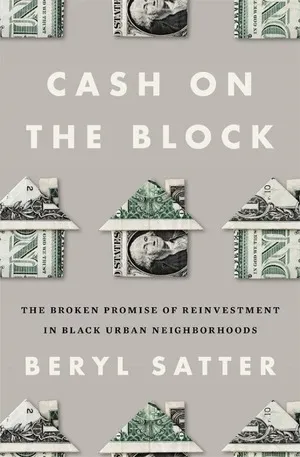
Cash on the Block
Satter, B. (2026). Cash on the block: The broken promise of reinvestment in Black urban neighborhoods. Harvard University Press.
Available here →October 20, 2026
20261020-satter-cash-on-the-block-in-a-nutshell
In a nutshell
The rest of this thread

© Kate Levy
Beryl Satter
Beryl Satter is Professor Emerita of History, Rutgers University-Newark. She received a Guggenheim Memorial Fellowship and an Andrew Carnegie Fellowship to work on Cash on the Block: The Broken Promise of Reinvestment in Black Urban Neighborhoods (Harvard University Press, 2026). Her book Family Properties: Race, Real Estate, and the Exploitation of Black Urban America (Metropolitan Books, 2009), won the Liberty Legacy Award for best book in civil rights history and the National Jewish Book Award in History. It was named one of the top ten books of the year by the New York Times and the Washington Post.
Pull this thread
Sending money to the rich to help poor Black neighborhoods has never worked.
Know something the rest of us don't?
Most threads on Rorotoko begin with our invitation. Any thread can begin with a proposal: you write it with the same prompts every thread answers, and we review it.
Propose a thread →