
Beryl Satter
Cash on the Block
Cash on the Block builds upon my previous book, Family Properties: Race, Real Estate, and the Exploitation of Black Urban America. There, I showed how real estate and finance professionals extracted capital from mid-twentieth-century Black urban neighborhoods. This led me to wonder about late twentieth century plans to reinvest capital or resources back into such communities. I found that while many reinvestment plans claimed to revive struggling Black urban neighborhoods, most failed to do so. Instead, they channeled government funds to wealthy outside interests.
Sending money to the rich to help the poor has never worked. Yet business and governmental programs repeatedly pursue this approach, in part because they believe that African Americans – especially poor ones -- are corrupt and incompetent. They embrace hoary racist tropes as truth, and make them the basis of public policy. They also believe that wealthy people can always be trusted to behave honestly and altruistically. Cash on the Block shows the price we have paid for such false beliefs.
My book also details an alternative approach, which has provided far stronger results; policy shaped by the residents of disinvested communities. My analysis of effective reinvestment plans was guided by the insights of mid-century Black intellectuals – specifically, Martin Luther King Jr.’s 1967 Where Do We Go from Here: Chaos or Community? and Stokely Carmichael and Charles V. Hamilton’s 1967 Black Power: The Politics of Liberation in America. These intellectuals agreed on three points. First, plans to revive Black urban neighborhoods must be based on an understanding of what caused their decay. Second, reinvestment plans should be largely shaped by residents of disinvested communities. A corollary was that community organizing is crucial. Third, reinvestment plans must reject centuries-old tropes about African Americans’ intrinsic incompetence or corruption. Those that didn’t were guaranteed to fail, because instead of addressing the causes of neighborhood decline, they simply blamed the victims.
Cash on the Block shows how top-down reinvestment schemes systematically inverted these insights. Instead of acknowledging anti-Black racism, they deployed it. Instead of crafting programs to address real problems, they supported predatory lending schemes, and blamed the victims when they failed. Instead of using government power to fight fraud and discrimination, they ensured that anti-discrimination laws were toothless. Instead of supporting community organizers, they marginalized or demonized them.
I also uncover a five-decade history of community organizations that centered real issues and rejected racist tropes. Neighborhood activists, many of whom were working-class women, understood the true causes of neighborhood decline: discriminatory governmental policies and exploitative financial institutions. To challenge such policies and institutions, they embraced community organizing. They rejected racist tropes and instead united across racial divides to challenge predatory finance and real estate practices. They stood firm, despite ongoing attacks from real estate and finance interests and from right-wing politicians. Cash on the Block revives their political vision in the hopes of providing a foundation for neighborhood revitalization that centers neighborhood residents. It is a vision with relevance for all institutionally marginalized communities, including those damaged by economic obsolescence.
Curator: Bora Pajo
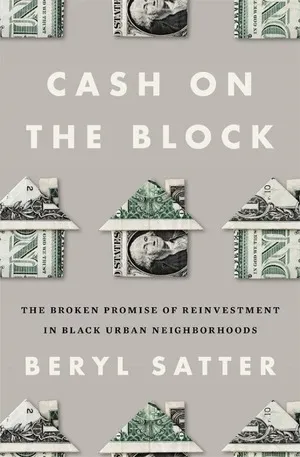
Cash on the Block
Satter, B. (2026). Cash on the block: The broken promise of reinvestment in Black urban neighborhoods. Harvard University Press.
Available here →October 20, 2026
20261020-satter-cash-on-the-block-the-wide-angle
The wide angle
The rest of this thread

© Kate Levy
Beryl Satter
Beryl Satter is Professor Emerita of History, Rutgers University-Newark. She received a Guggenheim Memorial Fellowship and an Andrew Carnegie Fellowship to work on Cash on the Block: The Broken Promise of Reinvestment in Black Urban Neighborhoods (Harvard University Press, 2026). Her book Family Properties: Race, Real Estate, and the Exploitation of Black Urban America (Metropolitan Books, 2009), won the Liberty Legacy Award for best book in civil rights history and the National Jewish Book Award in History. It was named one of the top ten books of the year by the New York Times and the Washington Post.
Pull this thread
Reinvestment in Black urban neighborhoods failed because it routed public money through outside lenders and never let residents shape it.
Know something the rest of us don't?
Most threads on Rorotoko begin with our invitation. Any thread can begin with a proposal: you write it with the same prompts every thread answers, and we review it.
Propose a thread →