
Peter L. Falkingham
T. rex takes a walk
Four footprints finally give an adult Tyrannosaurus rex a walking pace.
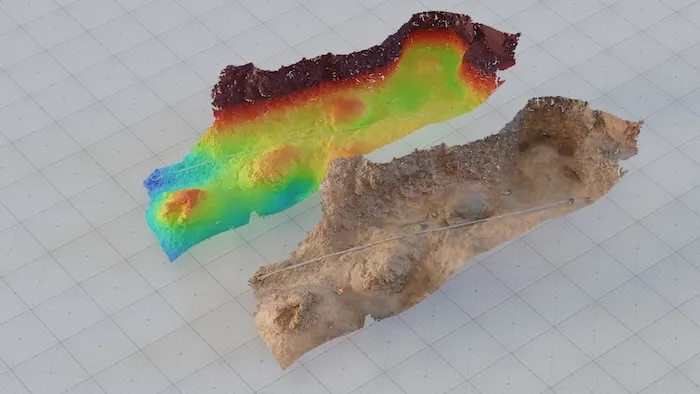
Footprints offer a glimpse of a living animal, moving and interacting with its environment. Bones are left behind by a dead animal. If we're honest, these tracks don't tell us a whole lot that we didn't already know – we know T. rex could walk on land. The tracks don't record running, or any unusual behaviour – it is just a sequence of four steps. But it's still pretty incredible to know that an adult T. rex walked in exactly that place, and how long its steps were, and that it placed its feet one in front of the other in quite a narrow line.
We infer it's an adult T. rex mostly through a process of elimination: the tracks are huge — among the largest three-toed tracks known. The only animal in the right place at the right time with feet that size is adult T.rex; we can date it to 66.5 million years ago, from magnetic reversals recorded in nearby rocks. T. rex bones are abundant at this locality; several partial skeletons come out of the same Badlands. Hadrosaurs, plant-eating dinosaurs, also made big three-toed tracks, but their toe impressions are broad and blunt, and their feet tend to be wider than long, so we can rule them out.
We can get a rough idea of speed from a combination of foot length and stride length, and in this case it's about 4 mph, a brisk walk for a human. That doesn't mean T. rex couldn't move faster, just that in this case, it was taking a leisurely stroll. A seven-tonne animal ambling along at walking pace is what physics predicts, but prediction is not observation; four footprints are the observation.
Ongoing thread. More from Peter L. Falkingham to follow.
Curator: Bora Pajo
T. rex takes a walk
Falkingham, P. L., Hups, K. M., Tamez-Galvan, E. M., Bercovici, A. D., & Lyson, T. R. (2026). A large tridactyl trackway from the Upper Cretaceous Hell Creek Formation of North Dakota, likely attributable to an adult Tyrannosaurus rex. Journal of Vertebrate Paleontology, e2706201. https://doi.org/10.1080/02724634.2026.2706201
Available here →November 14, 2026
20261114-falkingham-t-rex-takes-a-walk-in-a-nutshell
In a nutshell
The rest of this thread

Peter L. Falkingham
Peter Falkingham is Professor of Palaeobiology at Liverpool John Moores University, UK. He studies how tracks form, what they preserve, and what they can honestly be asked to tell us about extinct animals, particularly dinosaurs. His group combines experiments with live birds, robotics, and physics-based computer simulations of grains of sand to reconstruct how dinosaurs moved. He leads the UKRI-funded TRACKEVOL project and has spent two decades arguing that footprints are not feet. You can find out more about his work at http://peterfalkingham.com
Pull this thread
Four footprints show an adult T. rex walking at about four miles an hour with its feet in a narrow line.
More in Research
More in Books
Know something the rest of us don't?
Most threads on Rorotoko begin with our invitation. Any thread can begin with a proposal: you write it with the same prompts every thread answers, and we review it.
Propose a thread →