Hugo C. Ikehara-Tsukayama
Fernando “Huanchaco” Gutiérrez: Checán Stereo
Peruvian artist Fernando “Huanchaco” Gutiérrez aims to relate to ancient objects with something radical: love.
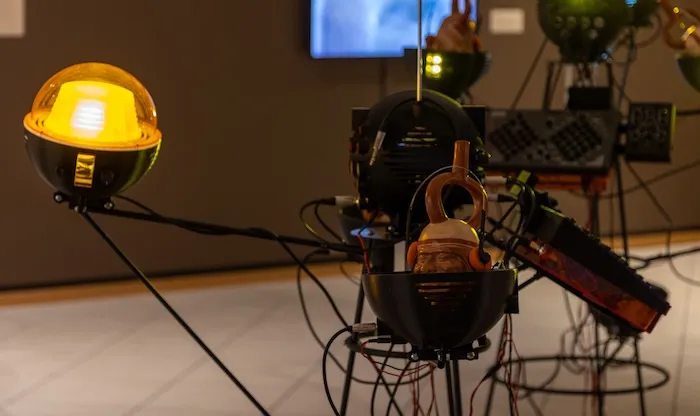
Image courtesy of the Johnson Museum of Art. © David O. Brown.
Peruvian artist Fernando “Huanchaco” Gutiérrez aims to relate to ancient objects with something radical: love.
What if some ceramic sculptures made by Indigenous artists from the Ancient Andes were seen as alive?
This thought motivated Fernando “Huanchaco” Gutiérrez, a contemporary visual artist from Peru, to create his installation “Checán Stereo.” Specifically, he was thinking of the so-called “Moche portrait heads” from Peru's North Coast, a place where his family comes from and where he spent part of his childhood.
These Moche portrait heads are naturalistically rendered ceramic heads crafted by the ancient Moche, a civilization that flourished in the coastal valleys of northern Peru more than a thousand years ago. Most Moche head sculptures in museum collections in Peru and abroad were obtained under unrecorded circumstances. Also, no oral or written records explain how they were used, and artists of this era did not sign their works. Thus, no primary sources can tell us what they were.
Much of what we know about these ceramic heads comes from archaeological and art-historical research. However, in their scholarly practice, they exercise a power relation with the object of study, much like what 20th-century anthropological research on people has often been criticized for. These ceramic heads are given names/labels, dates, and interpretations. Imagine how you would feel if you were one of these ceramic beings.
In this installation, “Checán Stereo,” the artist proposed something different. Let’s relate to these ancient objects in a more horizontal way, with respect and love. It sounds simple, but given how these items are often displayed and treated, it is a radical take.
“Huanchaco” starts simply: let’s talk to these ceramic sculptures the way one would treat a loved relative, with a salute. A good morning, a good afternoon, is always welcome, especially in one’s mother tongue. To do this, the artist brings back 20th-century recordings of Muchik, an extinct Indigenous Language from the Peruvian North Coast, likely a descendant of the original language spoken by some Moche communities. These are not conversations, but just a few dozen words and phrases spoken by the last person who knew how to pronounce them, Simón Quesquén. These recordings were made in 1974 by historian Américo Herrera, who was, curiously, “Huanchaco”’s first cousin once removed.
In “Checán Stereo,” the artist uses technology to relate to ancient Moche heads. However, instead of using a tablet or another consumer-ready device, “Huanchaco” took the complex (and complicated) task of designing machines. These machines, shaped like towers that hold reproductions of ceramic heads while playing back the Muchik words, are not just passive devices. They were conceived for the artist--but also other users--to play, distort, and overlap the words. The similarity between the “Checán Stereo” and an analog DJ mixer is not accidental; it reflects an artist who sees the technology as an interactive medium for relating to the ceramic heads.
The first impression of the exhibition at the Johnson Museum of Art is that it tries to explain who the Moche were and how the artist appropriates these ancient objects. However, by observing how the machine functions and how the artworks are arranged in the gallery, it should be clear that the sounds, images, and space were not designed for the public, but for the objects: modern reproductions in the machines, ancient originals in a nearby display. The public are just witnesses to the artist’s ultimate goal: to reconnect these ancient ceramic heads with their mother tongue and with views of the North Coast landscape, to wake them up and restore their ancestral memory. And, in a more familiar, warm space, for these ancient objects/people to feel they are being treated with love.
Ongoing thread. More from Hugo C. Ikehara-Tsukayama to follow.
Curator: Bora Pajo
The rest of this thread
Fernando “Huanchaco” Gutiérrez: Checán Stereo
Available here →November 24, 2026
20261124-ikehara-tsukayama-fernando-huanchaco-gutierrez-in-a-nutshell
In a nutshell

Hugo C. Ikehara-Tsukayama
Hugo C. Ikehara-Tsukayama is the Harris Family Curator of the Arts of the Americas at the Herbert F. Johnson Museum of Art, Cornell University. He holds a Ph.D. in anthropological archaeology from the University of Pittsburgh. Previously, he was an assistant professor of Anthropology at the Pontificia Universidad Católica de Chile and a member of the curatorial team for the Arts of the Ancient Americas in the renovation of the Michael C. Rockefeller Wing at The Metropolitan Museum of Art in New York.
More in Arts
More in Books
Know something the rest of us don't?
Most threads on Rorotoko begin with our invitation. Any thread can begin with a proposal: you write it with the same prompts every thread answers, and we review it.
Propose a thread →