
Jonathan Earle
He Has the People: Abraham Lincoln and the Election of 1860
One of my favorite quotations about history (often misattributed to Mark Twain) is "history doesn't repeat itself, but it often rhymes." We find ourselves yet again at the moment where we face critical elections in the United States and across the world, in the midst of serious crises. The election of 1860 took place as the nation was literally tearing itself apart over the issue of slavery. Then, as now, national institutions people took for granted proved to be less resilient than had been thought. Yet in this time of peak sectional crisis, Americans made their decisions, went to the polls, and elected the nation's first antislavery president. In response – before Lincoln even took the oath of office! – seven states seceded from the union rather than remain in a United States governed by a President Lincoln. Now, we're not facing the same type of geographical, sectional forces that our 19th century predecessors did, but it certainly feels like we're struggling as a polity to agree on the terms of our democracy, and whether to reform the way we participate politically.
These questions and concerns led me to a project that can be both a readable narrative from our past but also a way to highlight parts of American (and even global) history that seem to echo from 1860.
Ongoing thread. More from Jonathan Earle to follow.
Curator: Bora Pajo
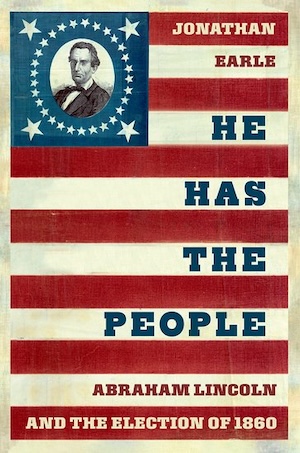
He Has the People: Abraham Lincoln and the Election of 1860
Earle, J. (2026). He Has the People: Abraham Lincoln and the election of 1860. Oxford University Press.
Get the book →August 19, 2026
20260819-earle-he-has-the-people-the-wide-angle
The wide angle
The rest of this thread

Jonathan Earle
Jonathan Earle is the Donald Cecil Delaune Professor and Dean of the Roger Hadfield Ogden Honors College at Louisiana State University, where he is also a professor of History and African & African American Studies. He is the author of Jacksonian Antislavery and the Politics of Free Soil, which won the James Broussard First Book Prize from the Society of Historians of the Early American Republic; John Brown's Raid: A Brief History with Documents; and editor (with Diane Mutti Burke) of Bleeding Kansas, Bleeding Missouri: The Long Civil War on the Border. He lives in Baton Rouge and New Orleans. www.abrahamlincoln1860.com
Know something the rest of us don't?
Most threads on Rorotoko begin with our invitation. Some begin with a proposal. Both use the same prompts and the same editing, with your own pages in the archive. Proposed threads carry a small Sponsored label and a fee.
Propose a thread →