
Jonathan Earle
He Has the People: Abraham Lincoln and the Election of 1860
Before he received the nomination of the Republican Party in 1860 Abraham Lincoln's political resume was astonishingly thin: he was a one-term Congressman who hadn't held elective office in more than a decade and wasn't even renominated by the Whig Party to stand for reelection! Yet he and his team ran a brilliant campaign for the nomination culminating in his selection on the third ballot at the national convention in Chicago over a long list of better-known contenders. Inside the "Wigwam," a convention space purposely erected for the Republicans' meeting, the feeling was electric as Ohio's delegation switched their votes to Lincoln:
'Fire the salute!' shouted one of the secretaries relaying the events inside the building to the large outdoor crowd, 'Abe Lincoln is nominated!' The feeling both inside and outside the Wigwam was electric, with bands playing, processions marching, and the news of a surprise nominee spreading in all directions. Delegates spilled out of the building hoarse and exhausted. 'There were men who had not tasted liquor who staggered about like drunkards,' reported the journalist Murat Halstead, 'unable to manage themselves.' One Lincoln man, who could hardly believe his political hero had secured the nomination and still harbored a grudge against presumed frontrunner William H. Seward and his well-heeled machine, joined a boisterous crowd for dinner at the nearby Tremont Hotel. 'Talk of your money and bring on your bullies with you!' he hollered to no one in particular. 'Abe Lincoln has no money and no bullies, but he has the people by ___!'
I hope the story of the election of 1860 strikes readers as essential for understanding our political present, which is still wrought (though hopefully not as dire as then), as well as a fascinating tale from the political past. And in an age where there is talk of an "end of reading" I very much welcome readers looking for absorbing and interesting narrative nonfiction to discover the critical canvass of 1860.
Curator: Bora Pajo
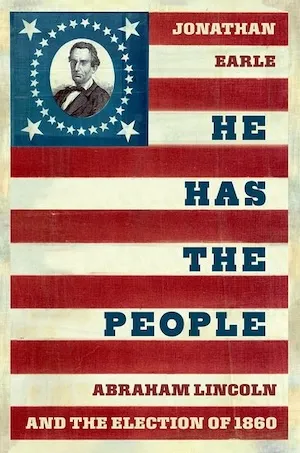
He Has the People: Abraham Lincoln and the Election of 1860
Earle, J. (2026). He Has the People: Abraham Lincoln and the election of 1860. Oxford University Press.
Available here →August 31, 2026
20260831-earle-he-has-the-people-a-close-up
A close-up
The rest of this thread

Jonathan Earle
Jonathan Earle is the Donald Cecil Delaune Professor and Dean of the Roger Hadfield Ogden Honors College at Louisiana State University, where he is also a professor of History and African & African American Studies. He is the author of Jacksonian Antislavery and the Politics of Free Soil, which won the James Broussard First Book Prize from the Society of Historians of the Early American Republic; John Brown's Raid: A Brief History with Documents; and editor (with Diane Mutti Burke) of Bleeding Kansas, Bleeding Missouri: The Long Civil War on the Border. He lives in Baton Rouge and New Orleans. www.abrahamlincoln1860.com
Pull this thread
pulls againstpulls alongside
Lincoln's rise was contingent, and the sense of its inevitability is an artifact of how 1860 is taught.
Against SB · Modern assassination is a state phenomenon, because the reaction of states is what gives political murder its charge. On: Large historical outcomes are contingent choices rather than the working-out of deep causes
Against EC · American houses were shaped by food, by dwellers rearranging space for storing, preserving, cooking and serving it. On: Historical meaning lies in exceptional events rather than in the texture of ordinary life
Against IH · Humans head toward ever more stuff because when things fail the fix is more things, and that cannot be reversed. On: Large historical outcomes are contingent choices rather than the working-out of deep causes
Against LB · Staying attached to what wears you out is the structure of optimism, not irrationality. On: Historical meaning lies in exceptional events rather than in the texture of ordinary life
Alongside JA · Capitalism is a culture, neither inevitable nor natural, so it takes a different shape in every country that adopts it. On: Large historical outcomes are contingent choices rather than the working-out of deep causes
Alongside WS · Every cause of the Great Divergence is downstream of one condition, that no empire like Rome ever returned to Europe. On: Historical meaning lies in exceptional events rather than in the texture of ordinary life
Alongside PW · The Thirty Years War was neither inevitable nor a religious conflict. On: Large historical outcomes are contingent choices rather than the working-out of deep causes
Alongside TS · The fourteen million murdered between Berlin and Moscow from 1933 to 1945 died in a single event. On: Historical meaning lies in exceptional events rather than in the texture of ordinary life
Know something the rest of us don't?
Most threads on Rorotoko begin with our invitation. Any thread can begin with a proposal: you write it with the same prompts every thread answers, and we review it.
Propose a thread →