
John E. McDonough
America's Wrong Turn: US Health Care in the Neoliberal Era
Following is the opening to Chapter 5: Maximizing Shareholder Value and the Financialization of US Medicine.
"The disposition to admire, and almost to worship, the rich and the powerful, or to despise, or, at least to neglect persons of poor and mean condition … is … the great and most universal cause of the corruption of our moral sentiments." Adam Smith (from The Theory of Moral Sentiments.)
In a New York Times Magazine op-ed, published on September 13, 1970, and titled "The Social Responsibility of Business Is to Increase Its Profits," economist Milton Friedman declared his core idea: "In a free enterprise, private property system, a corporate executive is an employee of the owners of the business. He has a direct responsibility to his employers. That responsibility is to conduct the business in accordance with their desires, which generally will be to make as much money as possible while conforming to the basic rules of the society, both those embodied in law and those embodied in ethical custom." So, does any sense of obligation to employees, customers, host communities, or the environment exist? In Friedman's view, it is all out the window. And what of businesses that dabble on the side in charitable or public interest philanthropy? Friedman answers, "This is one way for a corporation to generate good will as a biproduct of expenditures that are entirely justified in their own self-interest. It would be inconsistent for me to call on corporate executives to refrain from this hypocritical window dressing … If our institutions and the attitudes of the public make it in their self-interest to cloak their actions in this way, I cannot summon much indignation to denounce them."
To make his point even clearer, "The executive is an agent serving the interests of his principal, namely, the stockholders, or the shareholders." In familiar Friedman fashion, the choice is black or white, one or the other. Serve the shareholder only or shirk your obligation: "But the doctrine of 'social responsibility' taken seriously would extend the scope of the political mechanism to every human activity. It does not differ in philosophy from the most explicitly collectivist doctrine.'"
While nothing in Friedman's column was unprecedented, its publication at the dawn of the pivotal 1970s heralded a new cultural and political zeitgeist that aligned much of the baby boom generation growing into adulthood with hard-edged neoliberal/conservative/libertarian ideas and practices. Friedman elevated stock prices over corporate profits as a company's prime measure of success: shareholders over CEOs or board members and for-profit business over nonprofits and government, sending shockwaves that vibrate today.
Evidence of the Friedman article's impact and endurance was clear on September 13, 2020, when the Sunday New York Times included a special pullout section on "a landmark essay by Milton Friedman that changed the course of capitalism." The section reprinted his full original column, including commentaries from 22 corporate leaders, Nobel Prize laureates, and other notable thinkers.
The most curious set of reactions to Friedman and the movement he inspired came from The Business Roundtable (BRT), founded in 1972 as a new center of public policy activism by and for CEOs of major corporations. In 1981, BRT issued a "Statement on Corporate Responsibility" recognizing that "shareholders have a special relationship to the corporation … but the legitimate concerns of other constituencies must have the appropriate attention." In a notable turnaround, BRT's 1997 "Statement on Corporate Governance" noted, "The paramount duty of management and of boards of directors is to the corporation's stockholders." And on August 19, 2019, BRT released a "Statement on the Purpose of the Corporation," signed by 181 of their CEOs, outlining "a modern standard for corporate responsibility" that embraces "a fundamental commitment to all of our stakeholders," including customers, employees, communities, and shareholders."
Shareholders versus stakeholders: that was—and is—the public face of the debate that Friedman launched. In that era, celebrity CEOs such as General Electric's Jack Welch and Chrysler's Lee Iacocca were far more recognized and empowered. Shareholders had been largely unorganized and disregarded. All that changed over the course of the 1970s and 1980s. Large and powerful segments of American society came to embrace the premise that shareholders were—for the first time since the emergence of the modern corporation—the undisputed beneficiary of the corporation's activities, the only one to whom companies owed any obligations, formal or informal.
Curator: Bora Pajo
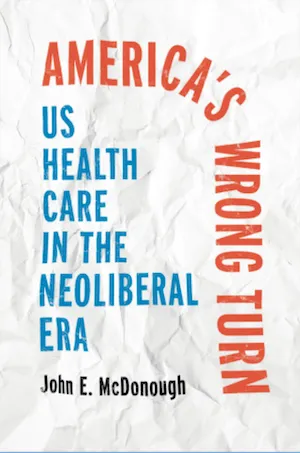
America's Wrong Turn: US Health Care in the Neoliberal Era
McDonough, J. E. (2026). America's wrong turn: US health care in the neoliberal era. Johns Hopkins University Press.
Available here →August 30, 2026
20260830-mcdonough-americas-wrong-turn-a-close-up
A close-up
The rest of this thread

John E. McDonough
John E McDonough is a professor of practice at the Harvard TH Chan School of Public Health. Between 2008 and 2010, he was Senior Advisor on National Health Reform in the U.S. Senate where he worked on creating the Affordable Care Act. Between 2003-2008, he was Executive Director of Health Care For All, Massachusetts' consumer health organization. From 1985 to 1997, he was a member of the Massachusetts House of Representatives. He holds a doctorate in public health from the University of Michigan and a master's in public administration from the Kennedy School at Harvard.
Pull this thread
pulls againstpulls alongside
American health care's separate dysfunctions have one cause, the neoliberal capture of political economy after 1980.
Against SB · Nazi imperialism was still imperialism, driven as much by fear of rival empires as by ambition. On: Fear and insecurity, rather than material deprivation, drive political reaction
Against IG · US empire is waning, and the security state is the phase in which it turns to war to stay superpower. On: Fear and insecurity, rather than material deprivation, drive political reaction
Alongside CJ · For unemployed educated young men in north India, waiting is a fertile condition that breeds friendships and protest. On: Fear and insecurity, rather than material deprivation, drive political reaction
Alongside DS · The broadest interracial solidarities in American history formed where organization was weakest, among migratory workers outside unions and parties. On: Fear and insecurity, rather than material deprivation, drive political reaction
Alongside SH · Independent truckers built, from the 1930s onward, the low-wage non-union distribution system that made the Wal-Mart economy possible. On: Fear and insecurity, rather than material deprivation, drive political reaction
Alongside FD · Poor Americans' patriotism is a reasoned sense of ownership, not stupidity or false consciousness. On: Fear and insecurity, rather than material deprivation, drive political reaction
Nearby DR · Between the mid-1970s and 2001 the words Americans used to grasp society broke into smaller pieces.
Know something the rest of us don't?
Most threads on Rorotoko begin with our invitation. Any thread can begin with a proposal: you write it with the same prompts every thread answers, and we read it.
Propose a thread →