
John E. McDonough
America's Wrong Turn: US Health Care in the Neoliberal Era
Many Americans have lost trust in our health and medical care systems with only 28% expressing "a great deal" or "quite a lot" of confidence, according to Gallup's most recent survey, down from 78% in 1975. Americans are angry about record level insurance premiums, sky high amounts of consumer cost sharing and medical debt, massive corporate consolidation, financial exploitation by private equity firms, gaping inequities in care, and much more.
While most Americans view these dysfunctions as distinct problems, they miss the essential reality that all these manifestations are tied to the politico-economic revolution called "neoliberalism" that captured American society in the early 1980s. At the time of President Ronald Reagan's first election in 1980, many commentators called his win "the end of the New Deal," that era of progressive reform that President Franklin Roosevelt launched in 1933. That 48-year era saw the creation of Social Security, Medicare, Medicaid and other essential programs that helped working- and lower-class Americans to survive.
The term "neoliberal" refers to aggressive and free-wheeling capitalism sometimes called "free market fundamentalism." Economist Milton Friedman was the most recognized promoter of the neoliberal movement. He famously wrote a New York Times OpEd in September 1970 titled: "A Friedman Doctrine‐- The Social Responsibility of Business Is to Increase Its Profits" declaring that business had no obligations to customers, workers, communities, and only to their stockholders. While the nickname for the 1970s was "the 'me' decade," the attribute for the 1980s was "the greed decade," a period of economic deregulation that expanded aggressively in subsequent decades.
Reinventing medical care was not a dominant preoccupation for neoliberals. But the broad power to rewrite the economy's rules could not leave US medical care untouched in its wake. In Reagan's first year, his Federal Trade Commission and Department of Justice guardians rewrote the nation's anti-trust guidelines to make it easier for large corporations to swallow up lesser competitors. Between 1980 and 2020, the sky was the limit for most corporate consolidation. Today, many economists regard corporate consolidation as the primary cause of our out-of-control medical spending.
Those wanting to understand why and how American health and medical care systems got so dysfunctional must understand the neoliberal movement and how it transformed so many of American society's economic and political fundamentals. I considered counter hypotheses to explain medical system dysfunction: managed care and health maintenance organizations, government regulation of Medicare payment, fraud and abuse, along with others. None can compare with neoliberalism's impact.
"If change is to be for the better," wrote the late and renowned economist Victor Fuchs, "it should be based on an understanding of why things are the way they are." Americans want solutions to disappearing trust in our health and medical care systems. My goal is to help them understand how we got to this place and to offer ways forward from here.
Curator: Bora Pajo
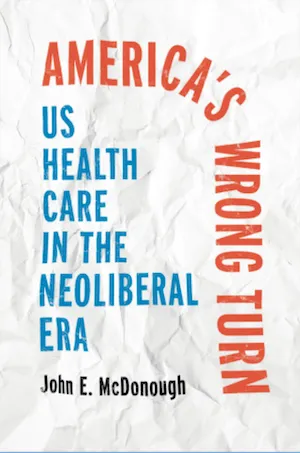
America's Wrong Turn: US Health Care in the Neoliberal Era
McDonough, J. E. (2026). America's wrong turn: US health care in the neoliberal era. Johns Hopkins University Press.
Available here →August 30, 2026
20260830-mcdonough-americas-wrong-turn-in-a-nutshell
In a nutshell
The rest of this thread

John E. McDonough
John E McDonough is a professor of practice at the Harvard TH Chan School of Public Health. Between 2008 and 2010, he was Senior Advisor on National Health Reform in the U.S. Senate where he worked on creating the Affordable Care Act. Between 2003-2008, he was Executive Director of Health Care For All, Massachusetts' consumer health organization. From 1985 to 1997, he was a member of the Massachusetts House of Representatives. He holds a doctorate in public health from the University of Michigan and a master's in public administration from the Kennedy School at Harvard.
Pull this thread
pulls againstpulls alongside
American health care's separate dysfunctions have one cause, the neoliberal capture of political economy after 1980.
Against SB · Nazi imperialism was still imperialism, driven as much by fear of rival empires as by ambition. On: Fear and insecurity, rather than material deprivation, drive political reaction
Against IG · US empire is waning, and the security state is the phase in which it turns to war to stay superpower. On: Fear and insecurity, rather than material deprivation, drive political reaction
Alongside CJ · For unemployed educated young men in north India, waiting is a fertile condition that breeds friendships and protest. On: Fear and insecurity, rather than material deprivation, drive political reaction
Alongside DS · The broadest interracial solidarities in American history formed where organization was weakest, among migratory workers outside unions and parties. On: Fear and insecurity, rather than material deprivation, drive political reaction
Alongside SH · Independent truckers built, from the 1930s onward, the low-wage non-union distribution system that made the Wal-Mart economy possible. On: Fear and insecurity, rather than material deprivation, drive political reaction
Alongside FD · Poor Americans' patriotism is a reasoned sense of ownership, not stupidity or false consciousness. On: Fear and insecurity, rather than material deprivation, drive political reaction
Nearby DR · Between the mid-1970s and 2001 the words Americans used to grasp society broke into smaller pieces.
Know something the rest of us don't?
Most threads on Rorotoko begin with our invitation. Any thread can begin with a proposal: you write it with the same prompts every thread answers, and we read it.
Propose a thread →