
John E. McDonough
America's Wrong Turn: US Health Care in the Neoliberal Era
After 20 years of working in federal and state governments, including 5 years in nonprofit advocacy, in 2011 I joined the faculty at the Harvard School of Public Health and began teaching Master of Public Health and other students about US and state health policy and politics. I often included updated versions of the chart below to offer perspective on the extreme differences in medical care spending between the US and some of our key global competitors. “What the heck happened in the early 1980s,” was the question I got asked more than any other. At the time, I had hypotheses and no clear answer. The question lingered in my head.
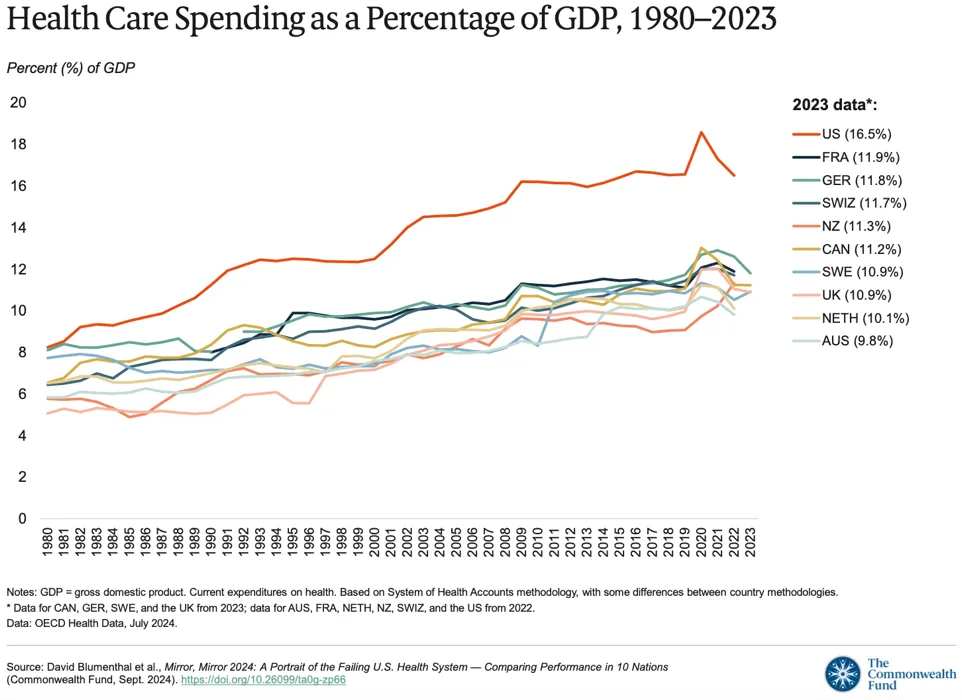
In 2018, health services research Austin Frakt wrote a New York Times op-ed titled: “Medical Mystery: Something Happened to US Health Spending after 1980.” Frakt interviewed about 20 experts and found many hypotheses with no definitive conclusion. There’s a book here, I saw. In May 2019, I learned about Yale Political Scientist Stephen Skowronek’s “regime” model of US politico-economic history that defines 5 successive multi-decade eras (initiative by Presidents Jefferson (1801-1828), Jackson (1829-1860), Lincoln (1861-1932), FDRoosevelt (1933-1980), and Reagan (1981-2020). Using Skowronek’s model, the structure to analyze US health policy and politics through the competing lenses of FDR’s New Deal and Reagan’s Neoliberal era fell into place.
I began intensive research and writing at the start of the COVID-19 epidemic in February 2020 hoping to finish in 2-3 years. Instead, I spent 5½ years before submitting my final manuscript to Johns Hopkins University Press. The volume of research on neoliberalism, US and global, was far more extensive than I had imagined, with new articles and books coming out daily. As I acquired a knowledge base of neoliberalism and the US health system, I became convinced that the answer to Austin Frakt’s query came from neoliberalism as practiced in the US.
Nonfiction book authors often worry that the relevance of and interest in their topics will wither and or disappear during the research and writing process. Though I held that concern, as my new book reaching its August 11 publication date, I only see Americans eager for explanations and solutions to our never-ending health and medical care crisis.
I dedicated this book to my students: past, present, and future. As emerging professionals planning to “save the world,” they want to understand the roots of our current dilemmas. They want to know how our situation can turn around. I like a quote from President Harry Truman: “There is nothing new in the world except the history you do not know.” I want to help Americans understand the deeper levels of our health and medical system dilemmas so that they can become meaningful change agents.
Curator: Bora Pajo
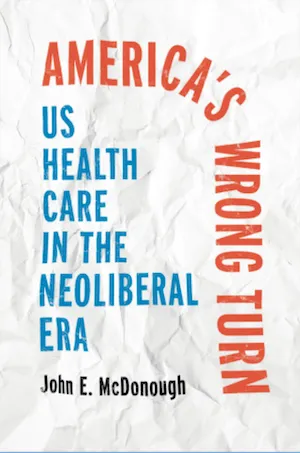
America's Wrong Turn: US Health Care in the Neoliberal Era
McDonough, J. E. (2026). America's wrong turn: US health care in the neoliberal era. Johns Hopkins University Press.
Available here →August 30, 2026
20260830-mcdonough-americas-wrong-turn-the-wide-angle
The wide angle
The rest of this thread

John E. McDonough
John E McDonough is a professor of practice at the Harvard TH Chan School of Public Health. Between 2008 and 2010, he was Senior Advisor on National Health Reform in the U.S. Senate where he worked on creating the Affordable Care Act. Between 2003-2008, he was Executive Director of Health Care For All, Massachusetts' consumer health organization. From 1985 to 1997, he was a member of the Massachusetts House of Representatives. He holds a doctorate in public health from the University of Michigan and a master's in public administration from the Kennedy School at Harvard.
Pull this thread
pulls againstpulls alongside
American health care's separate dysfunctions have one cause, the neoliberal capture of political economy after 1980.
Against SB · Nazi imperialism was still imperialism, driven as much by fear of rival empires as by ambition. On: Fear and insecurity, rather than material deprivation, drive political reaction
Against IG · US empire is waning, and the security state is the phase in which it turns to war to stay superpower. On: Fear and insecurity, rather than material deprivation, drive political reaction
Alongside CJ · For unemployed educated young men in north India, waiting is a fertile condition that breeds friendships and protest. On: Fear and insecurity, rather than material deprivation, drive political reaction
Alongside DS · The broadest interracial solidarities in American history formed where organization was weakest, among migratory workers outside unions and parties. On: Fear and insecurity, rather than material deprivation, drive political reaction
Alongside SH · Independent truckers built, from the 1930s onward, the low-wage non-union distribution system that made the Wal-Mart economy possible. On: Fear and insecurity, rather than material deprivation, drive political reaction
Alongside FD · Poor Americans' patriotism is a reasoned sense of ownership, not stupidity or false consciousness. On: Fear and insecurity, rather than material deprivation, drive political reaction
Nearby DR · Between the mid-1970s and 2001 the words Americans used to grasp society broke into smaller pieces.
Know something the rest of us don't?
Most threads on Rorotoko begin with our invitation. Any thread can begin with a proposal: you write it with the same prompts every thread answers, and we review it.
Propose a thread →