
Tarik O'Regan
Testament
The moment you put something on a stage, it becomes present.
One of the things I loved about working on Testament was that the process of making the opera began to mirror what the opera itself is about.
It started with Colm’s words. Then those words became a libretto. I set them to music. The score went to singers and instrumentalists. Then a director, designers and performers began interpreting it. By the time we reached the stage, something that had begun in the imagination of one writer had passed through a large number of other imaginations.
At each stage, somebody acquires a certain amount of authority.
That wasn’t just a neat parallel I noticed afterwards. As I composed, Colm continued to work on the libretto, making tiny adjustments as needed. A line that seemed complete on the page could need more space when sung; elsewhere, the music could carry a passage further without another word being added. We were making decisions together about where the language should lead and where it should give way.
That seems particularly appropriate for a work concerned with how stories are made.
Colm’s The Testament of Mary is intensely interior. Mary is remembering. In prose, a writer can move almost imperceptibly between what is happening now, what happened decades earlier, what somebody said, what Mary thinks somebody said, and what she now believes about it.
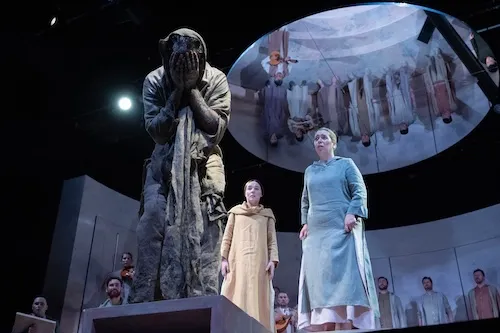
Opera has a different problem. The moment you put something on a stage, it becomes present.
That became our opportunity.
Rather than trying to reproduce the book’s interiority, we could make memory physically happen around Mary. A person she remembers could emerge from the ensemble. A recollection could become a scene. The past could suddenly occupy the same space as the present.
I became increasingly interested in making the musical structure work in the same way.
There is no conventional separation between “the orchestra” and “the stage” in Testament. The instrumentalists are onstage and visible. They perform as part of the same world as the singers and actors. There is no visible conductor.
That means the piece depends unusually heavily on listening. Performers have to breathe together, watch one another, sense where a phrase is going and sometimes communicate through tiny physical cues. In rehearsal, I realised that this wasn’t merely a practical solution. It was part of what the opera meant.
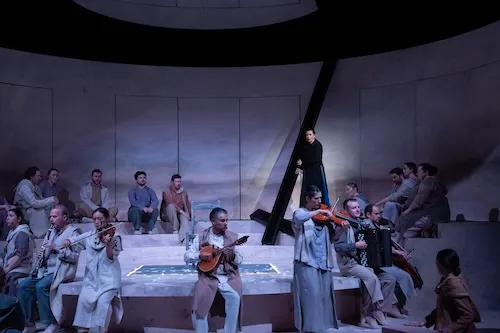
Everybody is watching everybody else.
Everybody is listening.
Everybody is trying to work out what happens next.
The sound world extends beyond the acoustic performers. There are fixed electronic soundscapes, but these are extrapolated from the musical material of the opera itself. I think of them almost as suspensions of the score’s DNA. They allow the music to remain present even when its source becomes difficult to locate.
That was important because the opera is full of things that are present without being physically there. Jesus himself is the most obvious example. He is the person around whom everything revolves, yet our focus remains on Mary and on the people reconstructing his story.
The larger tradition behind the piece is obviously enormous. Two thousand years of Christianity have given us an extraordinarily powerful set of images of Mary: the Madonna and Child, the Pietà, the grieving mother at the foot of the Cross.
But Colm’s Mary does something startling. She refuses the serenity of those images.
She is frightened. She is angry. She has doubts. She is still in pain. For me, that makes her more rather than less moving.
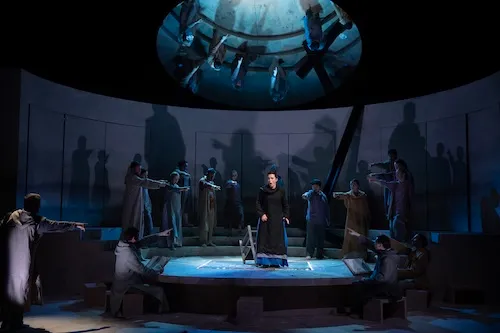
Opera has always been fascinated by myth. But myth usually arrives onstage already formed. Gods are gods. Heroes are heroes. We know the story.
Testament offered the possibility of looking at an earlier and much stranger moment: the point before the story has settled.
We see people trying to decide what happened.
And, perhaps more importantly, what it should mean.
Ongoing thread. More from Tarik O'Regan to follow.
Curator: Bora Pajo
Testament
Available here →October 5, 2026
20261005-oregan-testament-the-wide-angle
The wide angle
The rest of this thread
© Hearth & Haven Photography 2025
Tarik O'Regan
Tarik Hamilton O'Regan is a London-born composer based in San Francisco. Working across opera, dance, orchestral, choral, and chamber music, he is drawn to subjects at the intersection of history, literature, memory, and public life. His music has been described as "beautifully imagined, holding the audience rapt" (Financial Times) and "music of startling beauty" (The Observer). Recognized with two GRAMMY® nominations and two Ivors, his work is published exclusively by Novello, has been recorded on more than fifty albums, and is regularly performed throughout the world.
Recent projects include Testament, an opera with a libretto by Colm Tóibín for Irish National Opera; a concerto for oud and period orchestra written for Joseph Tawadros and Philharmonia Baroque Orchestra; and The Artificial Composer, a BBC Radio 3 documentary examining the relationship between artificial intelligence and musical creativity. In 2023 he was commissioned by His Majesty King Charles III to compose the Agnus Dei for the Coronation Service at Westminster Abbey.
Alongside his work as a composer, O'Regan is an experienced broadcaster and writer whose work for BBC Radio has explored the ways cities, technology, and cultural change shape musical life. He has written and presented documentaries, and contributed essays and commentary on music, creativity, and contemporary culture.
O'Regan is an Honorary Fellow of Pembroke College, Oxford, serves on the board of Yaddo, one of the oldest artists' communities in the United States, and is the recipient of the Coronation Medal, the Yaddo Artist Medal, inclusion in The Washington Post's 2022 list of artists "changing the classical landscape," and a Certificate of Honor from the City and County of San Francisco.
Pull this thread
Memory constantly reconstructs the past, and the promise of meaning never erases what happened to a person.
More in Arts
More in Books
Know something the rest of us don't?
Most threads on Rorotoko begin with our invitation. Any thread can begin with a proposal: you write it with the same prompts every thread answers, and we review it.
Propose a thread →