
Eleonora Biffi
Hearing shapes: the Bouba–Kiki effect in adult domestic dogs
Adult dogs, like humans and chicks, seem to hear shapes, too.
Adult dogs, like humans and chicks, seem to hear shapes, too.
The Bouba–Kiki effect is the spontaneous association between certain sounds and certain shapes. In a classic example, people are shown a rounded shape and a spiky one and asked which is “Bouba” and which is “Kiki”. Most people pair “Bouba” with the rounded shape and “Kiki” with the spiky one. The connection seems to arise spontaneously: it is not something we have to learn by being told that a particular word belongs to a particular shape. The two pseudo-words may invite different impressions. Bouba is made up of softer, more rounded sounds; Kiki has sharper consonants and a tighter, higher vowel. Those qualities seem to echo the curves of one shape and the points of the other. The effect is one example of sound symbolism: the idea that the sounds in a word can suggest something about its meaning. It is also a cross-modal correspondence, a link between information coming through different senses, hearing and vision. The effect was once known through other sound pairs, “Takete” and “Maluma”. Researchers first explored these associations partly to ask whether the connection between sounds and meanings might help explain how language began. But related sound–shape correspondences have been reported in young children and in other species, including one-day and three-days old chicks and rhesus macaques. This raises a broader question: does this association depend on language, or might it reflect a more widespread way of connecting what we hear with what we see?

We asked whether adult domestic dogs show a similar pattern. In our study, 70 dogs saw a rounded shape and a spiky shape at the same time while hearing either “Bouba” or “Kiki”. In the first study, 51 dogs took part with owners who could see the shapes and hear the sounds. To reduce the chance that owners might unintentionally cue their dogs, we tested a further 19 dogs whose owners wore headphones and could not hear the sounds. In both groups, dogs looked longer at the rounded shape when they heard “Bouba” and at the spiky shape when they heard “Kiki”. In the first group, dogs also looked toward the spiky shape sooner and spent more time looking at it overall, regardless of which sound they heard. During the exploration phase, those dogs explored the spiky shape more often and for longer when they heard “Kiki”. That exploration pattern did not appear in the second group.
The result suggests that an association between sounds and shapes is not exclusive to humans. It may arise without language. We need to keep in mind that the experiment does not tell us where the association comes from, how it develops or what purpose it serves. For now, the finding opens a bigger door rather than settling the question. Studying how dogs connect sounds with visual forms may help us understand which parts of this human tendency are tied to language, and which may be shared more widely across species.
Ongoing thread. More from Eleonora Biffi to follow.
Curator: Bora Pajo
The rest of this thread
Hearing shapes: the Bouba–Kiki effect in adult domestic dogs
Biffi, E., Pedretti, G., Normando, S., Lazebnik, T., Loconsole, M., & Valsecchi, P. (2026). Hearing shapes: The Bouba–Kiki effect in adult domestic dogs. Proceedings of the Royal Society B: Biological Sciences. https://doi.org/10.1098/rspb.2026.1209
Available here →November 21, 2026
20261121-biffi-hearing-shapes-in-a-nutshell
In a nutshell
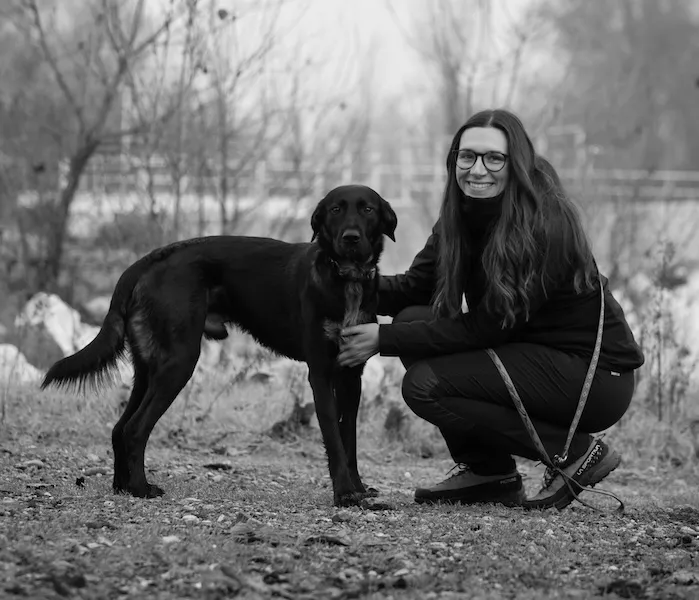
Eleonora Biffi with Dylan, her dog.
Eleonora Biffi
Eleonora Biffi is a PhD student in Neuroscience at the University of Parma, where she works at the Dog Ethology Laboratory under the supervision of Professor Paola Valsecchi. Her research focuses on canine cognition and behaviour. Alongside her academic work, she is interested in dog training and works with dogs with behavioural problems. Her scientific and practical interests reflect her fascination with the many dimensions of the human–dog relationship.
More in Research
More in Books
Know something the rest of us don't?
Most threads on Rorotoko begin with our invitation. Any thread can begin with a proposal: you write it with the same prompts every thread answers, and we review it.
Propose a thread →