
Sigbjørn Løland Bore
Why ice is so slippery
New evidence revives classic theories that a liquid film and frictional heat make ice slippery.
The slipperiness of ice has been debated for centuries. Most researchers, with some exceptions, have agreed upon there being a liquid film on top of the ice, below the sliding surface (such as a skate), but with fierce disagreement as to its origin. Historically three theories have been dominating. The premelting theory by Michael Faraday hypothesizes that there will exist a liquid layer in between ice and other surfaces, such as air or a sliding material. The pressure melting theory by Joly posits that the pressure below skates is so high that ice undergoes pressure melting, leading to a liquid layer. Finally, Bowden and Hughes proposed that the liquid film is created due to heat of friction between ice and the sliding surface. Later work in the last decade has put emphasis on other theories, such as a slushy mix of ice and water. In some regards we go back to the theories of old, in particular premelting and frictional heating. What is new is that our approach allows us to better identify the causes and their role in the overall phenomenon.
To answer this question, we took a modeling approach, where we simulated a nanoscale piece of silicate (a key ingredient in rocks) sliding on ice on the atomic scale (see image below), and made a macroscale theory of ice friction. The picture we came up with is the following.
On curling ice, there are pebbles, created from water droplets. A curling stone meets these ice pebbles at small points of contact. Due to differences in the materials meeting, a liquid layer will form in between them, forming what is known as a premelted film. This film provides lubrication, lowering friction. This explains the formation of the film, but this film alone is not so slippery.
The physical extent of our nanoscale modeling is so small that we don’t have macroscopic frictional heating. This weakness turns out to be a strength, as it allows us to show how, in a world without frictional heating, the slipperiness of ice would behave. The friction coefficient measures how hard you need to push to keep something sliding, compared with its weight; the higher it is, the less slippery. In such a world, we obtain a rise in the friction coefficient with increased velocity. Essentially, a curling stone would have a higher coefficient of friction when reaching high speeds, when the opposite is true.
When one slides on these pebbles of ice, heat is generated, and the temperature of the ice reaches almost the melting point, leading to a thicker, runnier film. When incorporating macroscopic frictional heating, we get the correct experimental trend for the coefficient of friction in glass and curling-stone experiments.
Ongoing thread. More from Sigbjørn Løland Bore to follow.
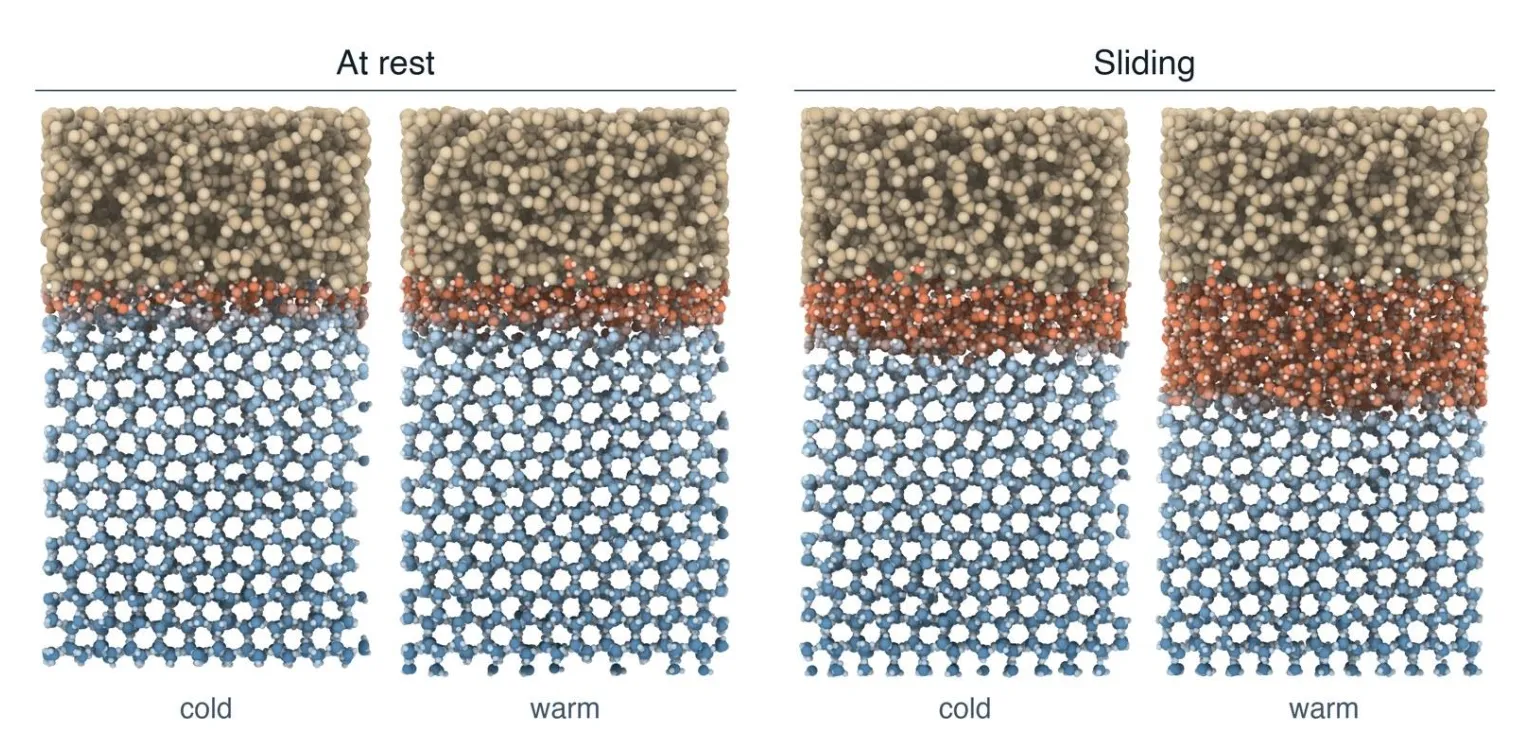
Premelting makes the film; warming thickens it. Computer simulation of glass (tan) on ice (blue), at rest and sliding, on cold and on warmer ice. The liquid-like water film (orange) is there even at rest, and it grows as the ice gets warmer. © Sigbjørn Løland Bore.
Curator: Bora Pajo
Why ice is so slippery
Bore, S. L., Persson, B. N. J., & Sveinsson, H. A. (2026). Why ice is so slippery. Physical Review Letters. Accepted for publication. https://doi.org/10.1103/9wv5-ypdm
Available here →November 18, 2026
20261118-bore-why-ice-is-so-slippery-in-a-nutshell
In a nutshell
The rest of this thread

Sigbjørn Løland Bore
Sigbjørn Løland Bore leads a research group at the Hylleraas Centre for Quantum Molecular Sciences, University of Oslo. He got his PhD in chemistry there in 2020 with Michele Cascella and did a postdoc with Francesco Paesani at the University of California, San Diego. His research combines computer simulations with machine learning to understand, from the basic laws of physics, how water behaves under exotic conditions. He was a Young CAS Fellow at the Norwegian Academy of Science and Letters, leading the project “Can ice be described from first principles?”, and is a Research Council of Norway Young Research Talent.
Pull this thread
Ice is slippery because a premelted film forms without sliding and frictional heating then thickens it.
More in Research
More in Books
Know something the rest of us don't?
Most threads on Rorotoko begin with our invitation. Any thread can begin with a proposal: you write it with the same prompts every thread answers, and we review it.
Propose a thread →