
Oliver Bimber
How Robot Dogs See the Unseeable: Improving Visual Interpretability via Peering for Exploratory Robots
If our eyes would be 1m in diameter, we would not need to do this.
Prior to peering, the robot perceives only the occluding foreground vegetation, limiting vision reasoning to the immediate surface of that vegetation. After peering and synthetic aperture processing, the robot reveals the entire scene behind the vegetation across a range of depths (within physical limits), enabling vision reasoning models to successfully interpret the background environment.
First, robotic platforms must be capable of navigating highly complex environments. Autonomous navigation relies directly on scene understanding, which in turn requires robust sensing despite severe vegetation-induced occlusion. This requirement is fundamental. While specific applications demand different robotic platforms, both the underlying challenge and its solution remain consistent. For instance, drones are often more efficient than ground robots for search-and-rescue operations, yet they face similar top-down canopy occlusion. Conversely, ground robotics applications in unconstrained outdoor environments often involve defense or tactical scenarios. Beyond general occlusion removal, our paper explores de-camouflage as a key application - evaluated first in simulation and subsequently on physical robotic platforms. The underlying principle is identical: while well-camouflaged targets evade detection by human observers and standard vision-reasoning systems, they can be revealed when leveraging motion parallax, a mechanism inspired by animal behavior. Broadly, this approach equips exploratory robots with robust scene-understanding capabilities in complex, vegetated environments.
Earlier this year, I participated in an expedition to locate the last remaining wild Sumatran rhinos in the dense rainforests of Indonesia. The species had not been sighted for nearly a decade, despite extensive monitoring efforts using drones, camera traps, eDNA sampling, and trained tracking dogs. Extreme humidity and dense jungle terrain severely constrain tracking dogs, suggesting that quadrupedal field robots equipped with chemical or olfactory sensors could eventually offer a viable alternative - provided they can navigate such dense environments. Ultimately, using our drone platforms, our expedition successfully located and verified a wild Sumatran rhino in just five days.
Curator: Bora Pajo
How Robot Dogs See the Unseeable: Improving Visual Interpretability via Peering for Exploratory Robots
Bimber, O., von Ellenrieder, K. D., Haller, M., Nathan, R. J. A. A., Lunardi, G., Youssef, M., Camurri, M., Orozco Soto, S. M., & Niven, J. E. (2026). How robot dogs see the unseeable: Improving visual interpretability via peering for exploratory robots. Science Robotics. https://doi.org/10.1126/scirobotics.aed8577
Available here →November 10, 2026
20261110-bimber-how-robot-dogs-see-the-unseeable-a-close-up
A close-up
The rest of this thread
Oliver Bimber
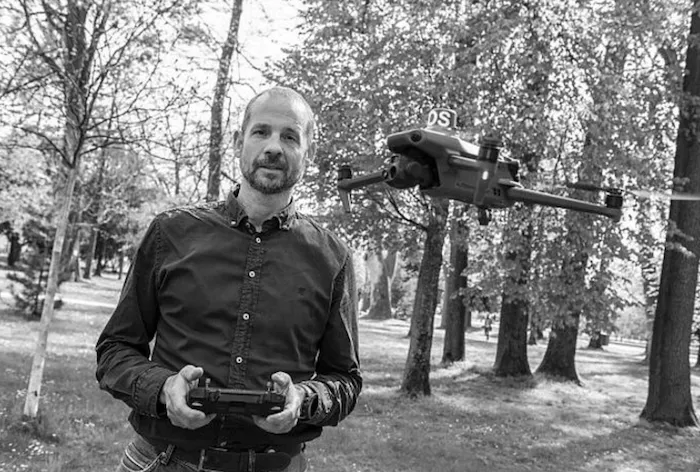
Oliver Bimber is a professor of computer science and head of the Institute of Computer Graphics at Johannes Kepler University Linz (JKU). After completing his doctorate at TU Darmstadt, his habilitation at TU Munich, and positions at Fraunhofer research stations in Germany and the USA, he taught and conducted research as an assistant professor at Bauhaus-University Weimar and as a visiting professor at renowned institutions such as the University of Cambridge and EPFL in Lausanne. In his research, Professor Bimber focuses on fundamentally novel sensor technology approaches that combine modern signal processing, optics, and artificial intelligence. Many of his interdisciplinary projects aim to make the seemingly invisible visible, even in highly complex environments.
Pull this thread
Robots see through foliage only when their swaying views are combined into one synthetic aperture.
More in Books
Know something the rest of us don't?
Most threads on Rorotoko begin with our invitation. Any thread can begin with a proposal: you write it with the same prompts every thread answers, and we review it.
Propose a thread →