
Oliver Bimber
How Robot Dogs See the Unseeable: Improving Visual Interpretability via Peering for Exploratory Robots
If our eyes would be 1m in diameter, we would not need to do this.
Our CS team at JKU has been exploring optical synthetic aperture sensing for occlusion removal since 2017. To date, we have deployed aerial platforms (such as individual drones, drone swarms, and airplanes) for applications including search and rescue, wildfire detection, wildlife monitoring, and forest ecology. A core research challenge across these domains is optimally sampling the synthetic aperture. Adapting this technique to ground robots introduces distinct challenges: unlike aerial vehicles that can freely sample large areas, ground robots are constrained by physical obstacles. To achieve efficient sampling under these conditions, we developed a bio-inspired strategy based on insect peering behavior. Working with leading zoologists at the University of Sussex, we utilized experimental data on peering insects to model equivalent motion patterns for robotic platforms. In parallel, our collaborators in Bozen provided essential field robotics expertise, control strategies, and hardware. Ultimately, this interdisciplinary project brings together computer scientists, zoologists, and field robotics researchers.
Beyond the general difficulty of operating robots in complex environments, we encountered several practical engineering hurdles. For instance, executing the required swaying trajectories presented a unique challenge, as lateral motion is not supported out-of-the-box on conventional robotic platforms. The native control system initially restricted these non-standard movements, requiring low-level modifications to ensure stable and reliable execution.
The primary finding of this paper is that advanced vision reasoning fails in scene understanding when provided solely with standard, individual images (even when supplied with hundreds of frames captured during peering) due to persistent partial occlusion across all views. However, vision reasoning succeeds when these peering frames are computationally combined into a focal stack via synthetic aperture sensing. This enables the models to inspect the scene across distinct focal depths without occlusion. Consequently, peering alone is insufficient - the key lies in combining peering with synthetic aperture sensing, where peering provides the motion baseline required to generate the synthetic aperture.
Ongoing thread. More from Oliver Bimber to follow.
Curator: Bora Pajo
How Robot Dogs See the Unseeable: Improving Visual Interpretability via Peering for Exploratory Robots
Bimber, O., von Ellenrieder, K. D., Haller, M., Nathan, R. J. A. A., Lunardi, G., Youssef, M., Camurri, M., Orozco Soto, S. M., & Niven, J. E. (2026). How robot dogs see the unseeable: Improving visual interpretability via peering for exploratory robots. Science Robotics. https://doi.org/10.1126/scirobotics.aed8577
Available here →November 10, 2026
20261110-bimber-how-robot-dogs-see-the-unseeable-the-wide-angle
The wide angle
The rest of this thread
Oliver Bimber
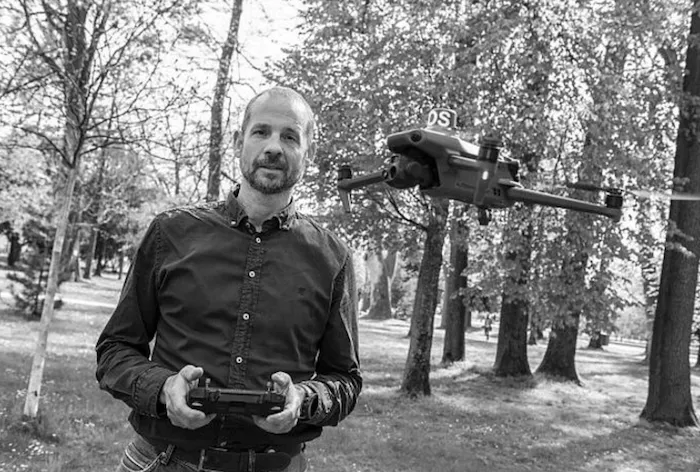
Oliver Bimber is a professor of computer science and head of the Institute of Computer Graphics at Johannes Kepler University Linz (JKU). After completing his doctorate at TU Darmstadt, his habilitation at TU Munich, and positions at Fraunhofer research stations in Germany and the USA, he taught and conducted research as an assistant professor at Bauhaus-University Weimar and as a visiting professor at renowned institutions such as the University of Cambridge and EPFL in Lausanne. In his research, Professor Bimber focuses on fundamentally novel sensor technology approaches that combine modern signal processing, optics, and artificial intelligence. Many of his interdisciplinary projects aim to make the seemingly invisible visible, even in highly complex environments.
Pull this thread
Robots see through foliage only when their swaying views are combined into one synthetic aperture.
More in Books
Know something the rest of us don't?
Most threads on Rorotoko begin with our invitation. Any thread can begin with a proposal: you write it with the same prompts every thread answers, and we review it.
Propose a thread →