
Oliver Bimber
How Robot Dogs See the Unseeable: Improving Visual Interpretability via Peering for Exploratory Robots
If our eyes would be 1m in diameter, we would not need to do this.
Vegetation-induced occlusion remains a fundamental challenge for robotic scene understanding, regardless of the sensor modality used (e.g., cameras, LiDAR, or radar).
Unlike humans, many insects lack stereoscopic vision for depth perception. Instead of single-lens eyes, they possess compound eyes. To gauge the distance to prey or obstacles, they sway their bodies from side to side (peering). This movement generates motion parallax, which serves as a primary depth cue.
Applying this peering strategy to robotic occlusion removal is motivated by principles in optics and signal processing: A standard camera features a small lens and a wide depth of field, meaning objects across a broad distance range (including occluders) remain sharp. If a robot were equipped with a massive lens (e.g., 1 m in diameter), focusing behind occluding vegetation would yield an extremely shallow depth of field, optically blurring the occluders until they effectively disappear from the captured signal. Because such a physical lens is infeasible, we adopt synthetic aperture sensing from signal processing: we mimic a large lens by sequentially capturing images with a standard camera as the robot peers. The distance covered during peering defines the synthetic aperture (i.e., the virtual lens diameter). By computationally combining these frames using motion parallax, we synthesize an image with an extremely shallow depth of field.
If our eyes would be 1m in diameter, we would not need to do this. But since our eyes’ apertures are only a few millimeters, we need to move. Our brain combines these images to one with suppressed occlusion.
Ongoing thread. More from Oliver Bimber to follow.
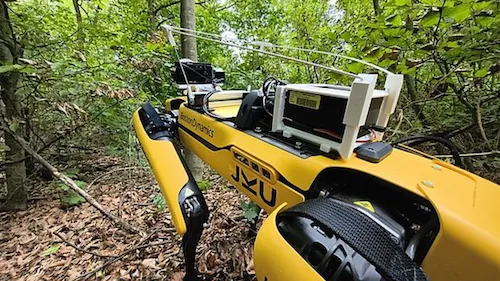
Spot the robot in the forest; Credit: Johannes Kepler University Linz, in Austria.
Curator: Bora Pajo
How Robot Dogs See the Unseeable: Improving Visual Interpretability via Peering for Exploratory Robots
Bimber, O., von Ellenrieder, K. D., Haller, M., Nathan, R. J. A. A., Lunardi, G., Youssef, M., Camurri, M., Orozco Soto, S. M., & Niven, J. E. (2026). How robot dogs see the unseeable: Improving visual interpretability via peering for exploratory robots. Science Robotics. https://doi.org/10.1126/scirobotics.aed8577
Available here →November 10, 2026
20261110-bimber-how-robot-dogs-see-the-unseeable-in-a-nutshell
In a nutshell
The rest of this thread
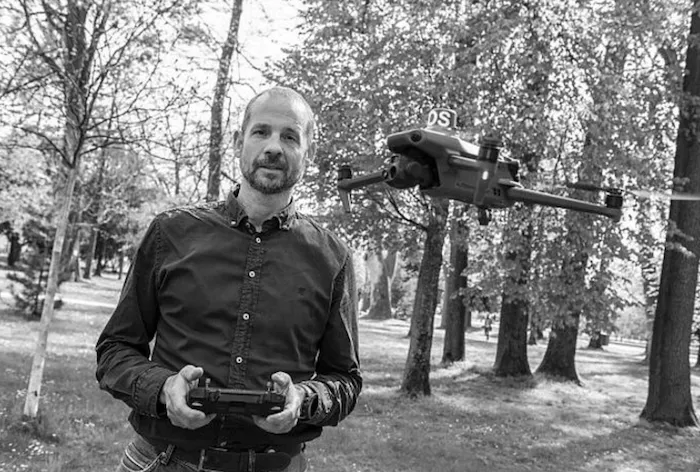
Oliver Bimber
Oliver Bimber is a professor of computer science and head of the Institute of Computer Graphics at Johannes Kepler University Linz (JKU). After completing his doctorate at TU Darmstadt, his habilitation at TU Munich, and positions at Fraunhofer research stations in Germany and the USA, he taught and conducted research as an assistant professor at Bauhaus-University Weimar and as a visiting professor at renowned institutions such as the University of Cambridge and EPFL in Lausanne. In his research, Professor Bimber focuses on fundamentally novel sensor technology approaches that combine modern signal processing, optics, and artificial intelligence. Many of his interdisciplinary projects aim to make the seemingly invisible visible, even in highly complex environments.
Pull this thread
Robots see through foliage only when their swaying views are combined into one synthetic aperture.
More in Research
More in Books
Know something the rest of us don't?
Most threads on Rorotoko begin with our invitation. Any thread can begin with a proposal: you write it with the same prompts every thread answers, and we review it.
Propose a thread →