
Julia Prével
Myology of the Horse – Muscle by Muscle
Sometimes, to understand the whole horse, you need to see one muscle at a time.
The drawing that helped me find my way
There is one drawing in my book that holds a particularly special place for me. It is not necessarily the most spectacular or the most elaborate. But it is the one that made me think, for the first time: “This is how I want to draw the muscles of the horse.”
I would like readers to spend a moment looking at this image. Rather than immediately trying to identify an anatomical name or memorize a description, I would invite them simply to observe the shape of the muscle, its path, its relationship with the bones, and the direction of its fibres.
For me, this drawing represents much more than a muscle. It marks the moment when I found a way to bring together two things that seemed equally important: understanding what I was looking at and enjoying the experience of looking at it.
I needed the muscle to truly exist on the page. I did not want it to be merely a coloured mass or a shape that was difficult to distinguish among others. I wanted the eye to be able to follow its path, understand where it begins, where it ends, and how it fits into the anatomy of the horse.
But I also wanted the drawing to have its own beauty. Not a decorative beauty that would artificially embellish the subject, but an aesthetic quality that could draw attention to the details and encourage the viewer to observe them for longer.
I began to realize that an anatomical illustration could also be an image someone would enjoy contemplating. The pursuit of accuracy and visual pleasure were not necessarily opposing goals. On the contrary, they could reinforce one another.
That first drawing I finally felt satisfied with became a kind of personal reference. It had taken a great deal of searching, experimenting, and starting again to arrive at a representation in which I could recognize both what I wanted to learn and what I wanted to express artistically.
It was not the discovery of a new anatomical truth. It was the discovery of a way to present existing knowledge so that it became more accessible to my own understanding.
From that point onwards, every new muscle brought its own questions. How could I make its shape understandable without distorting it? Which details needed to be preserved? How could I make its path easier to follow while respecting the real complexity of anatomical structures?
I did not always find the answers with equal ease, but that first drawing had given me a direction.
Even today, I like the idea that someone might pause in front of an illustration, look carefully at a muscle, and experience the small moment of realization I had been searching for during my own studies: the moment when something that once seemed complicated finally becomes possible to imagine.
If this book can create that feeling, even occasionally, then all those years spent drawing will have been worthwhile.
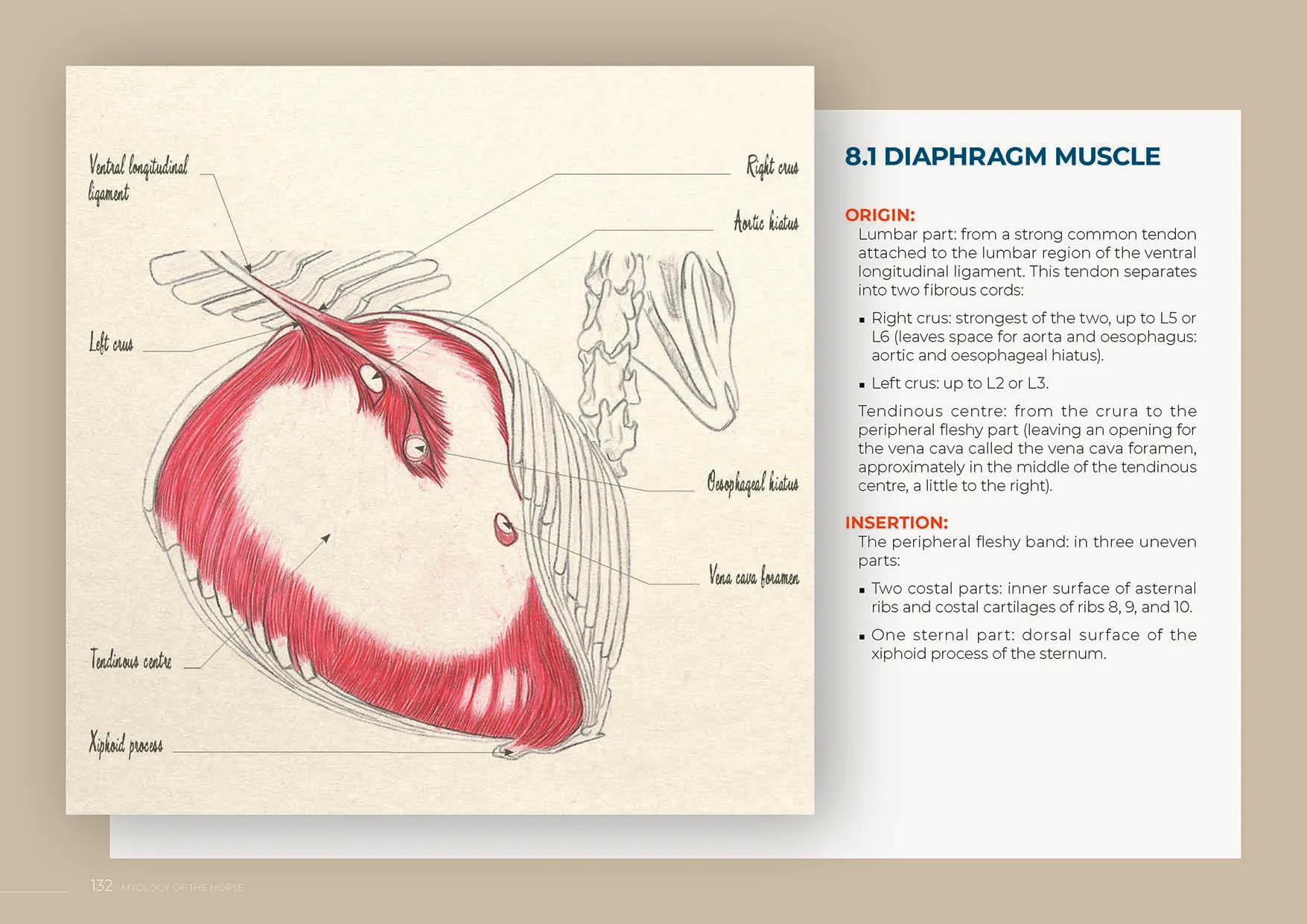
Diaphragm muscle © Julia Prével
Curator: Bora Pajo
Myology of the Horse – Muscle by Muscle
Available here →November 14, 2026
20261114-prevel-myology-of-the-horse-muscle-by-muscle-a-close-up
A close-up
The rest of this thread

Julia Prével
Julia Prével is a French author and illustrator with a background in equine studies, including training in equine massage and osteopathy. She began drawing muscles over skeletal diagrams to help herself understand horse anatomy. Over four years, this personal study method became Myologie du cheval – muscle par muscle, a 240-page book of individually illustrated muscles published through Camaya in 2022. The first French print run of 1,000 copies sold out. She is now preparing the first English edition and sharing updates on www.camaya.fr ahead of future pre-orders.
Pull this thread
Illustrating one muscle at a time helps learners picture anatomy that full atlas plates obscure.
More in Books
Know something the rest of us don't?
Most threads on Rorotoko begin with our invitation. Any thread can begin with a proposal: you write it with the same prompts every thread answers, and we review it.
Propose a thread →