
Julia Prével
Myology of the Horse – Muscle by Muscle
Sometimes, to understand the whole horse, you need to see one muscle at a time.
The drawings I never intended to publish
I remember looking at anatomical study materials and feeling that I understood the words on the page better than I understood the image in front of me. During my equine training, I studied established references, including the work of Robert Barone. Their illustrations were rich with information, but I often struggled to identify one muscle among overlapping structures, partly sectioned tissues and familiar, conventional viewpoints. I respected these books; I simply needed another way to learn from them.
Other teaching sheets showed a skeleton with red dots indicating where muscles attached. Those points were anatomically useful, yet they did not speak to me. I wanted to visualise the missing form: how the muscle travelled between its attachments, what its body might look like, and in which direction its fibres ran.
I began adding the muscles myself, drawing directly over skeletal diagrams. Depending on the subject, I used the outline of the whole horse, the head and neck, a forelimb or a hindlimb. I kept the conventional angles of the material I was studying. These were not illustrations conceived for a book. They were working drawings, made because I was trying to understand something that the red marks alone had not made clear to me.
Then a fellow trainee saw my pages and said something I had not expected: 'That's great. You should publish them.' Until that moment, publication had never been my goal. And there was a problem: I did not think my drawings were very beautiful. They helped me study, but they still looked like study notes.
That comment changed the direction of the project. I wanted to retain the clarity I had gained while giving the drawings a more considered artistic form. I began to focus closely on the part of the horse concerned, rather than always showing the whole skeleton. I looked for views beyond the conventional angles when another perspective could better reveal a muscle's shape and pathway. Using watercolour pencils, I gradually developed an approach that felt both clearer and more expressive.
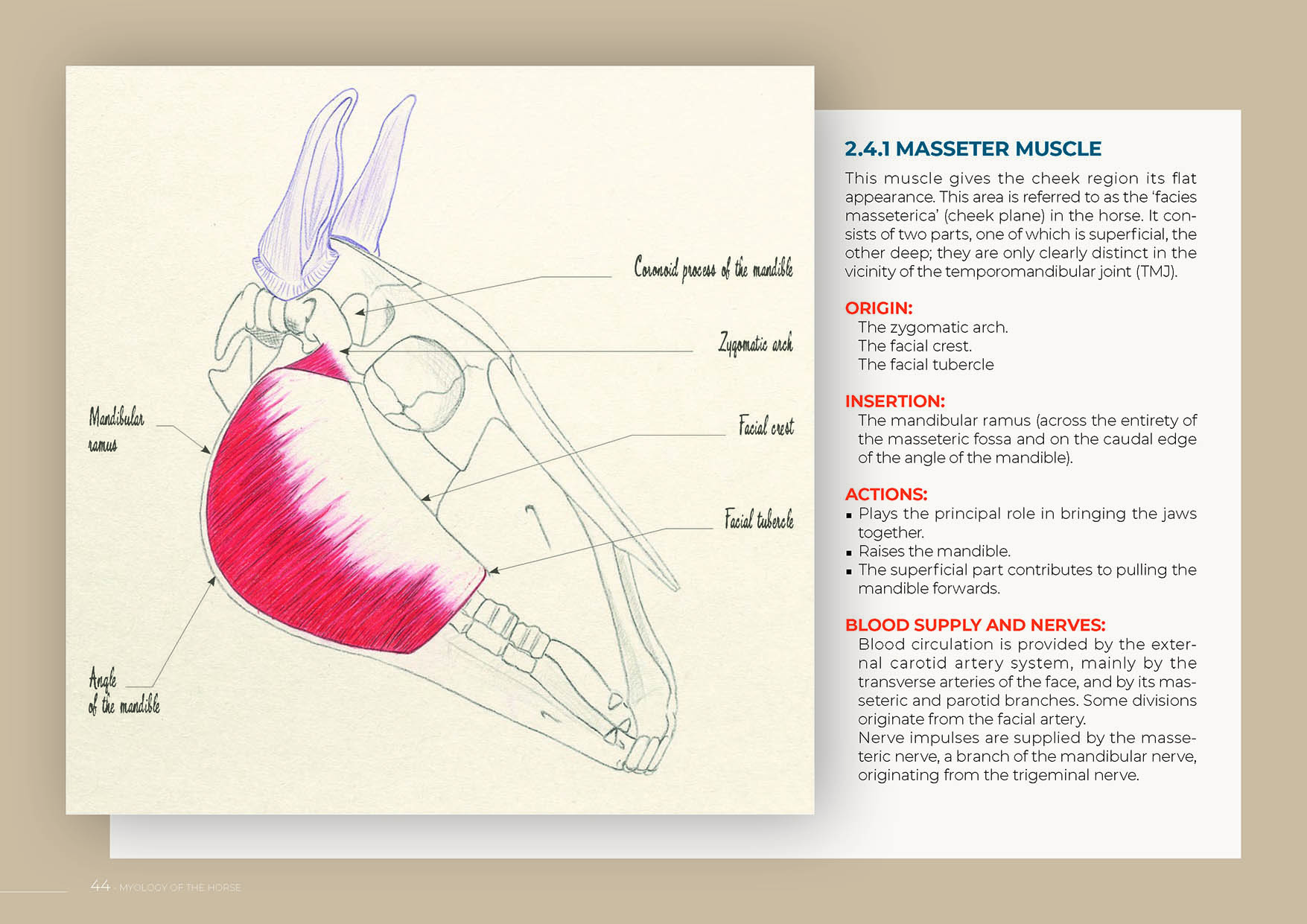
I wanted aesthetics to serve understanding, not distract from it. I tried to represent the muscles' attachments, their origins and insertions, and the direction of their fibres as faithfully as possible. I am not an anatomist by profession, and I do not pretend that every contour is beyond improvement. What mattered was to approach the structures conscientiously, with anatomical references always close at hand. I also worked on the text, trying to make dense explanations easier to read while preserving essential information on function, nerves and blood vessels.
What started as a personal study method grew beyond anything I had planned. After four years of work, the 240-page French edition was published in 2022 through Camaya. The first 1,000 copies sold out. I am now preparing a first English edition and sharing updates on www.camaya.fr in anticipation of future pre-orders.
The surprising part is that the book began with neither a publishing plan nor an artistic manifesto. It began with a student staring at red dots on a skeleton and trying to see the muscle between them.
Ongoing thread. More from Julia Prével to follow.
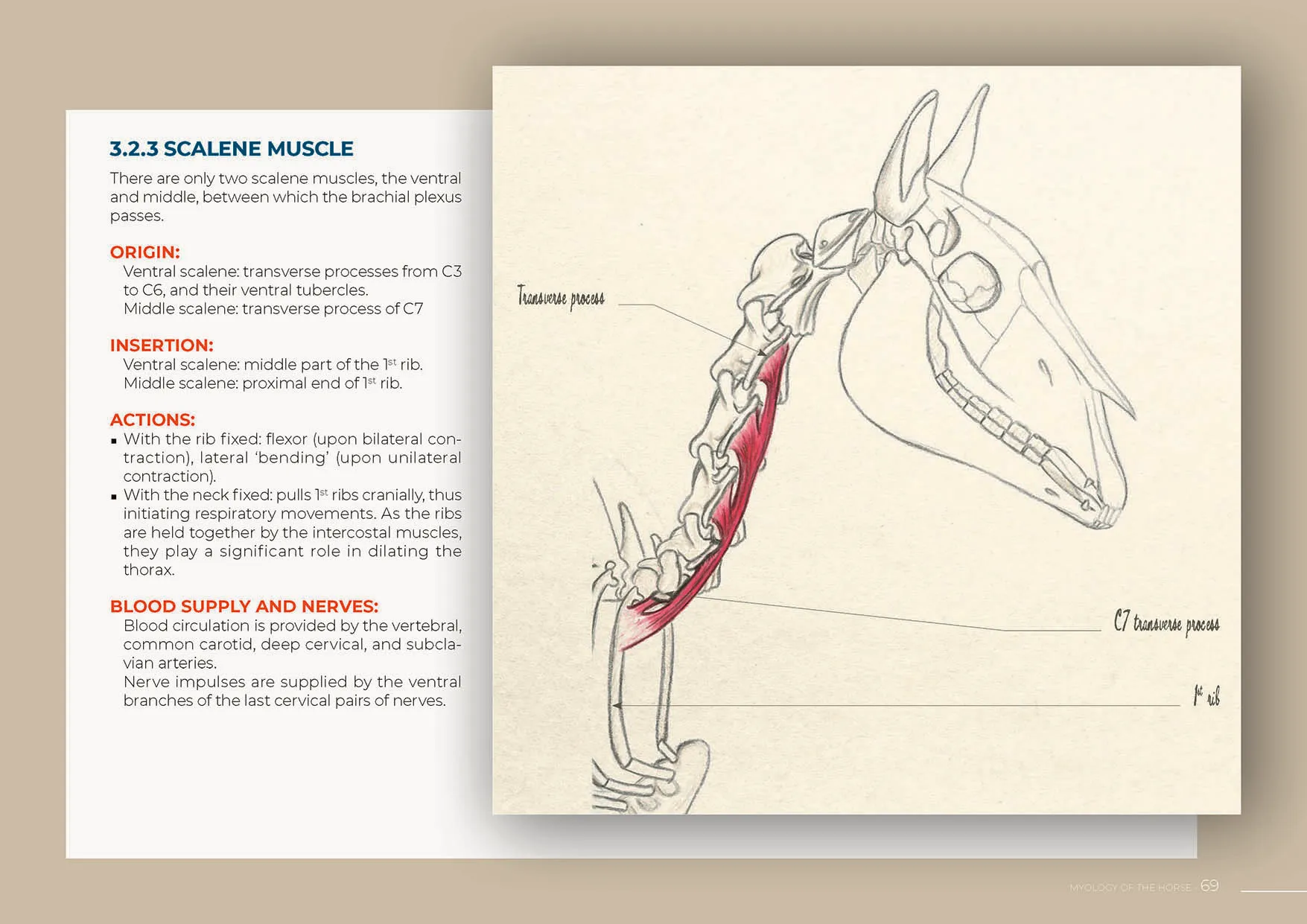
Scalene muscle © Julia Prével
Curator: Bora Pajo
Myology of the Horse – Muscle by Muscle
Available here →November 14, 2026
20261114-prevel-myology-of-the-horse-muscle-by-muscle-the-wide-angle
The wide angle
The rest of this thread

Julia Prével
Julia Prével is a French author and illustrator with a background in equine studies, including training in equine massage and osteopathy. She began drawing muscles over skeletal diagrams to help herself understand horse anatomy. Over four years, this personal study method became Myologie du cheval – muscle par muscle, a 240-page book of individually illustrated muscles published through Camaya in 2022. The first French print run of 1,000 copies sold out. She is now preparing the first English edition and sharing updates on www.camaya.fr ahead of future pre-orders.
Pull this thread
Illustrating one muscle at a time helps learners picture anatomy that full atlas plates obscure.
More in Books
Know something the rest of us don't?
Most threads on Rorotoko begin with our invitation. Any thread can begin with a proposal: you write it with the same prompts every thread answers, and we review it.
Propose a thread →