
Renée M. Jones
Untamed Unicorns
I approach these issues from my perspective as a legal academic, former financial regulator and former legal practitioner. I'm a professor at Boston College Law School, where I've taught corporate and securities law for more than twenty years. I practiced corporate law for eight years before joining the academy. My research has mainly focused on accountability mechanisms for public companies. In the mid-2010s, I started to notice that the kinds of problems that once only plagued public companies were cropping up in private companies, and I wanted to understand why. That's when I began case studies focused on Uber and Theranos, along with the legal changes that allowed startups to raise billions in the private markets and stay private indefinitely. In 2017, I wrote an article on this topic: The Unicorn Governance Trap.
I also served for two years as Director of the Division of Corporation Finance at the SEC, looking at the problem from a regulator's perspective and exploring how the agency might address it. So, the book doesn't just describe what's happening; it prescribes reforms to fix it.
Thinking about the wider picture—how we got to where we are— brings us back to a basic question: why were the securities laws adopted in the first place, and what purpose were they meant to serve?
To answer that question, we have to go back to the Great Stock Market Crash of 1929. During the crash, the market lost 90% of its value, and half the securities issued during the 1920s became worthless. The crash was followed by the Great Depression, which brought unemployment, poverty, and homelessness to vast numbers of people. Then came a banking crisis: thousands of banks failed every year from 1931 to 1933. There was no deposit insurance system, so when a bank failed, its depositors lost everything. It was this crisis, and the revelations about the financial misconduct behind it, that drove Congress to adopt the federal securities laws. These laws became one of the foundational elements of President Roosevelt's New Deal.
The securities laws, first adopted in 1933, were animated by a philosophy of disclosure. The philosophy drew on Louis Brandeis's famous line that sunlight is the best of disinfectants and electric light the most efficient policeman. In many ways, my book is about disclosure: its benefits, and the risks and costs of scaling it back.
Here's how the law works. The government doesn't decide which companies may raise capital from the public. Instead, the laws ensure that investors get enough information to make sensible decisions on their own, both when they invest and when they vote on corporate matters. The motivating idea is simple. As long as investors have reliable information about a company and its prospects, they'll direct capital to promising firms and help them prosper. At the same time, incompetent or unscrupulous actors won't gain traction in the market.
In general terms, the securities laws require companies to disclose information publicly when they raise new capital, by registering their offerings with the SEC. Large companies with a broad ownership base must also disclose publicly, whether or not they're raising funds at the time. Governance rules supplement these requirements, covering shareholder meetings, the composition of public company boards, and related matters.
That's the broad picture of the federal securities laws and why they exist. But there have always been exceptions — exemptions, we call them — to these disclosure requirements. At first these exemptions were narrow, tailored to situations where Congress decided disclosure was unnecessary. That might be because an offering was small, or because a close relationship with business owners gave investors access to the same information registration would provide. Over time, though, Congress and the SEC expanded these exemptions to the point that disclosure has become, for many companies, largely a matter of choice.
Today, more and more economically significant companies are avoiding the public markets and delaying their IPOs. Others are going private, removing their stock from public markets altogether. The result is thousands of enormous private companies; some as large and influential as any public company, operating in secrecy, shielded from accountability to investors and the public. In today's startups, it's common for the founder, not the investors, to control the board. That makes it very hard for investors to discipline or replace them. And it creates an environment in which founders can engage in fraud or misconduct for long stretches with little consequence.
Ongoing thread. More from Renée M. Jones to follow.
Curator: Bora Pajo
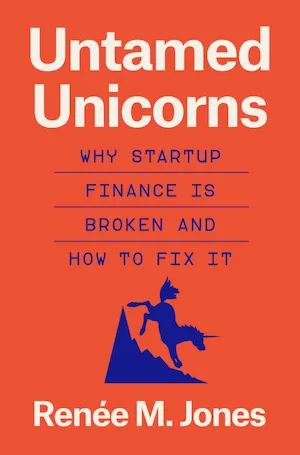
Untamed Unicorns
Jones, R. M. (2026). Untamed unicorns: Why startup finance is broken and how to fix it. Harvard University Press.
Available here →August 29, 2026
20260829-jones-untamed-unicorns-the-wide-angle
The wide angle
The rest of this thread

© Diana Levine
Renée M. Jones
Renée M. Jones is Professor of Law and Dr. Thomas F. Carney Distinguished Scholar at Boston College Law School. A nationally recognized expert in corporate and securities law, Jones served as the Director of the Securities and Exchange Commission's Division of Corporation Finance from 2021 to 2023. Jones lives in Wellesley, MA.
Pull this thread
pulls againstpulls alongside
Forty years of deregulation, not excessive regulation, shrank the public markets and delayed IPOs.
Against AG · In research universities the best scholars make the best leaders, and a hospital should be led by a doctor. On: Institutional outcomes are produced by structural design rather than by the qualities of the individuals inside
Against AG · Organizational toxicity is a clinical condition that spreads like a contagion, and it is treatable. On: Institutional outcomes are produced by structural design rather than by the qualities of the individuals inside
Alongside LR · Iraq's antiquities were pillaged for structural reasons, and most of the people involved acted in good faith. On: Institutional outcomes are produced by structural design rather than by the qualities of the individuals inside
Alongside RB · The American trial is dying from the bureaucratic and market structures around it, and that death is not inevitable. On: Institutional outcomes are produced by structural design rather than by the qualities of the individuals inside
Alongside AP · The immigration courts' dysfunction is structural, improvised in 1940 out of fear of a Nazi fifth column that never existed. On: Institutional outcomes are produced by structural design rather than by the qualities of the individuals inside
Alongside VK · School dysfunction is hardwired into governance, because school boards answer to an electorate mostly without school-aged children. On: Institutional outcomes are produced by structural design rather than by the qualities of the individuals inside
Know something the rest of us don't?
Most threads on Rorotoko begin with our invitation. Any thread can begin with a proposal: you write it with the same prompts every thread answers, and we read it.
Propose a thread →